2024.06.02
Good and bad days at work
面白い論文が出ていました。
職場で良い1日を過ごすか、悪い1日を過ごすか。
は何によって決まるのか?という研究。をまとめた研究。
ー
毎日が、良い1日だったなぁと感じるためにも、
ポジティブな影響の頻度を上げていくのが大事ですね。
↓の知見を使って、良い1日を設計していきましょう😊
全部なきゃいけない訳ではなく、夕方頃に、あ、今日のポジティブ足りない!となれば、チームメイトと話したり、誰かを助けたり、仕事のやりがいを再認識したり、してみると良いですね。
ーー
■良い1日にするには、ネガティブを減らし、ポジティブを見つける必要がある。
・ネガティブなことがないだけでは、良い1日にならない。
・一方、ポジティブは場合によっては、ネガティブを打ち消すこともある。
ーー
■朝が大事❗
睡眠量と質、朝のマインドフルネスや内省などのポジティブな出来事は、良い1日を招きやすい
悪い知らせ、通勤の問題は、悪い1日を招きやすい
ーー
■前日は、あんまり関係ない。
前日の夜の影響は、研究によってまちまち。(影響あるという話も、ないという話も。)
ただ、前日の夜がどうこうというより、それが翌朝まで引きずるかどうかの方が大事そう。
人間、寝れば解決!というのも、その通りですね😊
ーー
■仕事の中身
①ポジティブな影響
通常よりも高い職務資源(すなわち、自律性、コーチング、チーム風土)
肯定的なフィードバックを受けたり、臨機応変な状況に遭遇したりする(例えば、自主性を認められる)といった肯定的な出来事
仕事にやりがいを感じること
マインドフルであること
フローを経験すること
より快適な対人交流
他人を助けること
積極的であること
目標の進捗
サービス受益者からの感謝の認知
向社会的影響の認知(世の中の役に立ってる感)
休憩を取ること
外向性とポジティブな情動(個人の特性)
ー
②ネガティブな影響
より多くの非合法なタスク(すなわち、不必要なタスクや不合理なタスク)
同僚との口論
ストレスの多い状況(例えば、予測不可能な仕事)
表面演技(顔で笑って心で泣いて。みたいなの)→ネガティブ効果高め
リーダーのリーダーシップが乏しい
神経症傾向(個人の特性)
ー
③ポジティブにもネガティブにも影響(適度が大事)
チャレンジストレッサーに分類される継続的な状況(例えば、高い仕事量や時間的プレッシャー)
ーーー
そういえば、
以前紹介した仕事満足度の論文も、頻度が大事だ!って話でした。
仕事の満足度における個別の感情の役割: メタ分析
・ポジティブ感情もネガティブ感情も、その強さよりも頻度が仕事満足度に影響が大きい。
https://www.facebook.com/share/p/V1yXzg7kUsA6eswP/
ーーー
また、PERMAでいうと、特にAccimplishment(達成)は頻度が大事とありましたね。
■PERMAをリアルタイムで測ってみたら。
Accimplishment(達成)は特に頻度が大事
https://www.facebook.com/share/p/LgmsdXvvpjYH2eHX/
ーーー
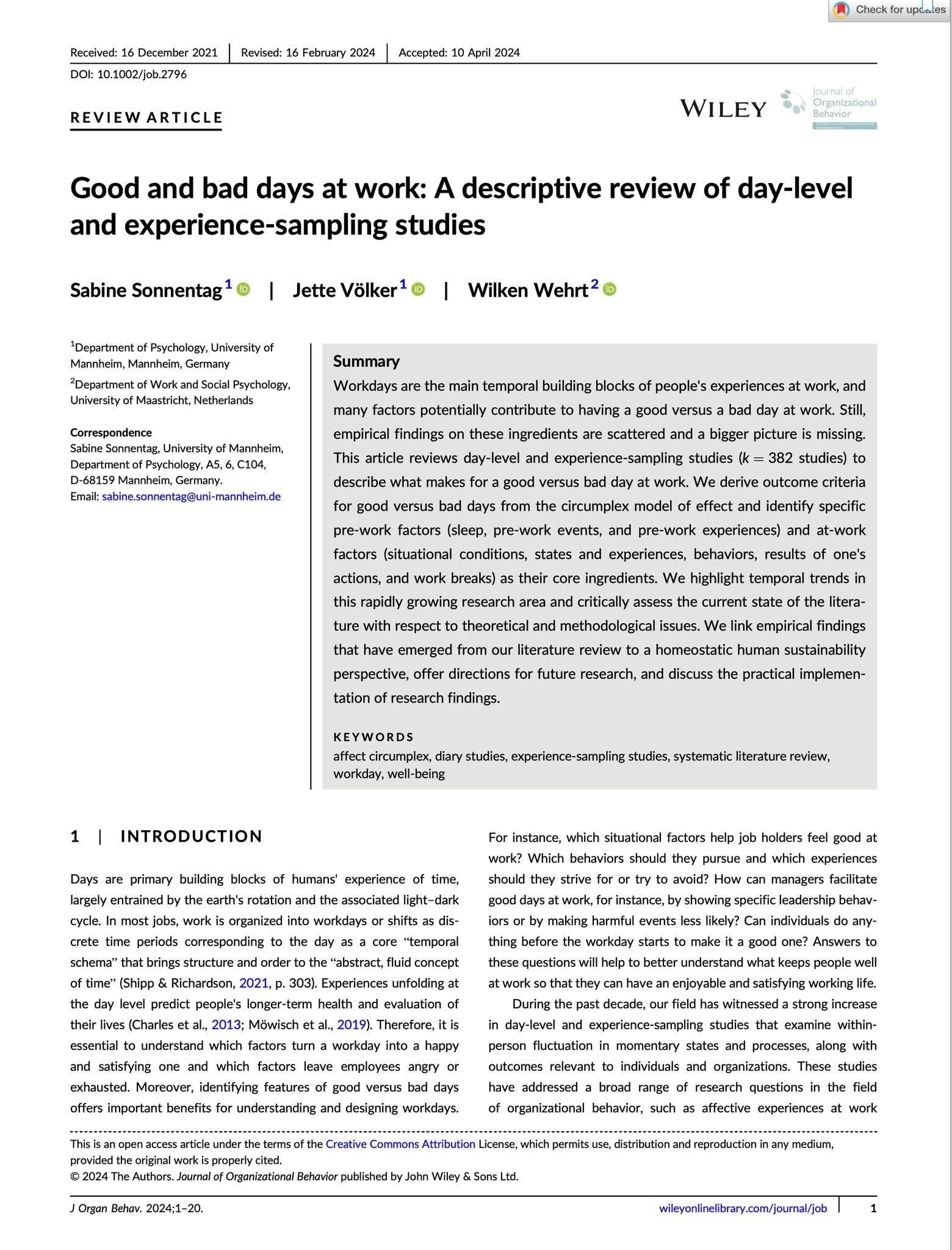
Good and bad days at work: A descriptive review of day-level and experience-sampling studies
Journal of Organizational Behavior,2024/5/23
https://onlinelibrary.wiley.com/doi/10.1002/job.2796?af=R
平日は、人々が職場で経験する主な時間的構成要素であり、職場で良い一日を過ごすか悪い一日を過ごすかには、多くの要因が潜在的に寄与している。しかし、これらの要素に関する実証的知見は散在しており、全体像が見えてこない。この論文では、1日レベルと経験サンプリングの研究(k= 382研究)をレビューし、何が仕事で良い1日と悪い1日を構成するのかを説明する。
私たちは、良い一日と悪い一日の結果基準を効果の複合体モデルから導き出し、その中心的な要素として、特定の仕事前要因(睡眠、仕事前の出来事、仕事前の経験)と仕事中要因(状況的条件、状態と経験、行動、自分の行動の結果、仕事の休憩)を特定する。急成長しているこの研究分野の時間的傾向を明らかにし、理論的・方法論的問題に関して文献の現状を批判的に評価する。
文献レビューから得られた経験的知見を恒常的な人間の持続可能性の視点と関連付け、今後の研究の方向性を提示し、研究成果の実践的な実施について議論する。
Received: 16 December 2021 | Revised: 16 February 2024 | Accepted: 10 April 2024 DOI: 10.1002/job.2796 REVIEW ARTICLE Good and bad days at work: A descriptive review of day-level and experience-sampling studies Sabine Sonnentag¹ | Jette Völker¹ | Wilken Wehr² ¹Department of Psychology, University of Mannheim, Mannheim, Germany ²Department of Work and Social Psychology, University of Maastricht, Netherlands Correspondence Sabine Sonnentag, University of Mannheim, Department of Psychology, A5, 6 C104, D-68159 Mannheim, Germany. Email: sabine.sonnentag@uni-mannheim.de Summary Workdays are the main temporal building blocks of people's experiences at work, and many factors potentially contribute to having a good versus a bad day at work. Still, empirical findings on these questions are scattered and a bigger picture is missing. This article reviews day-level and experience-sampling studies (k = 382 studies) to describe what makes for a good versus bad day at work. We derive outcome criteria for good versus bad days from the circumflex model of affect and identify specific pre-work factors (sleep, pre-work events, and pre-work experiences) and at-work factors (situational conditions, states and experiences, behaviors, results of one's actions, and work breaks) as their core ingredients. We highlight temporal trends in this rapidly growing research area and critically assess the current state of the literature with respect to theoretical and methodological issues. We link empirical findings that have emerged from our literature review to a homeostatic human sustainability perspective, offer directions for future research, and discuss the practical implementation of research findings. KEYWORDS affect circumplex, diary studies, experience-sampling studies, systematic literature review, workday, well-being 1 | INTRODUCTION Days are primary building blocks of humans' experience of time, largely entrained by the earth's rotation and the associated light-dark cycle. In most jobs, work is organized into workdays or shifts as discrete time periods corresponding to the day as a core "temporal schema" that brings structure and order to the "abstract, fluid concept of time" (Shiio & Richardson, 2021, p. 300). Experiences unfolding at the day level predict people's longer-term health and evaluation of their lives (Charles et al., 2013; Mõwisch et al., 2019). Therefore, it is essential to understand which factors turn a workday into a happy and satisfying one and which factors leave employees angry or exhausted. Moreover, identifying factors of good versus bad days at work offers important benefits for understanding and designing worksdays. For instance, which situational factors help job holders feel good at work? Which behaviors should they pursue and which experiences should they try to or try to avoid? How can managers foster good days at work, for instance, by showing specific leadership behaviors or by making harmful events less likely? Can individuals do anyt