2024.04.14
職場における創造性に関する研究
職場での創造性の発揮に関して、
能力→関心
なのか、
関心→能力
なのか。
というjournal of management studiesの研究。
ーー
結果はどっちもあった。
創造的内発的動機付け(関心)が高いと、創造的自己効力感(能力)→結果として創造性の発揮
(プロセスへの関与、タスク変動性がその流れを強める。)
だし、
創造的自己効力感(能力)が高いと、創造的内発的動機付け(関心)→結果として創造性の発揮
(レジリエンスと、タスク難易度がその流れを強める。)
研究では食品製造会社の新製品を考えるというお題での実験でした。
ーー
最初は、能力があまり高くないことが多いでしょうから、
まずは、
創造的な仕事に関心がある人に対して、タスク変動性の高い仕事に、プロセスから取り組んでもらう。
そして、能力が高まってきたら、
レジリエンスも高めながら、難しいタスクに取り組んでもらう。
というのが良さそう😊
そして、創造性を発揮できたら、ウェルビーイングも高まると😍
ーーー
能力は関心を高めるか、それとも逆か?従業員の創造性形成における創造的自己効力感と創造性に対する内発的動機づけの双方向的関係の解明
Competence Drives Interest or Vice Versa? Untangling the Bidirectional Relationships between Creative Self-Efficacy and Intrinsic Motivation for Creativity in Shaping Employee Creativity
2024/4/4,journal of management studies
https://onlinelibrary.wiley.com/doi/10.1111/joms.13072?af=R
要旨
研究では、従業員の創造性の重要な先行要因として、創造的自己効力感と創造性に対する内発的動機づけが検討されているが、この2つの先行要因が互いにどのように影響し合って従業員の創造性を育むのかについてはほとんど知られていない。
本研究では、2つの理論的可能性を提案する。
第一に、レジリエンスを高めることによって、創造的自己効力感は創造性に対する内発的動機づけを促進し、それが従業員の創造性を高める。
タスクの難易度は、創造的自己効力感が創造性に対する内発的動機づけと従業員の創造性に及ぼす効果を(レジリエンスを介して)さらに強める。
第2に、創造的プロセスへの関与を促進することで、創造性に対する内発的動機づけは創造的自己効力感を促進し、それが従業員の創造性を高める。
タスクの変動性は、創造性に対する内発的動機づけが創造的自己効力感と従業員の創造性に及ぼす効果を(創造的プロセスへの関与を経由して)さらに増幅させる。
2つの実験と2つの実地調査の結果は、仮説の関係をほぼ支持した。
我々は、従業員の創造性を形成する上での創造的自己効力感と創造性に対する内発的動機づけの相互関係を解明することで、創造性に関する文献を拡張する。
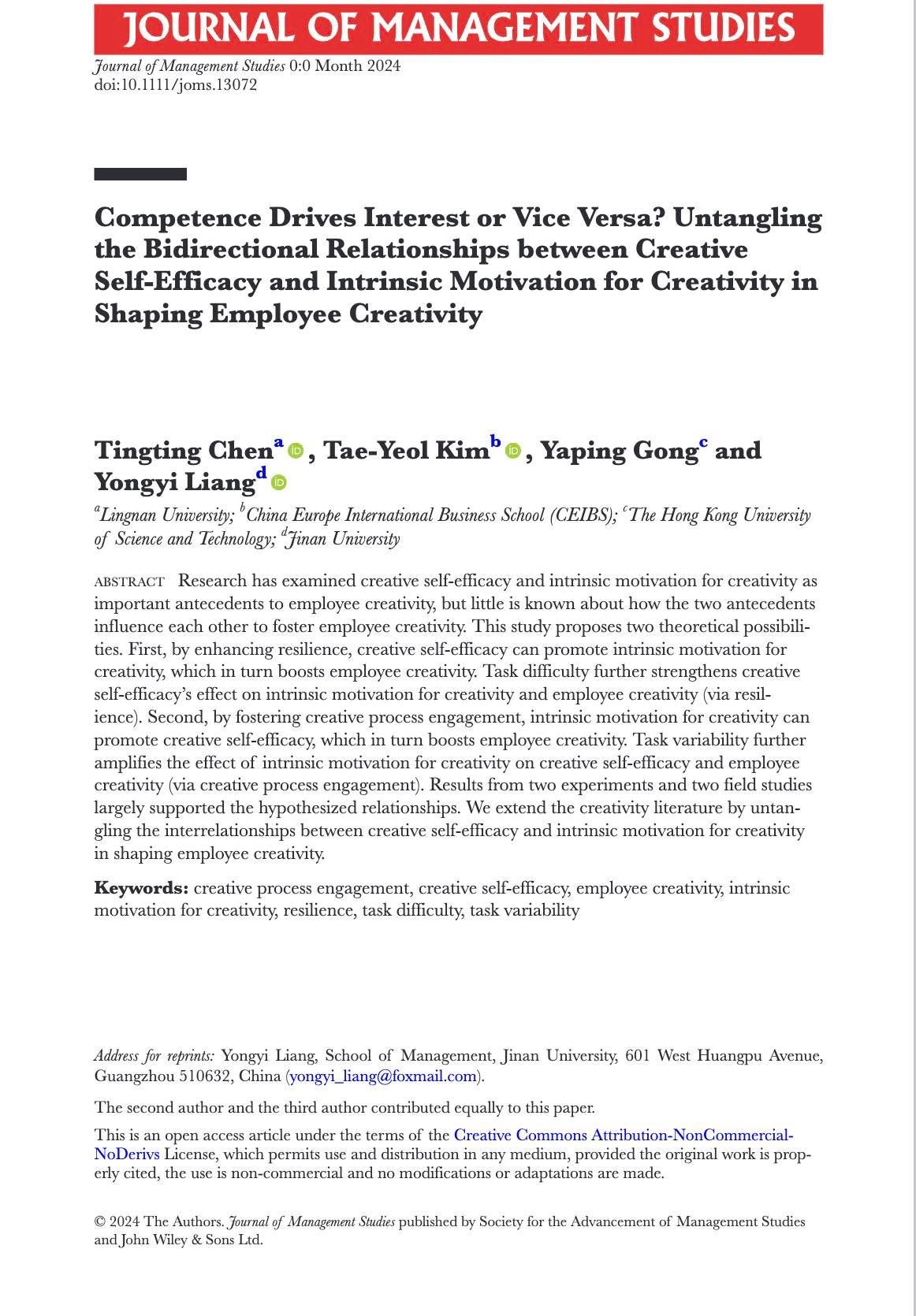
JOURNAL OF MANAGEMENT STUDIES Journal of Management Studies 0:0 Month 2024 doi:10.1111/joms.13072 Competence Drives Interest or Vice Versa? Untangling the Bidirectional Relationships between Creative Self-Efficacy and Intrinsic Motivation for Creativity in Shaping Employee Creativity Tinting Chen^a *, Tae-Yeol Kim^b, Yaping Gong^c and Yongyi Liang^d ^aLingnan University; ^bChina Europe International Business School (CEIBS); ^cThe Hong Kong University of Science and Technology; ^dJinan University ABSTRACT Research has examined creative self-efficacy and intrinsic motivation for creativity as important antecedents to employee creativity, but little is known about how the two antecedents influence each other to foster employee creativity. This study proposes two theoretical possibilities. First, by enhancing resilience, creative self-efficacy can promote intrinsic motivation for creativity, which in turn boosts employee creativity. Task difficulty strengthens creative self-efficacy's effect on intrinsic motivation for creativity and employee creativity (via resilience). Second, by fostering creative process engagement, intrinsic motivation for creativity can promote creative self-efficacy, which in turn boosts employee creativity. Task variability further amplifies the effect of intrinsic motivation for creativity on creative self-efficacy and employee creativity (via creative process engagement). Results from two experiments and two field studies largely supported the hypothesized relationships. We extend the creativity literature by untangling the interrelationships between creative self-efficacy and intrinsic motivation for creativity in shaping employee creativity. Keywords: creative process engagement, creative self-efficacy, employee creativity, intrinsic motivation for creativity, resilience, task difficulty, task variability Address for reprints: Yongyi Liang, School of Management, Jinan University, 601 West Huangpu Avenue, Guangzhou 510632, China (yongyi_liang@foxmail.com). The second author and the third author contributed equally to this paper. This is an open access article under the terms of the Creative Commons Attribution-NonCommercial- NoDerivs License, which permits use and distribution in any medium, provided the original work is properly cited, the use is non-commercial and no modifications or adaptations are made. © 2024 The Authors. Journal of Management Studies published by Society for the Advancement of Management Studies and John Wiley & Sons Ltd.
本研究のウェルビーイング小話はこちら😊
はぴテク相談室:職場における創造性に関する研究
https://wellbeing-archive.pages.dev/posts/2024-04-14-1713135609/