2024.06.09
生涯学習は高齢者の幸せにつながる。
というシンガポールの研究。
特に、↓が効いてくるそうです。
いくつになっても学びや成長は幸せに効いてくるし、何か皆で習い事をすることでつながりも醸成されるんだろうなぁ。
(ただし、あくまで相関であって、因果までは検討出来ていないとのこと。)
①歌、ダンス、音楽、運動などの授業活動への参加
論文では、過去12ヶ月間にこのような授業に参加したかどうかを尋ねています。分析の結果、授業活動への参加は「生活の質」「人生の満足度」「心理的幸福感」の全ての指標と統計的に有意な関連が見られました。
②生涯学習に対する前向きな態度
生涯学習の重要性を感じているかどうかという質問に対する回答を分析したところ、生涯学習に対して肯定的な態度を持つことは、特に「生活の質」の指標と強く関連していることが示されました。
ーー
ちなみに生涯学習に加えて、健康状態、家族関係もあると、幸せ爆上がりとのこと。
ーーー
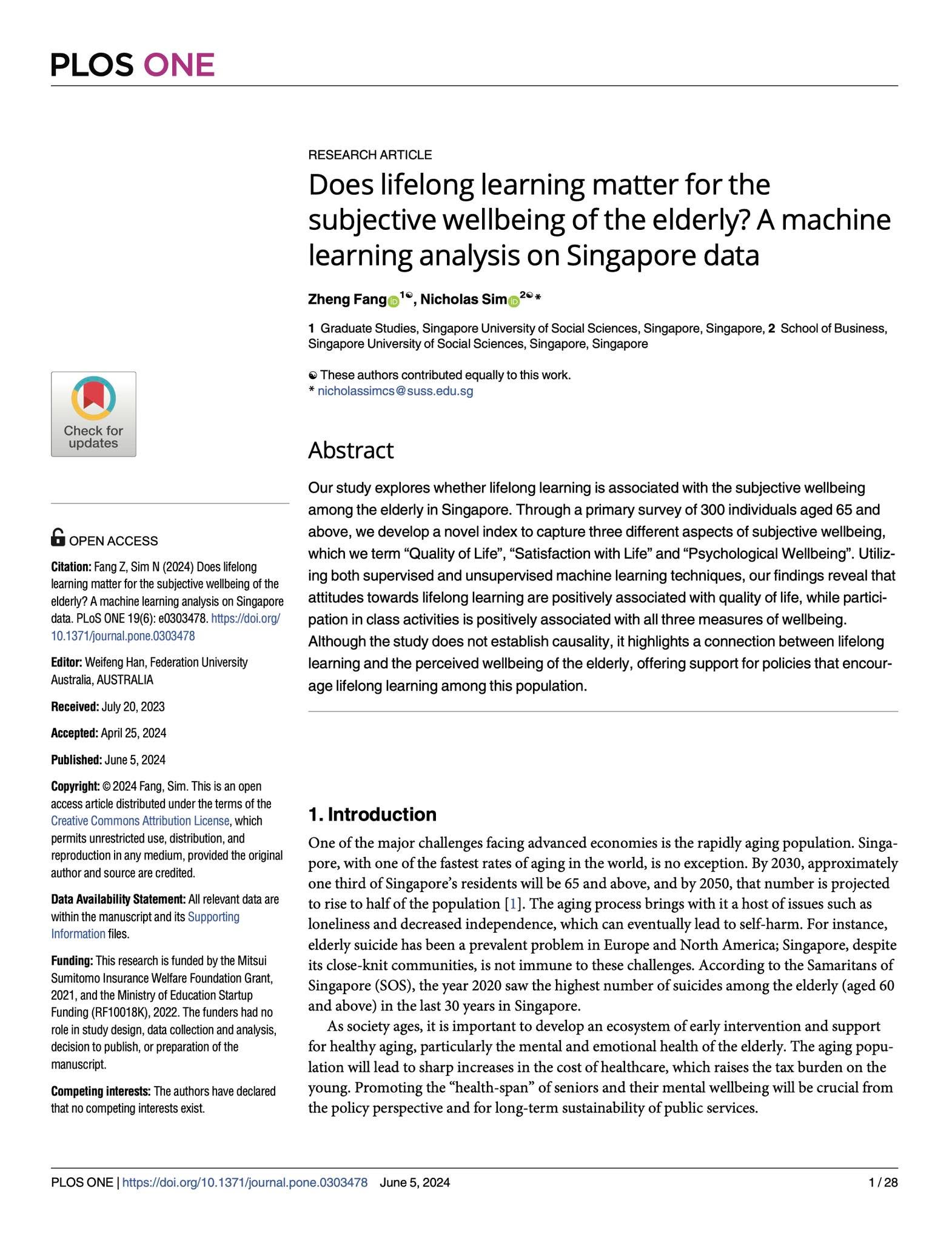
Does lifelong learning matter for the subjective wellbeing of the elderly? A machine learning analysis on Singapore data
生涯学習は高齢者の主観的幸福に重要なのか?シンガポールのデータに基づく機械学習分析
2024/6/5,PlosOne
https://journals.plos.org/plosone/article?id=10.1371/journal.pone.0303478
私たちの研究は、生涯学習がシンガポールの高齢者の主観的幸福感と関連しているかどうかを調査しています。65歳以上の300人を対象とした一次調査を通じて、私たちは主観的幸福感の3つの異なる側面を捉える新しい指標を開発しました。私たちはこれを「生活の質」、「生活への満足度」、「心理的幸福感」と呼んでいます。教師ありおよび教師なしの機械学習技術の両方を活用した私たちの調査結果では、生涯学習に対する態度は生活の質と正の関連があり、クラス活動への参加は3つの幸福感の尺度すべてと正の関連があることが明らかになりました。この研究では因果関係は確立されていませんが、生涯学習と高齢者の認識された幸福感との関連を強調し、この人口層の生涯学習を奨励する政策を支持するものです。
ーー
この論文は、シンガポールの65歳以上の高齢者を対象に、生涯学習と主観的幸福感の関連性を調査したものです。主な内容は以下の通りです。
300人の高齢者に対して一次調査を行い、生涯学習に対する態度と幸福感に関するデータを収集した。
幸福感は「生活の質」「人生の満足度」「心理的幸福感」の3つの側面から多次元的な指標を新たに作成して測定した。
機械学習の手法(多重コレスポンデンス分析、決定木、回帰分析)を用いて、生涯学習と幸福感の関連性を探索した。
分析の結果、生涯学習に対する前向きな態度は生活の質と関連していることが示された。また、歌やダンス、運動などの授業活動への参加は、3つの幸福感指標全てと関連が見られた。
健康状態や家族関係も幸福感と関連する重要な要因であった。
生涯学習、特に授業形式の学習を高齢者に推奨することは、彼らの幸福感向上に繋がる可能性があることが示唆された。
ただし本研究は関連性の探索に焦点を当てており、因果関係の特定はできていない。
以上のように、シンガポールの高齢者において、生涯学習が主観的幸福感と関連している可能性を機械学習の手法で示した点に本論文の意義があります。
PLOS ONE RESEARCH ARTICLE Does lifelong learning matter for the subjective wellbeing of the elderly? A machine learning analysis on Singapore data Zheng Fang ¹*, Nicholas Sim ²* 1 Graduate Studies, Singapore University of Social Sciences, Singapore, Singapore, 2 School of Business, Singapore University of Social Sciences, Singapore, Singapore ● These authors contributed equally to this work. * nicholassimc@suss.edu.sg Check for updates Abstract OPEN ACCESS Citation: Fang Z, Sim N (2024) Does lifelong learning matter for the subjective wellbeing of the elderly? A machine learning analysis on Singapore data. PLoS ONE 19(6): e0303478. https://doi.org/10.1371/journal.pone.0303478 Editor: Weiteng Han, Federation University Australia, AUSTRALIA Received: July 20, 2023 Accepted: April 25, 2024 Published: June 5, 2024 Copyright: © 2024 Fang, Sim. This is an open access article distributed under the terms of the Creative Commons Attribution License, which permits unrestricted use, distribution, and reproduction in any medium, provided the original author and source are credited. Data Availability Statement: All relevant data are within the manuscript and its Supporting Information files. Funding: This research is funded by the Mitsui Sumitomo Insurance Welfare Foundation Grant, 2021, and the Ministry of Education Startup Funding (RIF1008). The funders had no role in study design, data collection and analysis, decision to publish, or preparation of the manuscript. Competing interests: The authors have declared that no competing interests exist. Our study explores whether lifelong learning is associated with the subjective wellbeing among the elderly in Singapore. Through a primary survey of 300 individuals aged 65 and above, we develop a novel index to capture three different aspects of subjective wellbeing, which we term "Quality of Life", "Satisfaction with Life" and "Psychological Wellbeing". Utilizing both supervised and unsupervised machine learning techniques, our findings reveal that attitudes towards lifelong learning are positively associated with quality of life, while participation in class activities is positively associated with all three measures of wellbeing. Although the study does not establish causality, it highlights a connection between lifelong learning and the perceived wellbeing of the elderly, offering support for policies that encourage age lifelong learning among this population. 1. Introduction One of the major challenges facing advanced economies is the rapidly aging population. Singapore, with one of the fastest rates of aging in the world, is no exception. By 2030, approximately one third of Singapore's residents will be 65 and above, and by 2050, that number is projected to rise to half of the population [1]. The aging population brings with it a host of issues such as loneliness and decreased independence, which can eventually lead to self-harm. For instance, elderly suicide has been a prevalent problem in Europe and North A

本研究のウェルビーイング小話はこちら😊
はぴテク相談室:生涯学習は高齢者の幸せにつながる。
https://wellbeing-archive.pages.dev/posts/2024-06-09-1717972205/