2023.12.13
大人が遊び心を持つと、幸せになるし、仕事パフォーマンスも高まる
ちょうど、大人の遊び心についての統合的レビュー(色んな論文を整理したようなの)が公開されていました😊
大人も、ちゃんと遊ぶこと。そして、何事にも遊び心を持って取り組むことって、めっちゃ大切ですね😍😍
(先日の子ども心をもつ大人は幸せだ、とか、社長のおごり自販機とか、にも繋がってきます。)
ーー
大人の遊びや遊び心は↓を高める。
・仕事の生産性(Martocchio & Webster, 引用1992)、
・創造的なパフォーマンス(発散思考など)、
・革新的な行動(Bateson & Nettle,引用 2014; Felsman et al、Citation2021; Nisula & Kianto,Citation2018; Tegano,Citation 1990)、
・学業成績(Proyer,Citation2011)、
・自己を楽しませる能力(Shen et al.,Citation2014b)、
・フロー(Csikszentmihalyi,Citation1981,Citation2014)、
・ストレス対処と回復力(Chang et al.,Citation2016; Qian & Yarnal,Citation2011)、
・全体的な適応力(Shen et al.)
ーー
また、ウェルビーイング関連↓のような項目にも効く。
・体力(Proyerら、引用2018)、
・ポジティブな感情や感情的ウェルビーイング(Felsmanら、引用2020;Fredrickson、引用2003;Fredrickson & Branigan、引用2005)、
・仕事満足度(Yuら、引用2007)、
・全体的なウェルビーイングや生活満足度(Erezら、引用2016;Proyer、引用2011、引用2013;Yueら、引用2016)。
ーーー
**The playful mediator, moderator, or outcome? **
An integrative review of the roles of play and playfulness in adult-centered psychological interventions for mental health
遊びの仲介者、司会者、あるいは結果?メンタルヘルスのための成人中心の心理学的介入における遊びと遊び心の役割の統合的レビュー
**2023/12/6,The Journal of Positive Psychology **
https://www.tandfonline.com/doi/full/10.1080/17439760.2023.2288955?af=R
要旨
遊びや遊び心は、成人のメンタルヘルスにどのように寄与するのだろうか?我々は、20の心理学的介入から得られた経験的証拠を、参加者の遊び心と、変化の主体としての遊びのプロセスを強調するレンズを通して評価した。我々は、
(1)遊びが成人のメンタルヘルスにおける肯定的な変化の原因物質であることを支持する予備的証拠、おそらく媒介物質と媒体という2つのメカニズムを介して、
(2)介入の有効性に対する参加者の遊び心の中和効果をめぐる限定的で不明確な証拠を発見した。
われわれの知見は、遊びに関するプロセスと健康アウトカムをより厳密に定量的に評価する必要性と、介入アウトカムとしての遊び心を検討する際の、より明確な特性状態の区別の必要性を強調している。成人の健康とウェルビーイングを改善するために、遊びの変容的で治療的な力を活用するために、より理論的な統合と、境界を越えた変化のメカニズムを理解することに重点を置いた、全体的で発達に敏感なアプローチが必要である。
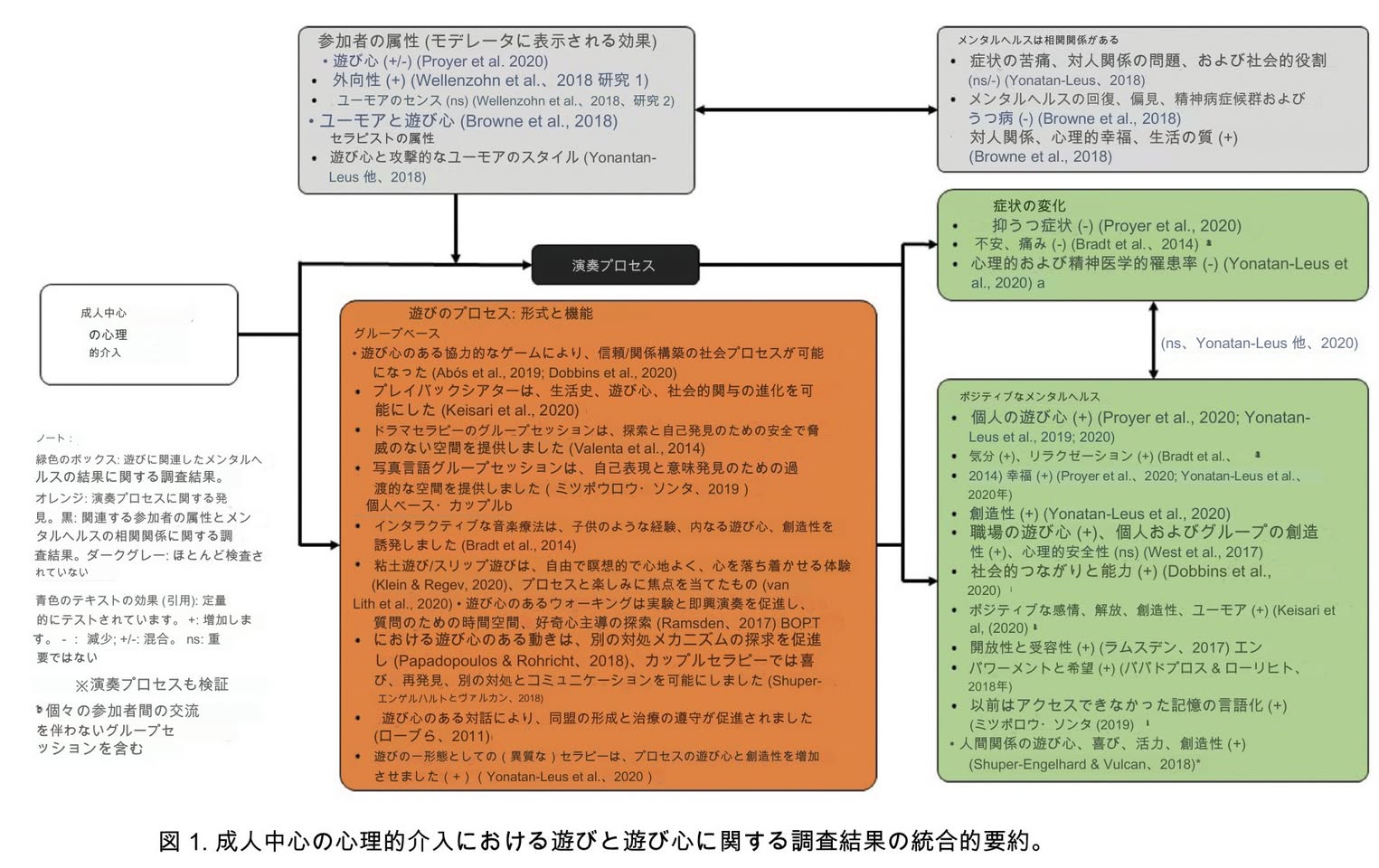
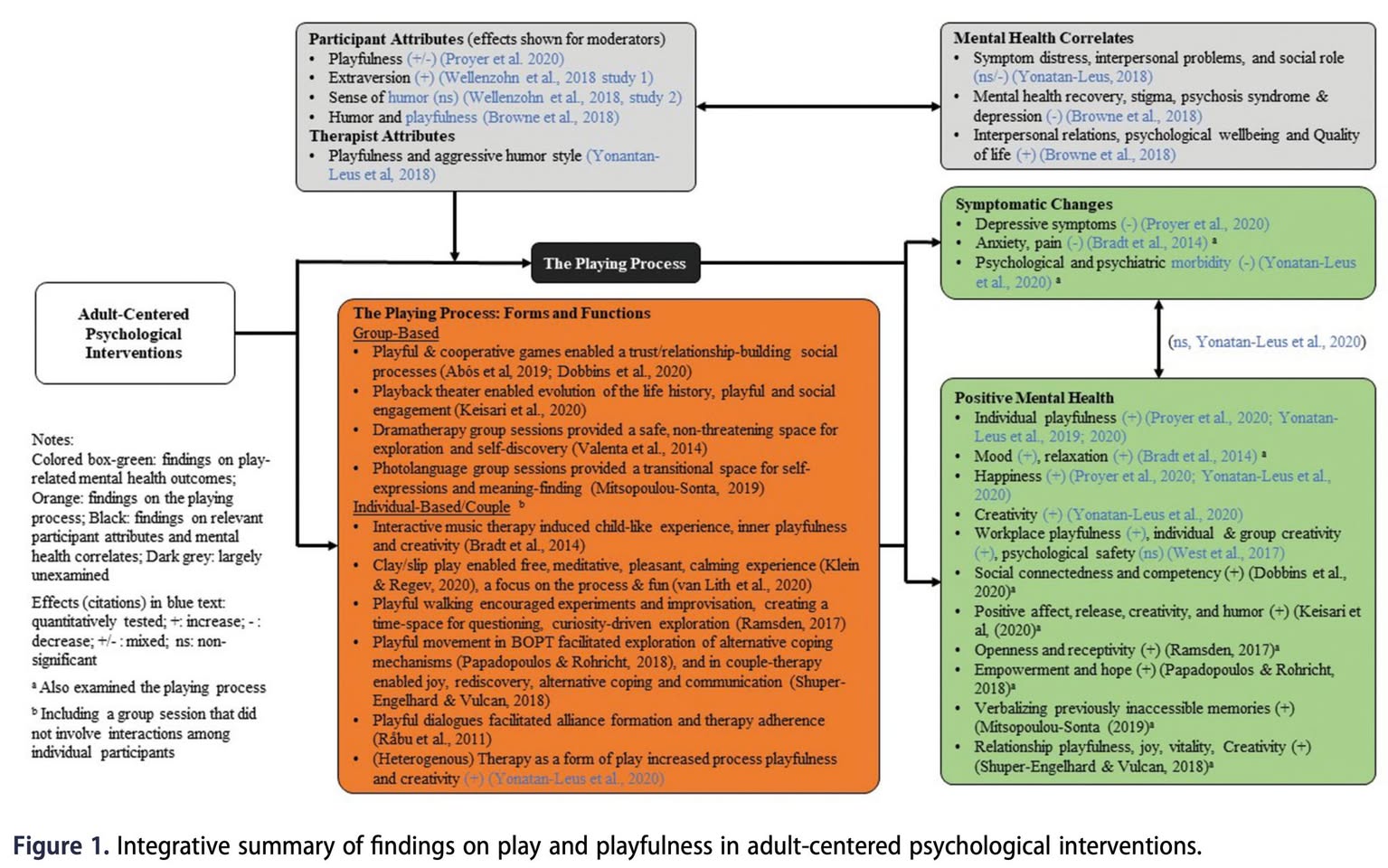
参加者の適性(モテレータ応答される効果) ・選びひ (+) (Proyer et al. 2020) ・外向性 (+) (Wellenzohn et al., 2018 研究 1) ・ユーモアのスキル (m) (Wellenzohn et al., 2018, 研究 2) ・ユーモアと選びひ (Browne et al., 2018) セラピストの適性 ・選びひと攻撃的なユーモアのスタイル (Yonatan-Leus 他, 2018) メンタルヘルス従事者向けおよび ・虐待の歴史、対人関係の問題、および社会的設置 (ns;) (Yonatan-Leus, 2018) ・メンタルヘルスの信念、機敏、精神的症候群および うつ病 (-) (Browne et al., 2018) ・対人関係、心理的幸福、生活の質 (+) (Browne et al., 2018) 症状の変化 ・抑うつ症状 (-) (Proyer et al., 2020) ・不安、融み込み (Breil et al., 2014) * ・心理的および精神医学的健康率 (-) (Yonatan-Leus et al., 2020) a 成人中心 めぐ法 めか入 [ms., Yonatan-Leus 他, 2020] ノート: 線色のボックス:連びに関連したメンタルヘル スの適性に関する研究領域 オレンジ:選ぶプロセスに関する有、黒:同線子の有無性について 質問:選びのある機能面および タルヘルスの関連機関に関する調査 結果:ダークフリー、線と心理 実装者プロセスを検証 実装:の参加者間の交流 を伴わないグループセ ッション名含む ポジティブメンタルヘルス ・個人の選びひ (+) (Proyer et al, 2020; Yonatan- Leus 他, 2019 a) ・察知 (+), リラクセーション (+) (Breil et al., 2014) 苦悩 (-) (Proyer et al., 2020; Yonatan-Leus et al., 2020年) ・幸福者 (-) (Yonatan-Leus et al., 2020) ・職場の選びひ (+)、個人および/グループの葛藤 解く (-)、ストレス対策 (Khodarahimi, 2017) ・社会的つながりと地力 (+) (Dobbins et al., 2020) ・ポジティブな情動、解敏、満清性、ユーモア (+) (Kaisari et. (2020) ) ・胸板性と幸福感 (+) (ラムスチン, 2017) エン パワーメント発掘 2018年) ・以前はアウアシスで支えなかった把握の自言詩化 (+) (ミッボロフ:ソマ (2019) ・人間関係の泉びひ (-), 親密性 (+) (Stuper-Engelhard & Vulcan, 2018)* 図1. 成人中心の心理的介入における遊びと遊びひに関する調査結果の統合的要約。 Participant Attributes (effects shown for moderators) • Playfulness (=) (Proyer et al., 2020) • Extraversion (+) (Weizenbaum et al., 2018 study 1) • Sense of humor (ns) (Weizenbaum et al., 2018, study 2) • Humor and playfulness (Browne et al., 2018) Therapist Attributes • Playfulness and aggressive humor style (Yonatan-Leus et al., 2018) Mental Health Correlates • Symptom: stress, interpersonal problems, and social role (-, +) (Yonatan-Leus, 2018) • Mental health recovery, stigma, psychosis syndrome & depression (-) (Browne et al., 2018) • Interpersonal relations, psychological wellbeing and Quality of life (+) (Browne et al., 2018) The Playing Process Adult-Centered Psychological Interventions The Playing Process: Forms and Functions Group-Based • Playful & cooperative games enabled a trust-relationship-building social processes (Abós et al 2019; Dobkins et al., 2020) • Playback theater enabled evolution of the life history, playful and social engagement (Costa et al., 2020) • Dramatherapy group sessions provided a safe, non-threatening space for exploration and self-discovery (Valente et al., 2013) • Photolanguage group sessions provided a transitional space for self-expression and meaning-finding (Messsopoulou-Sonia, 2019) Individual-Based Couple ² • Interactive active therapy induced child-like experience, inner playfulness and creativity (Bradt et al., 2014) • Clowning play enabled ego regulation, pleasurable calming and creativity (Klein & Repev, 2020), a focus on the process & fun (van Lith et al., 2020) • Playful walking & humor interactions enabled a time-space for questioning, curiosity-driven exploration (Ramsden, 2017) • Playful movement in DOPT facilitated exploration of alternative coping mechanisms (Papad