2024.12.06
ソフトウェアエンジニアの幸福:体系的な文献レビューと理論
ソフトウェアエンジニアさんの幸せについて、
2000-2023年の研究をまとめたもの。を発表頂きました😊
ー
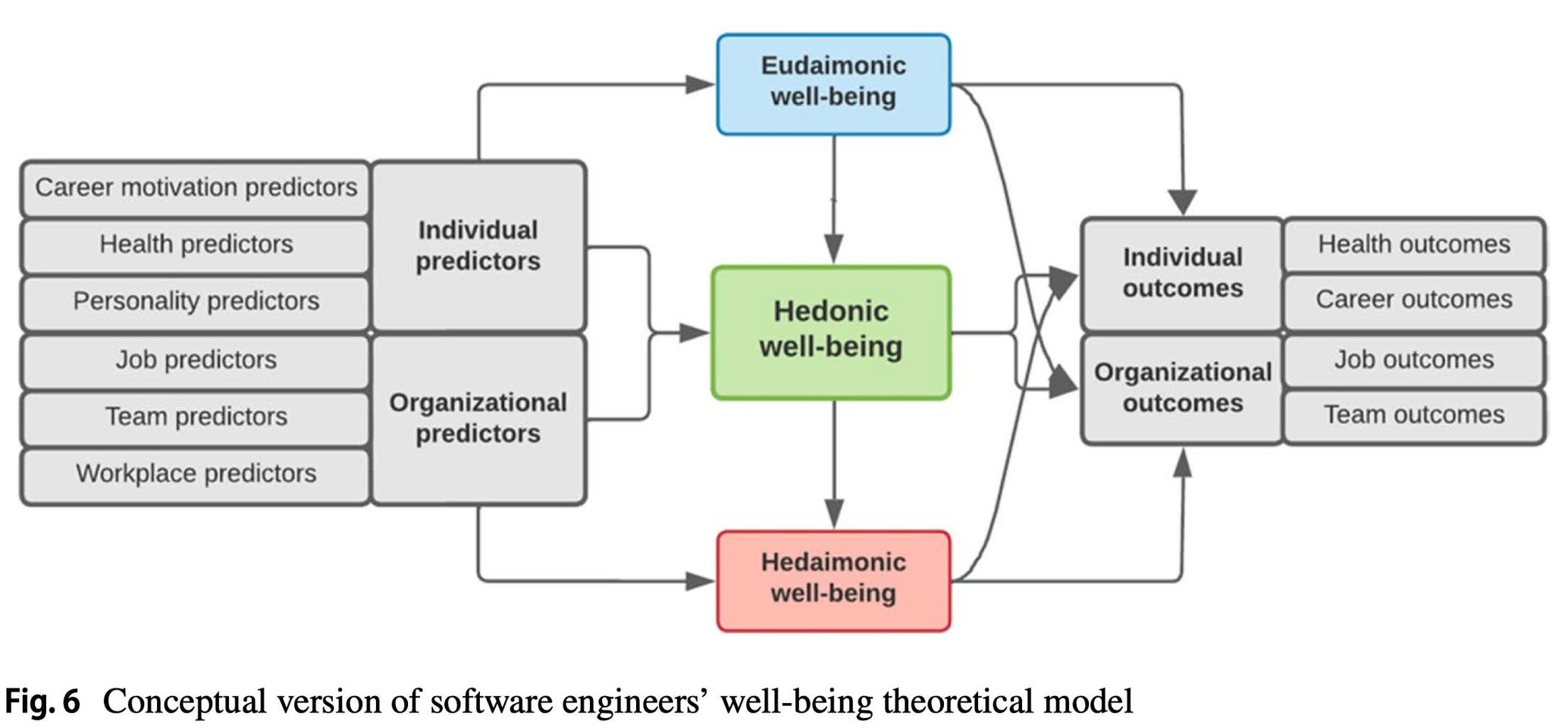
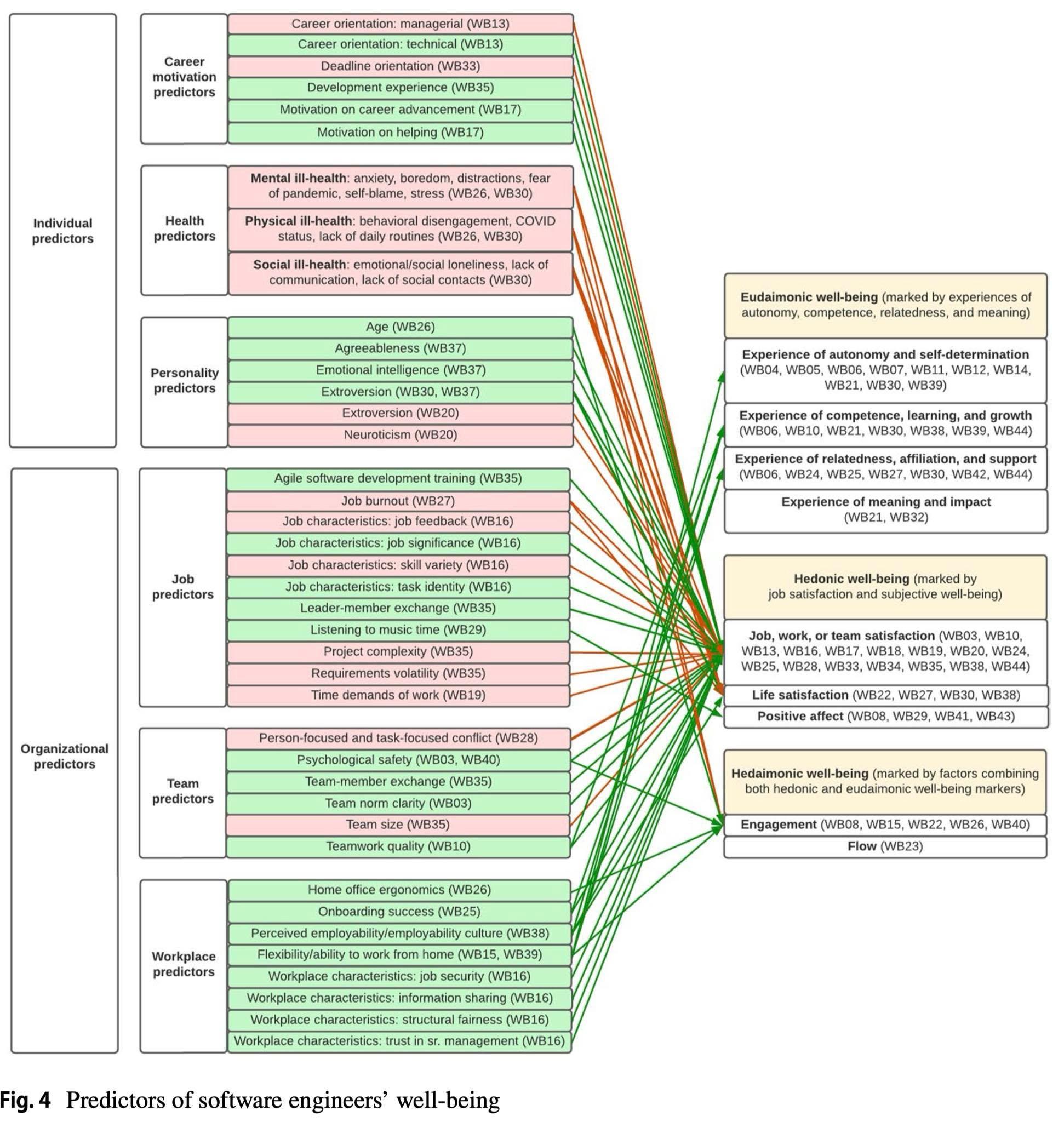
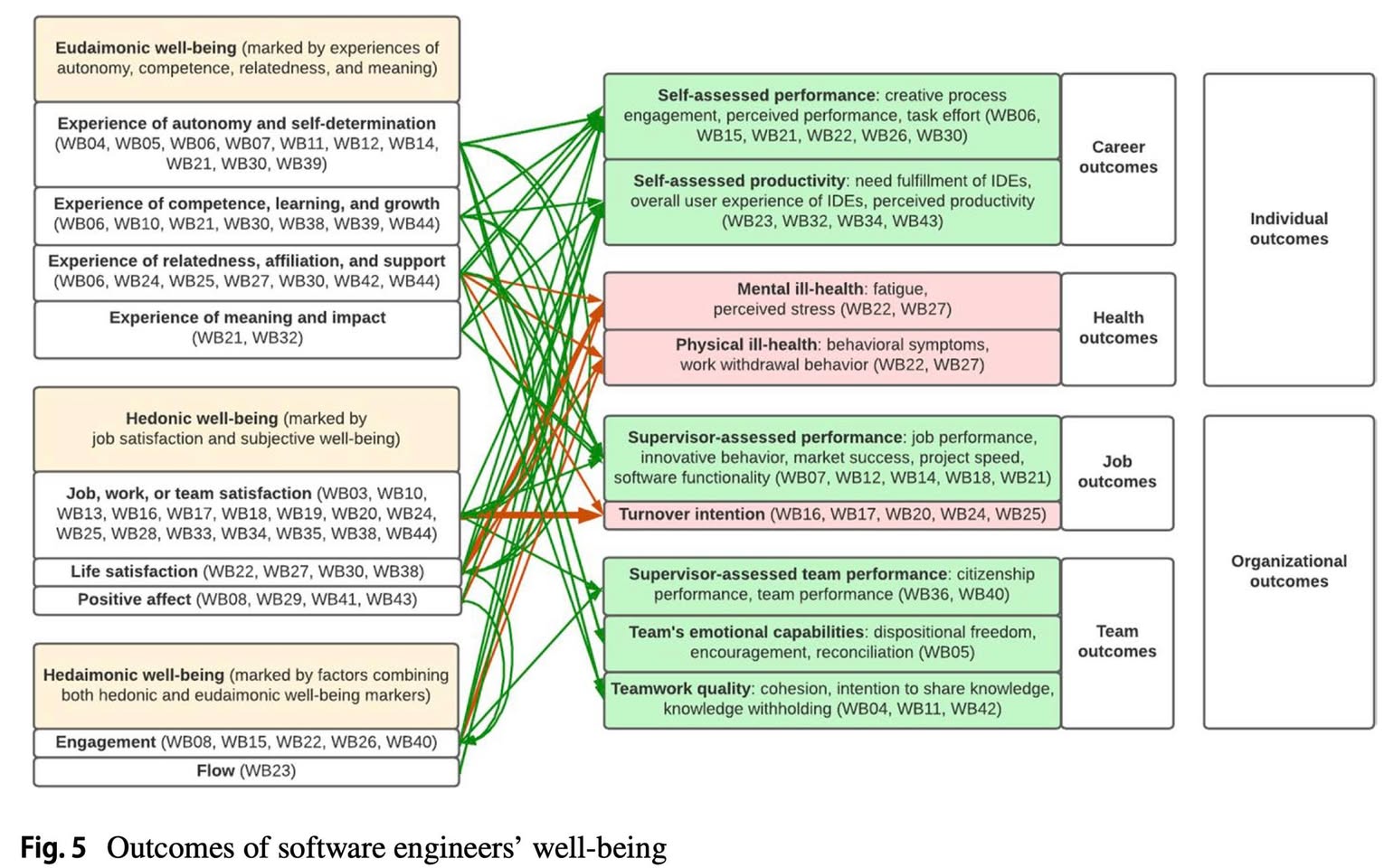
↓の3つのウェルビーイングについて、その原因(indicator)と、結果(outcome)を整理頂いています😊
①快楽的(hedonic): 生活満足度や感情的な幸福感
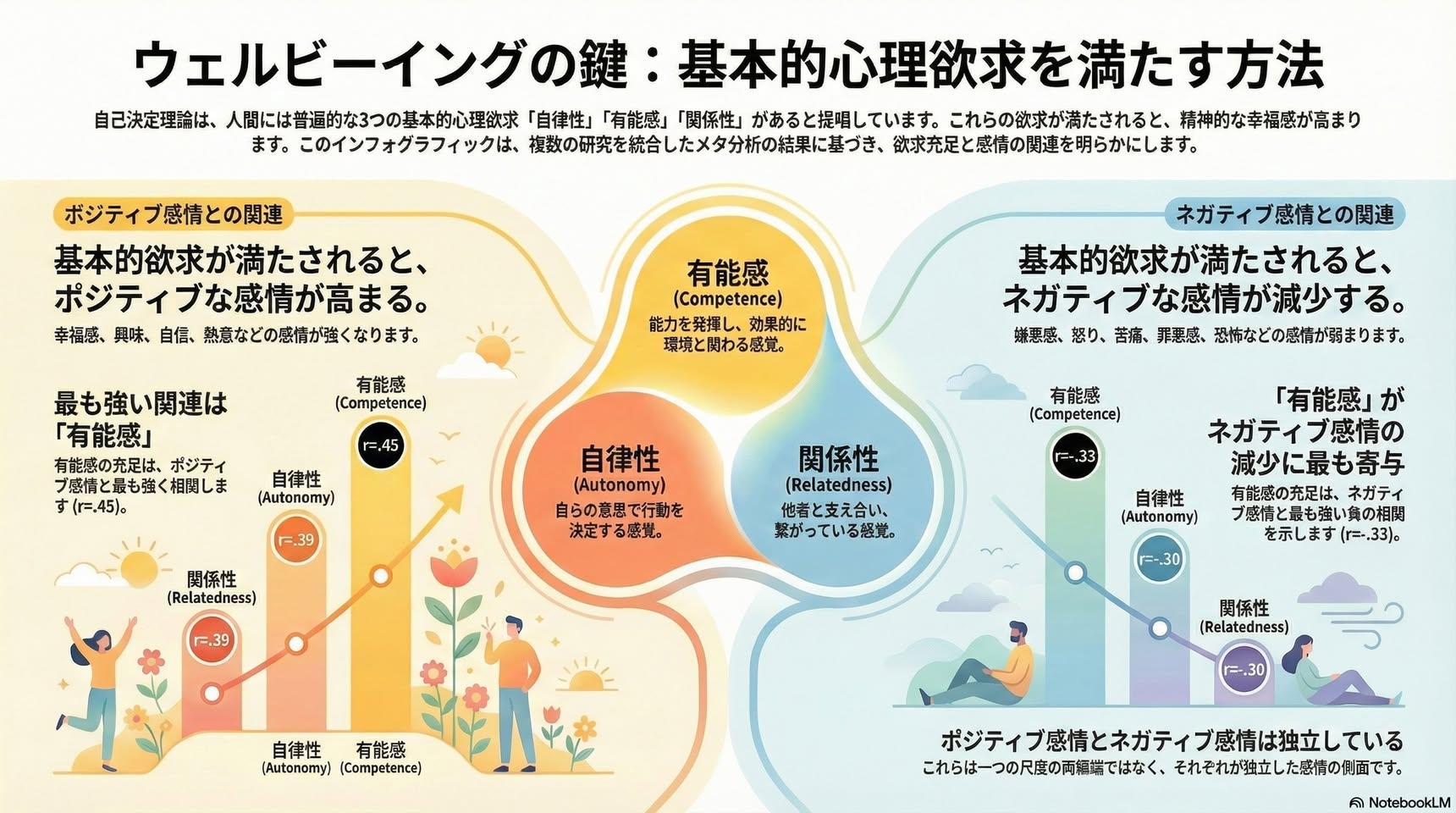
②エウダイモニック(eudaimonic): 自律性、能力、関係性、意味などの充実感
③統合的(hedaimonic): 仕事への没入感やエンゲージメント
ー
そして、ソフトウェアエンジニアさんも、幸せな人ほど、個人やチームの生産性が高い❗
エンジニアさん以外にも参考になる部分がありますね😍
ーーー
■一般の人と、ソフトウェアエンジニアの主な違い
①一般の人と違う特徴:
ネガティブな感情(恐れ、悲しみ、怒り)をより多く感じやすい特徴がある(−)
一方で、他の職種と比べてポジティブな感情もやや多く経験している(+)
内向的な性格が多い(その人の性格による)
メンタルヘルスの課題の発生率が一般人口の約2倍(約8.5%)(−)
フロー状態(没入感)を経験しやすい(+)
ーー
②一般の人よりも幸せへの影響が大きい特徴:
●プラスの影響が大きい要因:
タスクの自律性(+)
心理的安全性のある環境(+)
適切なフィードバック(+)
チームの良好な関係性(+)
技術的な課題への挑戦機会(+)
問題解決の機会(+)
社会への貢献実感(+)
●マイナスの影響が大きい要因:
プロジェクトの複雑さ(−)
要件の変動性(−)
締め切りのプレッシャー(−)
タスクの相互依存性(−)
チーム内のコンフリクト(−)
ーー
③一般の人よりも幸せへの影響が小さい特徴:
ーー
ただし、同じ状況でも、個人や文脈によってプラスにもマイナスにもなりうる要因があります
(ソフトウェアエンジニアに限りませんが。)
ーーー
ソフトウェアエンジニアの幸福:体系的な文献レビューと理論
The well-being of software engineers: a systematic literature review and a theory
Empirical Software Engineering,2024/12/3
https://link.springer.com/article/10.1007/s10664-024-10543-8
Career motivation predictors Health predictors Personality predictors Job predictors Team predictors Workplace predictors Individual predictors Organizational predictors Eudaimonic well-being Hedonic well-being Hedaimonic well-being Individual outcomes Organizational outcomes Health outcomes Career outcomes Job outcomes Team outcomes Fig. 6 Conceptual version of software engineers' well-being theoretical model Career orientation: managerial (WB13) Career orientation: technical (WB13) Deadline orientation (WB33) Development experience (WB35) Motivation on career advancement (WB17) Motivation on helping (WB17) Career motivation predictors Mental ill-health: anxiety, boredom, distractions, fear of pandemic, self-blame, stress (WB26, WB30) Physical ill-health: behavioral disengagement, COVID status, lack of daily routines (WB26, WB30) Social ill-health: emotional/social loneliness, lack of communication, lack of social contacts (WB30) Health predictors Age (WB26) Agreeableness (WB37) Emotional intelligence (WB37) Extroversion (WB30, WB37) Extroversion (WB20) Neuroticism (WB20) Personality predictors Individual predictors Agile software development training (WB35) Job burnout (WB27) Job characteristics: job feedback (WB16) Job characteristics: job significance (WB16) Job characteristics: skill variety (WB16) Job characteristics: task identity (WB16) Leader-member exchange (WB35) Listening to music time (WB29) Project complexity (WB35) Requirements volatility (WB35) Time demands of work (WB19) Job predictors Person-focused and task-focused conflict (WB28) Psychological safety (WB3, WB40) Team-member exchange (WB35) Team norm clarity (WB3) Team size (WB35) Teamwork quality (WB10) Team predictors Home office ergonomics (WB26) Onboarding success (WB25) Perceived employability/employability culture (WB38) Flexibility/ability to work from home (WB15, WB39) Workplace characteristics: job security (WB16) Workplace characteristics: information sharing (WB16) Workplace characteristics: structural fairness (WB16) Workplace characteristics: trust in sr. management (WB16) Workplace predictors Organizational predictors Eudaimonic well-being (marked by experiences of autonomy, competence, relatedness, and meaning) Experience of autonomy and self-determination (WB04, WB05, WB06, WB07, WB11, WB12, WB14, WB21, WB30, WB39) Experience of competence, learning, and growth (WB06, WB10, WB21, WB30, WB38, WB39, WB44) Experience of relatedness, affiliation, and support (WB06, WB24, WB25, WB27, WB30, WB42, WB44) Experience of meaning and impact (WB21, WB32) Hedonic well-being (marked by job satisfaction and subjective well-being) Job, work, or team satisfaction (WB03, WB10, WB13, WB16, WB17, WB18, WB19, WB20, WB24, WB25, WB28, WB33, WB34, WB35, WB36, WB44) Life satisfaction (WB22, WB27, WB30, WB38) Positive affect (WB08, WB29, WB41, WB43) Hedaimonic well-being (marked by factors combining both hedonic and eudaimonic well-being markers) Engagement (WB08, WB15, WB22, WB26, WB40)
>Our Common Agenda に 2024 年 9 月に Summit of the Future「未来サミット」の開催が提案され、そこで、新しい指標群が提案される予定だったが、実際 2024 年 9 月 22 日に採択されたのは、ハイレベルの独立した専門家委員会を設置して審議の上、来年の総会で報告してもらい、その上でもう一度国連システムの関係者で議論しようという文章であった 20。先延ばしである。
😂
でも、国連さんからは、こんな流れも。来年が楽しみですね😍😍
https://www.facebook.com/groups/wellbeinginfo/permalink/1715812859229405/
ブランド総研さんの幸福度調査の話と、
フィンランドから学ぶ幸せの話😊
週末に是非❗