2024.12.03
毎日ヒーリング音楽を30分聞くと、幸福度が爆上がり
最近の論文で、幸福度が爆上がっていた事例。
4週間、毎日ヒーリング音楽を30分聞くと、
幸福度の指標であるSWLS(人生満足度)が65→80に高まった。@ティーンエイジャー
(計算方法が記載されていないっぽかったですが、たぶん100点満点に換算してるのかな。)
ーー
ちょっと脅威的な伸びです❗
今回15%くらい伸びてますが、めっちゃ辛いこと(会社を急にクビになるとか)で5-10%程度落ちるとか言われています。
作業とかしながら聞いて良いのか、音楽だけに集中するのか、不明ではあるのですが、
ヒーリング音楽って、めっちゃ効果があるのかも😍うーん、ちょっと聞いてみようかな。
他にも、自分のことを知る(自己概念の明確さ)とか、レジリエンス、ネガティブ感情なんかにも効果大。
ーーー
■AIサマリー
この研究論文は、音楽が青少年のメンタルヘルスに与える影響を調査した4週間の実験研究です。主なポイントは以下の通りです:
ー
音楽が青少年のメンタルヘルスに与える影響の既存研究
・音楽は脳内のドーパミン分泌に影響を与え、ポジティブな感情反応を生み出す
・青少年期特有の情緒不安定や気分の揺れに対して、音楽は感情調整ツールとして機能する
・伝統的な介入方法(薬物療法や心理療法)と比較して、音楽は低コストで副作用がなく受け入れやすい
・音楽は自己アイデンティティの形成を促進し、内面の感情表現を助ける媒体となる
・ストレス解消や心理的レジリエンス向上に効果があり、青少年の精神的健康の維持・改善に貢献する
ー
実験設計:
ー
測定指標:
感情状態 (PANAS尺度) 各10項目1-5点
心理的レジリエンス (RS尺度)
不安レベル (STAI尺度)
自己認識 (自己概念尺度)
人生満足度 (SWLS尺度)
ー
主な結果:
・すべての指標において、ヒーリング音楽の効果が瞑想よりも顕著
・ヒーリング音楽は特に感情状態とレジリエンスの改善に効果的
・瞑想も緩やかな改善効果を示したが、変化の幅は小さい
・非介入対照群はほとんど変化なしか、わずかな悪化傾向
・音楽群の改善幅は概ね2-3倍以上、瞑想群の改善幅を上回る
ー
結論:
音楽は青少年のメンタルヘルス向上に効果的な非薬物的介入方法として有用であることが示された。
対照群の瞑想時間については、実験群と同じく1日30分間でした。瞑想は深呼吸やマインドフルネス瞑想の練習を含み、静かな環境で行われました。
ーーー
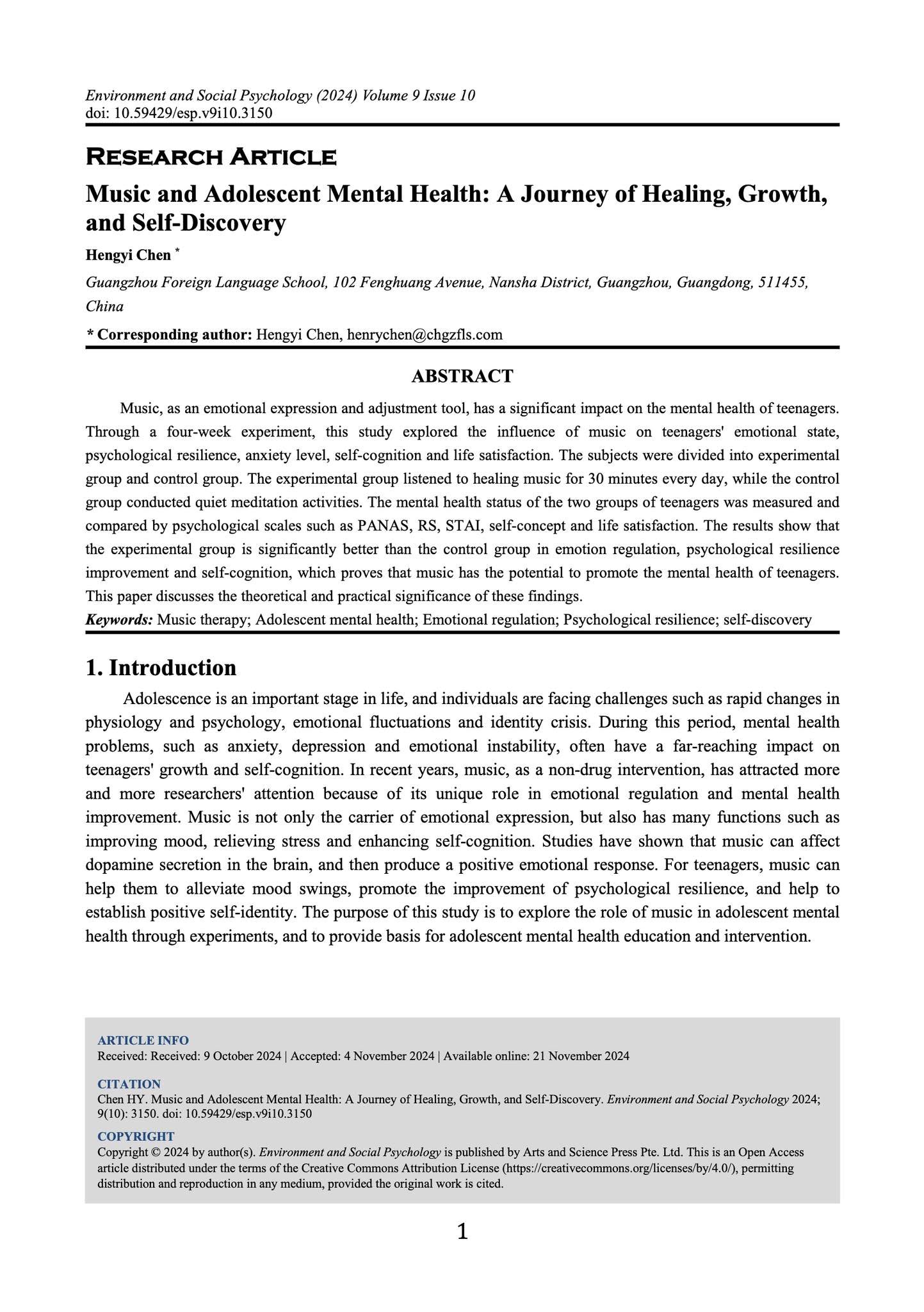
音楽と思春期のメンタルヘルス:癒し、成長、自己発見の旅
Music and Adolescent Mental Health: A Journey of Healing, Growth, and Self-Discovery
Environment and Social Psychology,2024/11
https://esp.as-pub.com/index.php/esp/article/viewFile/3150/1506
音楽は感情表現や感情調整の手段として、ティーンエイジャーの精神衛生に大きな影響を与えます。
この研究では、4週間の実験を通して、音楽がティーンエイジャーの情緒状態、心理的回復力、不安レベル、自己認識、生活満足度に与える影響を探りました。被験者は実験グループと対照グループに分けられました。実験グループは毎日30分間ヒーリング音楽を聴き、対照グループは静かな瞑想活動を行いました。2つのグループのティーンエイジャーの精神状態は、PANAS、RS、STAI、自己概念、生活満足度などの心理尺度によって測定され、比較されました。その結果、実験グループは、感情のコントロール、心理的回復力の向上、自己認識において、対照グループよりも有意に優れていることが分かりました。これは、音楽がティーンエイジャーの精神衛生を促進する潜在的可能性があることを証明しています。
本論文では、これらの調査結果の理論的および実践的な意義について論じています。
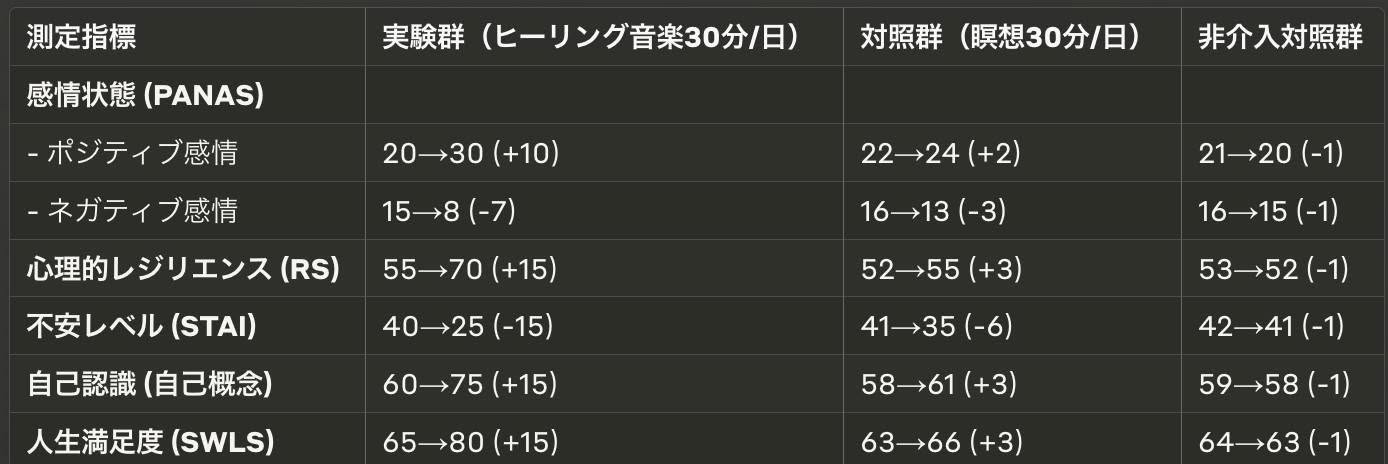
測定指標 | 実験群(ヒーリング音楽30分/日) | 対照群(瞑想30分/日) | 非介入対照群 感情状態(PANAS) - ポジティブ感情 | 20→30 (+10) | 22→24 (+2) | 21→20 (-1) - ネガティブ感情 | 15→8 (-7) | 16→13 (-3) | 16→15 (-1) 心理的レジリエンス(RS) | 55→70 (+15) | 52→55 (+3) | 53→52 (-1) 不安レベル(STAI) | 40→25 (-15) | 41→35 (-6) | 42→41 (-1) 自己認識(自己概念) | 60→75 (+15) | 58→61 (+3) | 59→58 (-1) 人生満足度(SWLS) | 65→80 (+15) | 63→66 (+3) | 64→63 (-1) Environment and Social Psychology (2024) Volume 9 Issue 10 doi: 10.59429/esp.v9i10.3150 RESEARCH ARTICLE Music and Adolescent Mental Health: A Journey of Healing, Growth, and Self-Discovery Hengyi Chen* Guangzhou Foreign Language School, 102 Fenghuang Avenue, Nansha District, Guangzhou, Guangdong, 511455, China * Corresponding author: Hengyi Chen, henrychen@chgzfls.com ABSTRACT Music, as an emotional expression and adjustment tool, has a significant impact on the mental health of teenagers. Through a four-week experiment, this study explored the influence of music on teenagers' emotional state, psychological resilience, anxiety, self-cognition and life satisfaction. The subjects were divided into experimental group and control group. The experimental group listened to healing music for 30 minutes every day, while the control group conducted quiet meditation activities. The mental health status of the two groups of teenagers was measured and compared by psychological scales such as PANAS, RS, STAI, self-concept and life satisfaction. The results show that the experimental group is significantly better than the control group in emotion regulation, psychological resilience improvement and self-cognition, which proves that music has the potential to promote the mental health of teenagers. This paper discusses the theoretical and practical significance of these findings. Keywords: Music therapy; Adolescent mental health; Emotional regulation; Psychological resilience; self-discovery 1. Introduction Adolescence is an important stage in life, and individuals are facing challenges such as rapid changes in physiology and psychology, emotional fluctuations and identity crisis. During this period, mental health problems, such as anxiety, depression and emotional instability, often have a far-reaching impact on teenagers' growth and self-cognition. In recent years, music, as a non-drug intervention, has attracted more and more researchers' attention because of its unique role in emotional regulation and mental health improvement. Music is not only the carrier of emotional expression, but also has many functions such as improving mood, relieving stress and enhancing self-cognition. Studies have shown that music can affect dopamine secretion in the brain, and then produce a positive emotional response. For teenagers, music can help them to alleviate mood swings, promote the improvement of psychological resilience, and help to establish positive self-identity. The purpose of this study is to explore the role of music in adolescent mental health through experiments, and to provide basis for adolescent
本研究のウェルビーイング小話はこちら😊
はぴテク相談室:毎日ヒーリング音楽を30分聞くと、幸福度が爆上がり
https://wellbeing-archive.pages.dev/posts/2024-12-03-1733263804/