2024.08.16
怒りは、短期的にはパフォーマンスを高めるが、不正の確率が上がり、より自分を守ろう
・短期的には怒りの感情もパフォーマンスに効果がある。
(長期的には危険性もある。)
・簡単な課題だと効果無し、難しい課題だと効果あり。
・ただし、怒りベースだと不正を働く確率が高まるのと、より自分を守ろうとする。
とのこと。
ー
ポジティブな感情はパフォーマンスを高める研究は多数ありますが、
ネガティブな感情も短期的にはパフォーマンスにつながるよ。という研究。
ー
動き始めは怒りで始めて、じょじょに愛や志ベースで打ち込める。という流れも有ですね😊そういう起業家の方はわりといる気がします。
(もちろん最初から愛や志で目標に向かっていく方が、危険性もなく良いですが。)
ーーー
■AIのサマリー
この研究は、怒りの感情が目標達成に与える影響を調査したものです。主な知見は以下の通りです:
怒りは、困難な状況下での目標達成を促進する傾向があります。
7つの研究を通じて、怒りは以下のような結果をもたらしました:
これらの効果は、主に困難な課題や状況で見られました。簡単な課題では怒りの効果はあまり見られませんでした。
怒りの効果は、他のネガティブな感情(悲しみなど)や中立的な状態と比較して顕著でした。
怒りが目標達成を促進する効果は、個人の感情に対する信念とは関係ありませんでした。
研究者らは、これらの結果は怒りが目標達成を助ける機能的な感情であるという理論を支持するものだと結論付けています。特に障害や困難に直面した際に、怒りが目標に向けた行動を促進する可能性があることを示唆しています。
ーーー
※論文
Anger has benefits for attaining goals.
Journal of Personality and Social Psychology,
https://www.apa.org/pubs/journals/releases/psp-pspa0000350.pdf
感情は機能的なものであり、人々の成果を向上させるものである。 感情の機能的説明に基づき、私たちは、怒りは課題が存在する場合に目標達成を向上させるはずだと理論化した。 7つの研究において、目標達成に対する様々なレベルの課題を伴う状況で目標達成を評価した。 各研究において、怒りは中立的な条件と比較して、挑戦的な課題を含む課題において、より大きな目標達成を促進する行動をもたらした。 難しいパズルを解くという目標では、怒りによってより多くのパズルを正確に解くことができた(研究1)。 賞品獲得が目標では、怒りは不正行為率と未獲得賞品数を増加させた(研究2)。 ビデオゲームでうまくやることを目標にした場合、怒りは回避すべき課題があるゲームの得点を増加させたが、他の得点は増加させなかった(研究3)。 怒りの焦点である困難な課題に対する怒りの結果を調べた2つの研究では、怒りは試練に勝つという目標に対する反応時間を減少させ(研究4)、争いの多い2つの選挙で投票する努力をすることを予測した(研究5)。 財源を守る目標では、怒りは生理的覚醒状態に比べて損失を防ぐためにとる行動を増加させた(研究6)。
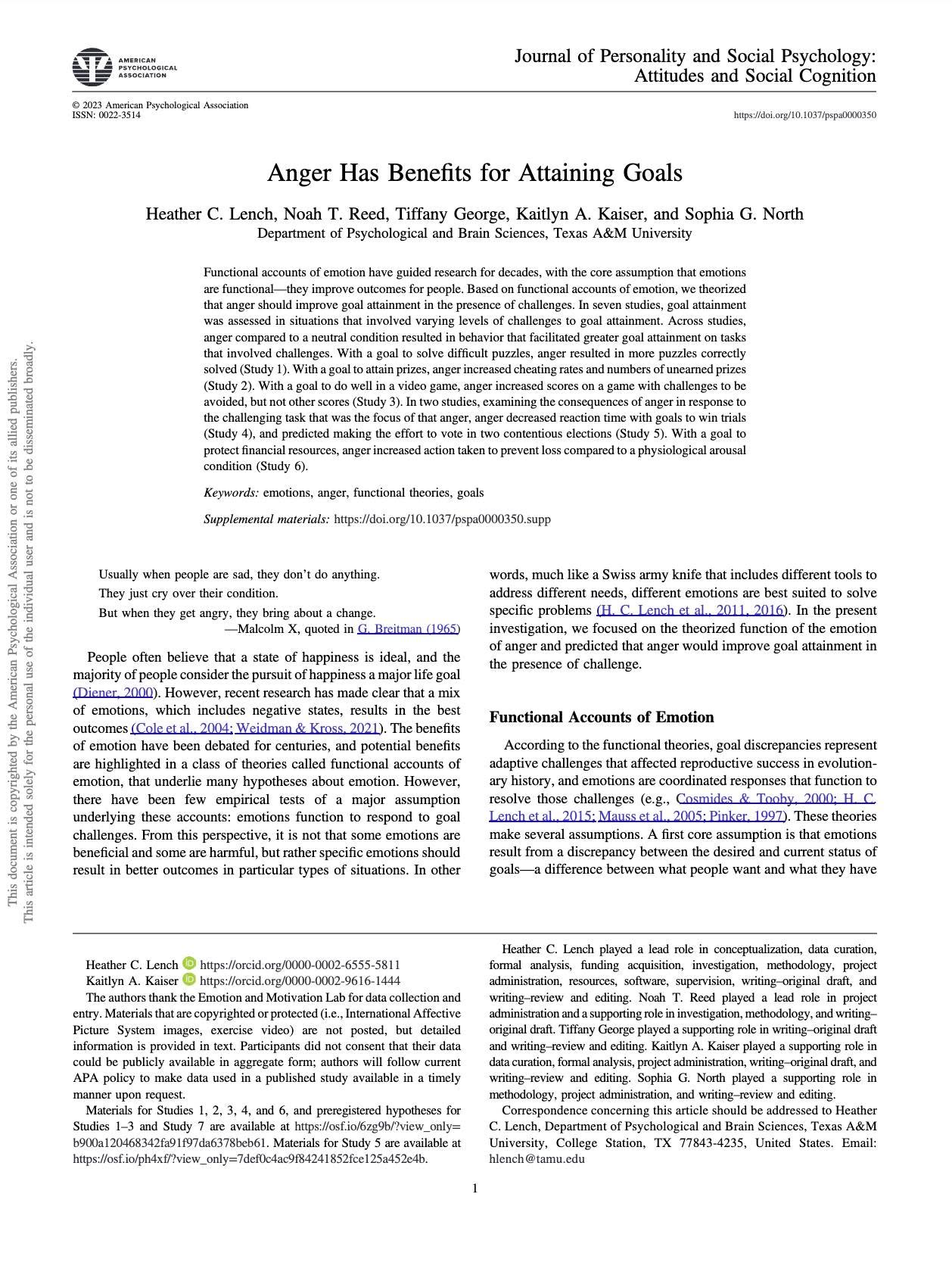
Journal of Personality and Social Psychology: Attitudes and Social Cognition © 2023 American Psychological Association ISSN: 0022-3514 https://doi.org/10.1037/pspa0000350 Anger Has Benefits for Attaining Goals Heather C. Lench, Noah T. Reed, Tiffany George, Kaitlyn A. Kaiser, and Sophia G. North Department of Psychological and Brain Sciences, Texas A&M University Functional accounts of emotion have guided research for decades, with the core assumption that emotions are functional—they improve outcomes for people. Based on functional accounts of emotion, we theorized that anger should improve goal attainment in the presence of challenges. In seven studies, goal attainment was assessed in situations that involved varying levels of challenges to goal attainment. Across studies, anger related to sustained emotion resulted in behavior that facilitated greater goal attainment on tasks that involved challenges. With a goal to solve difficult puzzles, angrier resulted in more puzzles correctly solved (Study 1). When a goal involved prize, angrier increased cheating rates and numbers of unclaimed prizes (Study 2). With a goal to do well in a video game, angrier increased scores on a game with challenges to be avoided, but not on challenges without difficulty (Study 3). In two studies examining the consequences of anger in response to goal blocks, angrier decreased the loss of anger, anger decreased cheating (Study 4), and predicted taking the effort to win in two contexts compared with anger (Study 5). With a goal to prevent nuisances, anger increased task-taken to prevent loss compared to a physiological arousal condition (Study 6). Keywords: emotions, anger, functional theories, goals Supplemental materials: https://doi.org/10.1037/pspa0000350.supp Usually when people are sad, they don't do anything. They just cry over their condition. words, much like a Swiss army knife that includes different tools to address different needs, different emotions are best suited to solve specific problems (H. C. Lench et al., 2011, 2016). In the present investigation, we focused on the theoretical function of the emotion of anger and predicted that anger would improve goal attainment in the presence of a challenge. —Malcolm X, quoted in G. Breitman (1965) People often believe that a state of happiness is ideal, and the majority of people consider the pursuit of happiness a major life goal (Diener, 2000). However, recent research has made clear that a mix of emotions, which includes negative states, results in the best outcomes (Lench et al., 2004; Weidman & Gross, 2021). The benefits of emotion have been debated for centuries, and potential benefits are highlighted in a class of theories called functional accounts of emotion, that underlie many hypotheses about emotion. However, there have been few empirical tests of a major assumption underlying these accounts: emotions function to respond to goal challenges. From this perspective, it is that emotions are beneficial an

本研究のウェルビーイング小話はこちら😊
はぴテク相談室:怒りは、短期的にはパフォーマンスを高めるが、不正の確率が上がり、より自分を守ろう
https://wellbeing-archive.pages.dev/posts/2024-08-16-1723846203/