という韓国の研究。
ーー
●マキシマイザーとサティスファイザーとは
マキシマイザー(最大化戦略):全てのことに最高を追い求める
サティファイザー:ほどほどで満足
という考え方があり、選択肢の多い現代社会において、
マキシマイザーの幸福度が低い。という話があります。
(行動経済学のバリー・シュワルツ先生。)
ーー
●今回の研究:マキシマイザーも集団主義文化では、人生の意味の探索経由で幸せにつながる
でも、マキシマイザーでも幸福度高まる場合もあるのでは?という研究。
で、実際に、恋愛、キャリアの中で、
マキシマイザー(最大化戦略)が幸せに繋がったそうです。(特にキャリア)
何故かというと、
最大化戦略は人生の意味の探索につながる。で、これが幸せにつながる。
とのことでした。
確かに、恋愛もキャリアも向き合うと、自分の人生を考えるキッカケになりそうな。
ーー
●でもそもそも人生の意味の探索は、幸せに効いたり効かなかったり。
ただ、欧米(個人主義)では違う傾向がでそうです。
そもそも人生の意味の探索は、欧米ではむしろ不幸せにつながる場合もあると言われています。
人生の意味をどれだけ経験しているか、は国によらず幸せにつながる。
人生の意味を熱心に追い求める、は欧米(個人主義)では影響小さいし場合によっては不幸せ、集団主義だと幸せにつながる。
Li, J.-B., Dou, K., & Liang, Y. (2021)
人生の意味を追い求めるのは、ほどほどが良いのかなと思います。
個人主義だとそもそも意味を追い過ぎちゃうから、追わない方が幸せ。
集団主義だと追わなすぎるので、追った方が幸せ。
なのかなと。
ーー
●個人的感想
結局は、サティスファイザー過ぎても、マキシマイザー過ぎても、よろしくなく。
適度に最高を追い求めつつも、一定で満足。というのが幸せなんだろうなぁと思います😊
(オススメは期限を決めてマキシマイザー、期限が来たらサティスファイザー。作戦。
例えば家電を買うときは、2時間は色々調べて最高の一品を探す。
2時間過ぎたら、その時点で最高なやつを買って、その製品を愛する。みたいな。)
ーーー
■マキシマイザーとサティスファイザーの以前の投稿
「不満な人生を送る人」と「楽しい人生を送る人」、たった1つの考え方の差
→サティスファイザーは幸せだよ〜という話。
https://www.facebook.com/share/p/oSDCWGwhkwJBEwww/
コロナ時代のマキシマイザーとサティスファイザーのウェルビーイング、最新研究
→でもマキシマイザーにも良いところあるよ〜という話。
https://www.facebook.com/share/p/ez9MDMxozeDioEcE/
ーーー
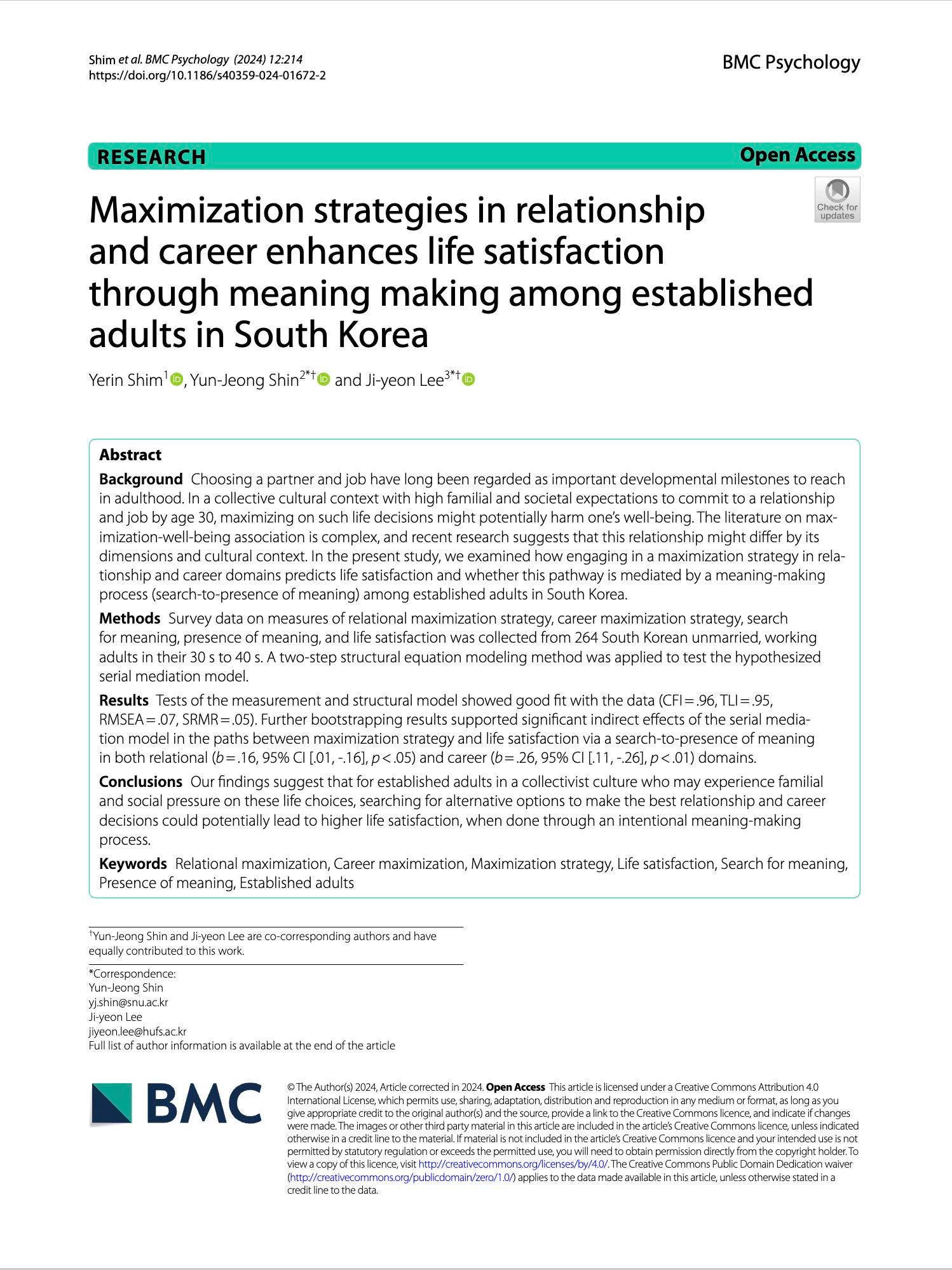
人間関係とキャリアにおける最大化戦略が、韓国の成人における意味づけを通じて人生の満足度を高める
Maximization strategies in relationship and career enhances life satisfaction through meaning making among established adults in South Korea
BMC Psychology,2024/4/17
https://www.ncbi.nlm.nih.gov/pmc/articles/PMC11025140/
この研究は、韓国の30代から40代の未婚の成人を対象に、恋愛関係とキャリアにおける最大化戦略が人生満足度に与える影響と、その過程における意味づけの役割を検討したものです。主な結果は以下の通りです:
①恋愛関係とキャリアの両方の領域で、最大化戦略は意味の探索を介して人生の意味の存在感を高め、それが人生満足度の向上につながることが示されました。
②キャリアの最大化戦略の方が、恋愛関係の最大化戦略よりも意味の探索との関連が強いことがわかりました。
③集団主義的な文化背景を持つ韓国では、30代、40代の確立された成人が恋愛やキャリアの選択においてより良い選択肢を探すことで、むしろ人生の満足度が高まる可能性が示唆されました。
④これらの結果は、最大化戦略が必ずしも幸福度を下げるわけではなく、意味づけのプロセスを通じて人生満足度を高める可能性があることを示しています。
この研究は、文化的背景や発達段階を考慮しながら、最大化戦略と幸福度の関係をより詳細に理解する上で重要な示唆を提供しています。
Shim et al. BMC Psychology (2024) 12:214 https://doi.org/10.1186/s40359-024-01672-2 BMC Psychology RESEARCH Open Access Maximization strategies in relationship and career enhances life satisfaction through meaning making among established adults in South Korea Yerin Shim¹ , Yun-Jeong Shin²*† and Ji-yeon Lee³*† Abstract Background: Choosing a partner and job have long been regarded as important developmental milestones to reach in adulthood. In a collective cultural context with high familial and societal expectations to commit to a relationship and job by age 30, maximizing on such life decisions might potentially harm one's well-being. The literature on max- imization-well-being association is complex, and recent research suggests that this relationship might differ by its dimensions and cultural context. In the present study, we examined how engaging in a maximization strategy in rela- tionship and career domains predicts life satisfaction and whether this pathway is mediated by a meaning-making process (search-to-presence of meaning) among established adults in South Korea. Methods: Survey data on measures of relational maximization strategy, career maximization strategy, search for meaning, presence of meaning, and life satisfaction was collected from 264 South Korean unmarried, working adults in their 30 s to 40 s. A two-step structural equation modeling method was applied to test the hypothesized serial mediation model. Results: Tests of the measurement and structural models showed good fit with the data (CFI = .96, TLI = .95, RMSEA = .07, SRMR = .05). Further bootstrapping results supported significant indirect effects of the serial media- tion model in the paths between maximization strategy and life satisfaction via a search-to-presence of meaning in both relational (β = .16, 95% CI [.01, .16], p< .05) and career (β = .26, 95% CI [.11, .26], p < .01) domains. Conclusions: Our findings suggest that for established adults in a collective culture who may experience familial and social pressure on these life choices, searching for alternative options to make the best relationship and career decisions could potentially lead to higher life satisfaction, when done through an intentional meaning-making process. Keywords: Relational maximization, Career maximization, Maximization strategy, Life satisfaction, Search for meaning, Presence of meaning, Established adults †Yun-Jeong Shin and Ji-yeon Lee are co-corresponding authors and have equally contributed to this work. *Correspondence: Yun-Jeong Shin yjshin@hufs.ac.kr Ji-yeon Lee jiyeon.lee@hu.ac.kr Full list of author information is available at the end of the article BMC © The Author(s) 2024. Article corrected in 2024. Open Access This article is licensed under a Creative Commons Attribution 4.0 International License, which permits use, sharing, adaptation, distribution and reproduction in any medium or format, as long as you give appropriate credit to the original author(s) and the source, pro
本研究のウェルビーイング小話はこちら😊
はぴテク相談室:マキシマイザーも集団主義文化だと幸せだ
https://wellbeing-archive.pages.dev/posts/2024-06-28-1719615084/