2024.04.18
タッチとウェルビーイング
のメタ論文(色んな論文をまとめたもの)。natureより。
マッサージ、もしくは近しい人であれば、ギュっとするのは大事ですね😍
マッサージも1回の時間より頻度が効いてきそうなので、サブスク式のそんなマッサージ店があっても良さそう。
柔道とか柔術とかレスリングも効くのかな?実感値としては、取っ組み合いは効きそうです😊(憎しみあっての取っ組み合いではなく、ライオンのじゃれ合いみたいな。)
ーー
・全体として、"触れる"という介入は身体的・精神的ウェルビーイングに中程度の効果があった。
ー
●大人
・大人では、痛み、うつ、不安の改善に特に効果的だった。
・元気な人より、落ち込んでいる人の方が効く
・時間よりも頻度が大事。
・頭部はより効果的。(頭皮マッサージとか良さそう)
・ゆっくりとしたリズミカルなタッチは、ストレス緩和に特に効く。
・大人は、近しい人以外でも専門家(医療、マッサージ師)でも、同様に効果的。
・ロボや人工物は、今後の研究に期待。
(現状だと、人間とのタッチより効果が低い。でも、先日紹介したようにぬいぐるみのウェルビーイング効果なんかもありますね😊)
ー
●新生児
・新生児では、コルチゾールの調整と体重増加に特に効果があった。
・新生児では、親が行った方が効果的
ーーー
タッチ介入による身体的および精神的健康上の利点に関する系統的レビューと多変量メタ分析
A systematic review and multivariate meta-analysis of the physical and mental health benefits of touch interventions
2024/4/8,nature human behaviour
https://www.nature.com/articles/s41562-024-01841-8
多くの研究で、タッチが精神的および肉体的な健康を促進することが示されているため、タッチを受け取ることは非常に重要です。私たちは、事前登録された(PROSPERO: CRD42022304281)システマティックレビューとマルチレベルメタアナリシスを実施しました。これには、メタアナリシスの137件の研究とシステマティックレビューの75件の追加研究が含まれます(n = 12,966人、Google Scholar、PubMed、Web of Scienceで検索) 2022 年 10 月 1 日まで)タッチ介入の有効性を低下させる重要な要因を特定します。含まれる研究では常に、従属変数として多様な健康結果を伴うタッチとタッチなしの制御介入が取り上げられていました。
バイアスのリスクは、小規模な研究、ランダム化、順序付け、パフォーマンス、および減少のバイアスを通じて評価されました。
接触介入は、新生児のコルチゾール値の調節 (ヘッジズg = 0.78、95% 信頼区間 (CI) 0.24 ~ 1.31) と体重の増加 (0.65、95% CI 0.37 ~ 0.94)、および痛みの軽減 (0.69) に特に効果的でした。
成人の場合、抑うつ感(0.59、95% CI 0.40 ~ 0.78)および状態(0.64、95% CI 0.44 ~ 0.84)または特性不安(0.59、95% CI 0.40 ~ 0.77)。
物体やロボットを使ったタッチ介入を比較すると、身体的健康上の利点は同様でしたが(0.56、95% CI 0.24 ~ 0.88 対 0.51、95% CI 0.38 ~ 0.64)、精神的健康上の利点は低かった(0.34、95% CI 0.19 ~ 0.49 対 0.58、95% CI 0.43~0.73)。
成人臨床コホートは、健康な人と比較して、メンタルヘルス領域でより大きな利益をもたらしました(0.63、95% CI 0.46 ~ 0.80 対 0.37、95% CI 0.20 ~ 0.55)。
身近な人や医療専門家によるタッチを比較した場合、成人の健康上の利点に差は見られませんでしたが(0.51、95% CI 0.29 ~ 0.73 対 0.50、95% CI 0.38 ~ 0.61)、
新生児では親によるタッチの方が有益でした。 (0.69、95% CI 0.50 ~ 0.88 対 0.39、95% CI 0.18 ~ 0.61)。
小さいながらも重大な小さな研究バイアスと実験条件を盲検化することの不可能性を考慮する必要があります。タッチ介入の有効性に影響を与える要因を活用することで、将来の介入の利点を最大化し、この分野の研究に焦点を当てることができます。
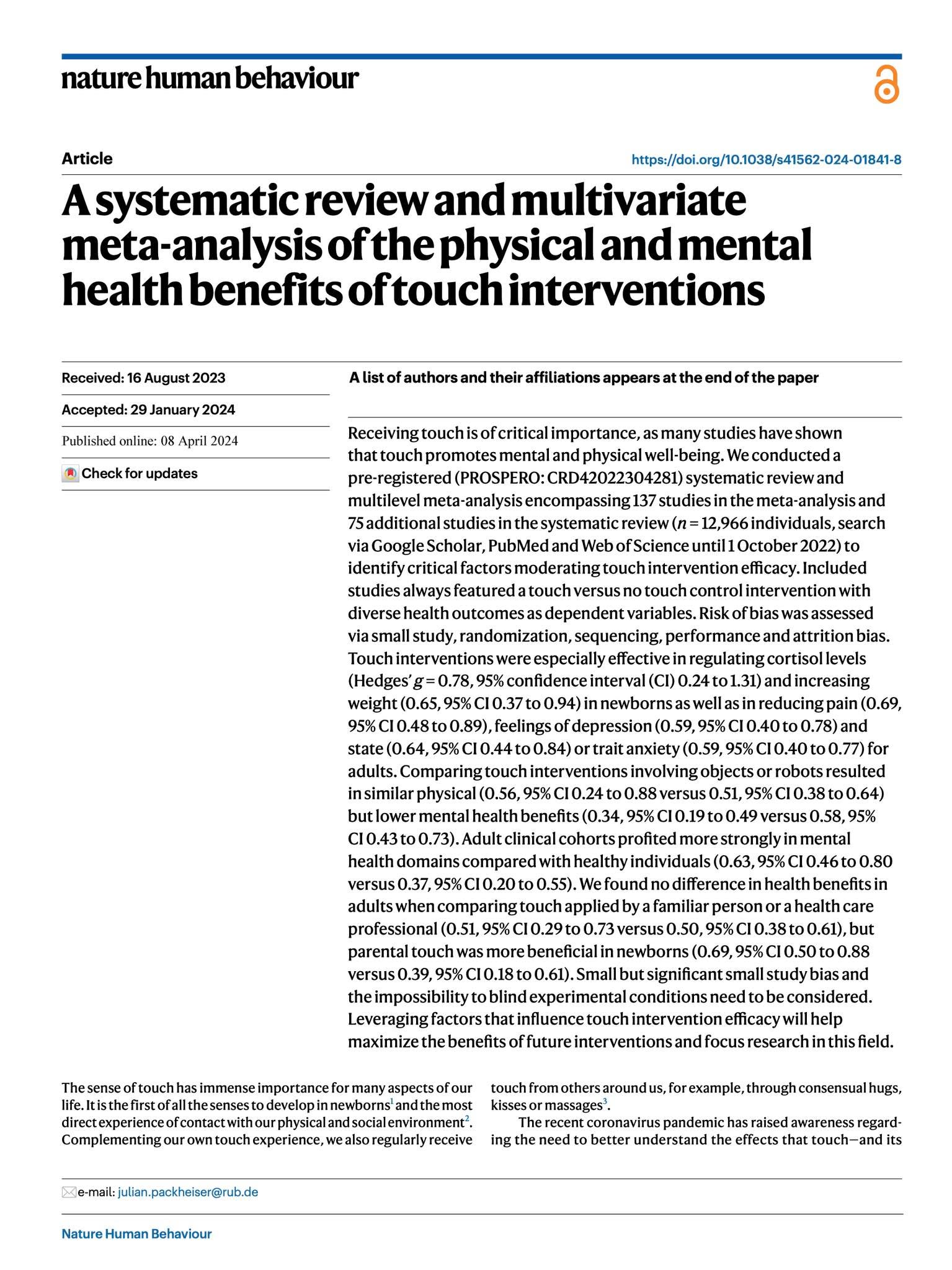
nature human behaviour Article https://doi.org/10.1038/s41562-024-01841-8 A systematic review and multivariate meta-analysis of the physical and mental health benefits of touch interventions Received: 16 August 2023 A list of authors and their affiliations appears at the end of the paper Accepted: 29 January 2024 Published online: 08 April 2024 Check for updates Receiving touch is of critical importance, as many studies have shown that touch promotes mental and physical well-being. We conducted a pre-registered (PROSPERO: CRD42022304281) systematic review and multilevel meta-analysis encompassing 137 studies in the meta-analysis and 73 additional studies in the systematic review (n = 12,966 individuals, search via Google Scholar, PubMed and Web of Science until 1 October 2022) to identify critical factors moderating touch intervention efficacy. Included studies always featured a touch versus no touch control intervention with diverse health outcomes as dependent variables. Risk of bias was assessed via small study, randomization, sequencing, performance and attrition bias. Touch interventions were especially effective in regulating cortisol levels (Hedges g = 0.78, 95% confidence interval (CI) 0.24 to 1.31) and increasing weight (0.65, 95% CI 0.37 to 0.94) in newborns as well as in reducing pain (0.69, 95% CI 0.48 to 0.89), feelings of depression (0.59, 95% CI 0.40 to 0.78) and state (0.64, 95% CI 0.44 to 0.84) or trait anxiety (0.59, 95% CI 0.40 to 0.77) for adults. Comparing touch interventions involving objects or robots resulted in similar physical (0.52, 95% CI 0.24 to 0.88 versus 0.51, 95% CI 0.38 to 0.64) but lower mental health benefits (0.34, 95% CI 0.19 to 0.49 versus 0.58, 95% CI 0.43 to 0.73). Adult clinical cohorts profited more strongly in mental health domains compared with healthy individuals (0.63, 95% CI 0.46 to 0.80 versus 0.37, 95% CI 0.20 to 0.55). We found no difference in health benefits in adults when comparing touch applied by a familiar person or a health care professional (0.51, 95% CI 0.29 to 0.73 versus 0.50, 95% CI 0.38 to 0.61), but parental touch was more beneficial in newborns (0.69, 95% CI 0.50 to 0.88 versus 0.39, 95% CI 0.18 to 0.61). Small but significant small study bias and the impossibility to blind experimental conditions need to be considered. Leveraging factors that influence touch intervention efficacy will help maximize the benefits of future interventions and focus research in this field. The sense of touch has immense importance for many aspects of our life. It is the first of all the senses to develop in newborns¹ and the most direct experience of contact with our physical and social environment². Complementing our own touch experience, we also regularly receive touch from others around us, for example, through consensual hugs, kisses or massages³. The recent coronavirus pandemic has raised awareness regarding the need to better understand the effects that touch—and its e-mail: julian.packheiser@rub