2024.04.18
怒りは発散させるよりも、チルが大事。
怒りを収めるのに、
覚醒度を上げる取り組み(バッグを叩く、サンドバッグを叩く、運動等:カタルシス)、
覚醒度を下げる取り組み(深呼吸、マインドフルネス、瞑想:チル)、
どっちが良いの?
のメタ論文。
ー
結論としては、
覚醒度下げる取り組みは有効で、覚醒度上げる取り組みは全体としては有意な効果が出ていない。
とのこと。
性別、人種、年齢、文化などに寄らず。
ー
ただ、覚醒度上げる取り組みも、効果があったり、なかったりしていて、全く効果がない訳ではないです。
ジョギングは怒りを高めたり、ボールスポーツやエアロビは怒りを減らしたり。と良く分からない結果が出ていたり。
なので、あくまで覚醒度上げる取り組みは、今後も検討が必要。といった所。
ー
うーん、私もエクセルで幸せのデータ分析をゴリゴリやった後に、
エクセルが落ちたときとか、「あー」って大声を出して気持ちを切り替えていたのですが、あまり良くないのかな。。。
チル系にしようかな。
ーーー
A meta-analytic review of anger management activities that increase or decrease arousal: What fuels or douses rage?
覚醒を増減させるアンガーマネジメント活動のメタ分析レビュー:何が怒りを煽るのか、煽らないのか?
2024/4,Clinical Psychology Review
https://www.sciencedirect.com/science/article/pii/S0272735824000357
怒りは不快な感情であり、ほとんどの人がそれを取り除きたいと願っている。アンガーマネジメントの活動には、覚醒を減少させることに焦点を当てたもの(例:深呼吸、マインドフルネス、瞑想)もあれば、覚醒を増加させることに焦点を当てたもの(例:バッグを叩く、ジョギング、サイクリング)もある。このメタ分析レビューでは、10,189人の参加者を含む184の独立サンプルを含む154の研究に基づいて、両方のタイプの活動の有効性を検証した。
その結果、覚醒度を低下させる活動は怒りと攻撃性を低下させることが示され(g= -0.63, [-0.82, -0.43])、その結果は頑健であった。性別、人種、年齢、文化が異なる参加者においても、その効果は経時的に安定していた。覚醒度低減活動は、学生と非学生、犯罪者と非犯罪者、知的障害の有無にかかわらず有効であった。覚醒を低下させる活動は、提供方法(デジタルプラットフォーム、研究者、セラピストなど)に関係なく、グループセッションでも個人セッションでも、また野外でも実験室でも効果的であった。
対照的に、覚醒度を高める活動は全体的に効果がなく(g= -0.02, [-0.13, 0.09])、異質で複雑であった。これらの知見は、怒りを発散したり走ったりすることが効果的なアンガーマネジメント活動であるという考えを支持するものではない。怒りを管理するためのより効果的なアプローチは、「熱を下げる」こと、つまり覚醒を減少させる活動に従事することで気持ちを落ち着かせることである。
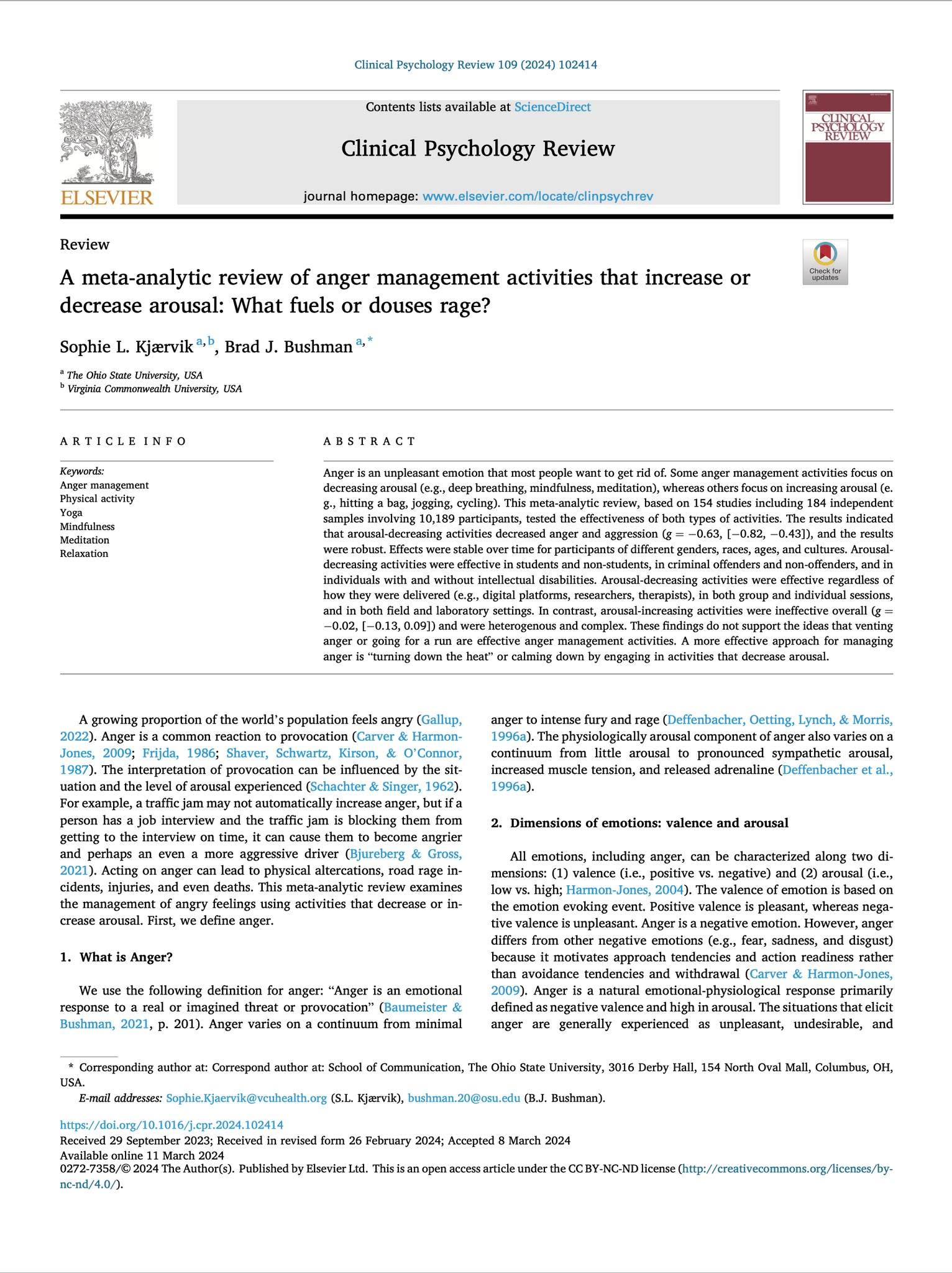
Clinical Psychology Review 109 (2024) 102414 Contents lists available at ScienceDirect Clinical Psychology Review journal homepage: www.elsevier.com/locate/clinpsychrev Review A meta-analytic review of anger management activities that increase or decrease arousal: What fuels or douses rage? Sophie L. Kjervik a,b, Brad J. Bushman a,* a The Ohio State University, USA b Virginia Commonwealth University, USA ARTICLE INFO Keywords: Anger management Physical activity Yoga Mindfulness Meditation Relaxation ABSTRACT Anger is an unpleasant emotion that most people want to get rid of. Some anger management activities focus on decreasing arousal (e.g., deep breathing, mindfulness, meditation), whereas others focus on increasing arousal (e. g., hitting a bag, jogging, venting). This meta-analytic review, based on 154 studies including 146 independent samples (N = 10,656), examined the efficacy of anger management activities varying in arousal. Results showed that arousal-decreasing activities decreased anger and aggression (g = −0.63, [−0.82, −0.43]), and the results were robust. There were cubic time for participants of different genders, races, ages, and cultures. Arousal- decreasing activities were effective in students and non-students, in criminal offenders and non-offenders, and in individuals with and without intellectual disabilities. Arousal-decreasing activities were effective regardless of how they were delivered (e.g., digital platforms, researchers, therapists), in both group and individual sessions, and in both field and laboratory settings. In contrast, arousal-increasing activities were ineffective overall (g = −0.02, [−0.13, 0.09]) and were heterogeneous and complex. These results provide robust support for the idea that venting anger does not "let off steam" or provide anger management activities. A more effective approach for managing anger is "turning down the heat" of calming down by engaging in activities that decrease arousal. A growing proportion of the world's population feels angry (Gallup, 2022). Anger is a common reaction to provocation (Carver & Harmon- Jones, 2009; Prisco, 1986; Shaver, Schwartz, Kirson, & O'Connor, 1987). The interpretation of provocation can be influenced by the sit- uation and the level of personal experienced closedness (Shaver, 1962). For example, a traffic jam may not automatically increase anger, but if a person has a job interview and the traffic jam is blocking them from getting to the interview on time, it can cause them to become angrier and peeked as more a more aggressive driver (Bushman & Gross, 2023). Acting on anger can lead to physical alterations, road rage in- cidents, injuries, and even death. This meta-analytic review examines the management of anger feelings using activities that decrease or in- crease arousal. First, we define anger. 2. Dimensions of emotions: valence and arousal All emotions, including anger, can be characterized along two di- mensions: (1) valence (i.e., positive vs. neg

最近の怒りについての研究
怒りを完全に手放す方法〜紙に書いて、ポイ!〜
https://www.facebook.com/groups/wellbeinginfo/permalink/1646485196162172/
最近の怒りについての研究
スマナサーラ長老に聞く、アンガーマネジメント
https://www.facebook.com/groups/wellbeinginfo/permalink/1647606526050039/
ちょっと昔ですが、こんな記事も。
イライラと怒りの区別、およびそれらと衝動性および主観的幸福との関連
→衝動性は幸福度を落とすが、自分の気持ちに気付くという点は幸福度を高める。
https://www.facebook.com/groups/wellbeinginfo/permalink/1487184352092258/