2024.03.03
性格と幸福度の関係性を時間軸で見るとー知的好奇心が未来の幸せをつくるー
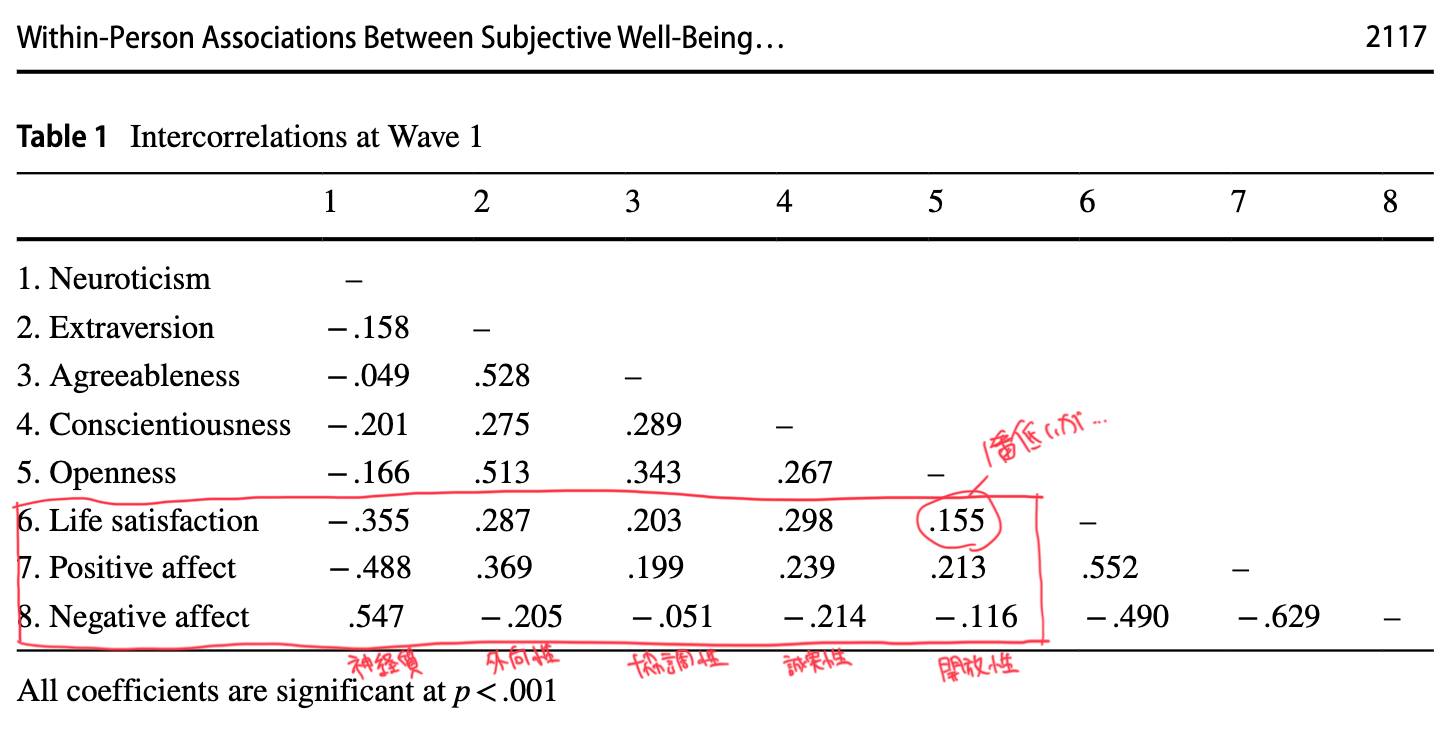
性格(ビッグ5)と幸福度は相関がある。というのはよくある話で、
神経質傾向が小さくて、外向的で、協調的で、誠実で、開放的(何事も面白がれる)と幸せ。
ー
でも、それは、沢山の人に聞くと、
より神経質傾向が小さい人の方が、幸せと答える。という傾向。
なので、それを約20年に渡って追いかけ調査するとどうなるか。
性格が将来の幸せを予想するのか、幸せが将来の性格を予想するのか。
ー
すると、
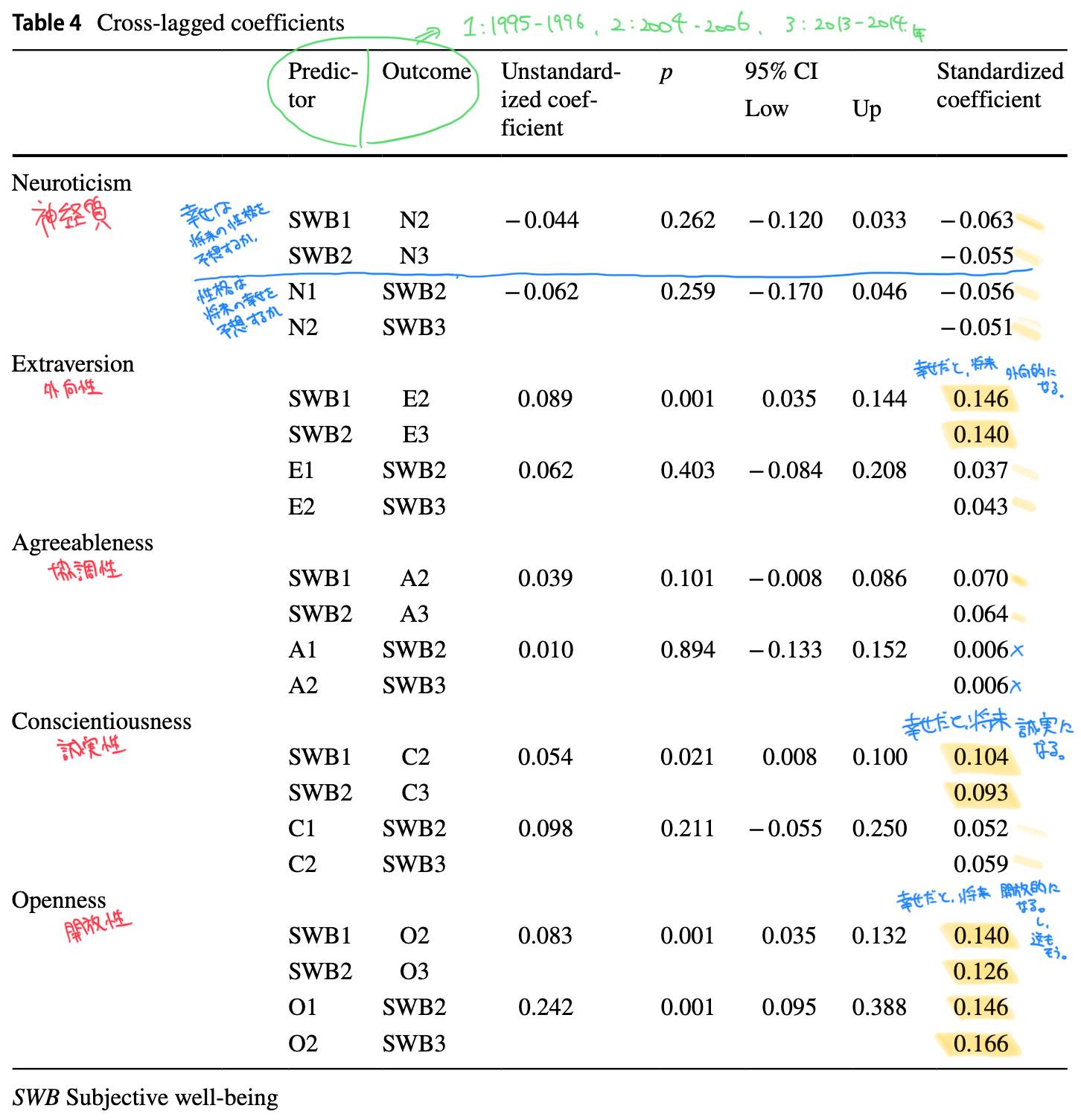
今の性格→未来の幸福。よりも、今の幸福→未来の性格。の方が影響が大きいことが分かった。
(もちろん、今の性格→将来の幸福の影響もありますが。)
ーー
で、特に、↓の影響が大きい。
①
今、幸せだと、
将来、外向的で、誠実で、開放的(何事も面白がれる)になる。
②
今、開放的(何事も面白がれる)だと、
将来幸せになる。
ー
とのことで、開放性(何事も面白がれる)って、凄いですね😊
何事も、面白がる。どんなことにも、面白ポイントを見つけ出す力は、将来の幸せのために大切です❗
し、今幸せな人は、将来何事も面白がれるでしょう😊
ーー
昨年の論文ですが、原文を見つけたので、シェアします。(DLは出来ないけど。)
ーーー
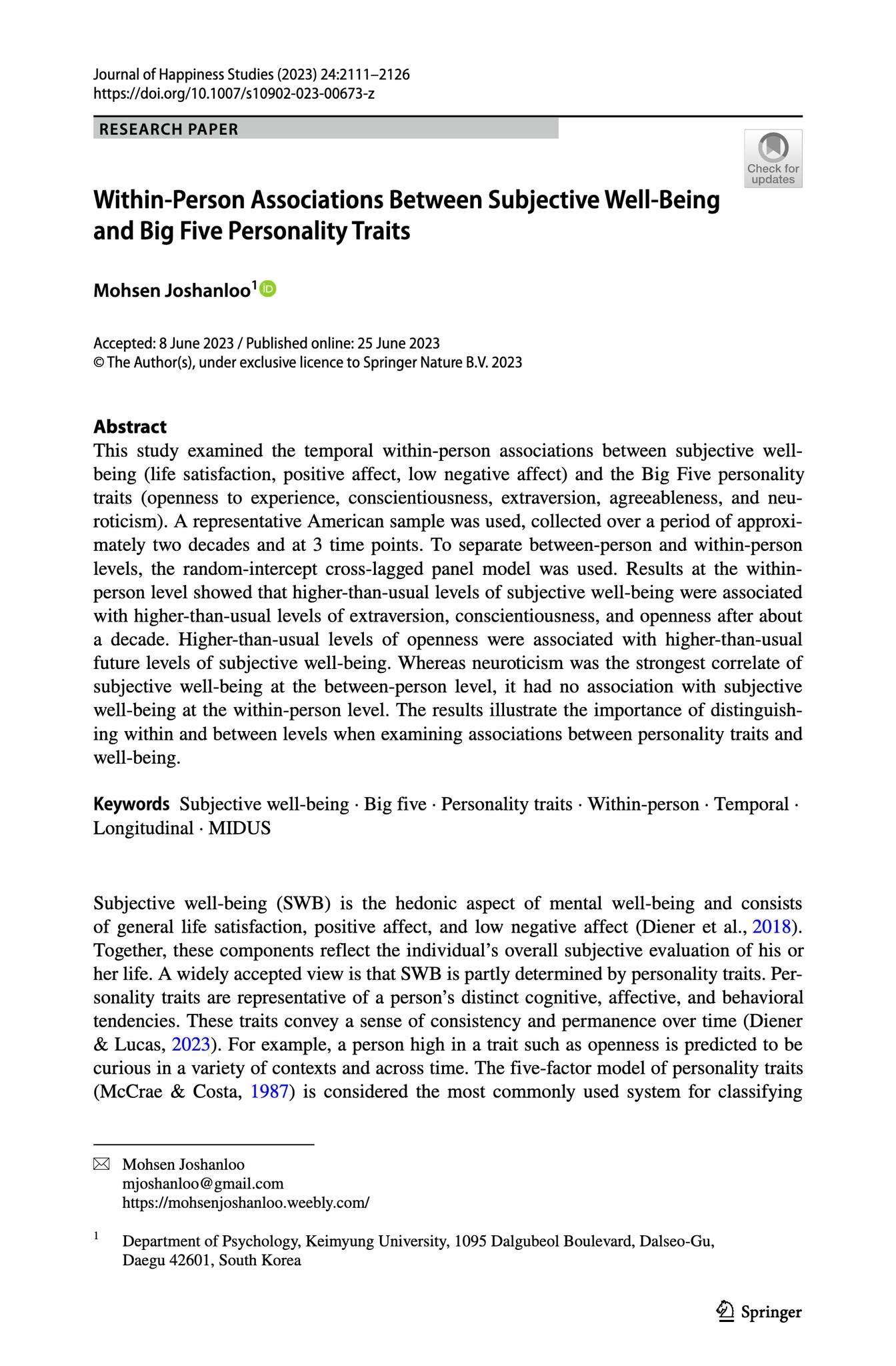
主観的幸福感とビッグファイブ性格特性との間の個人内関連
Within-Person Associations Between Subjective Well-Being and Big Five Personality Traits
2023/6/25,Journal of happiness study
https://link.springer.com/article/10.1007/s10902-023-00673-z
↓論文
https://link.springer.com/epdf/10.1007/s10902-023-00673-z?sharing_token=6KllBeuL051x8d_lTS03Vfe4RwlQNchNByi7wbcMAY6-rXr8Lq2-tl1i4RIzKZOs4oylJUCuOXwG6uYWxvRd9oUtdIz6PKssdfc02yf5TLioZYQu-ZDYq74PuGJo2UF_qjYlq71FkiIc_-i5gxl7Co6QyPNRdqFq_VIbftSoHII%3D
要旨
本研究では、主観的幸福感(生活満足度、肯定的感情、否定的感情の低さ)とビッグファイブ性格特性(経験に対する開放性、良心性、外向性、同意性、神経質性)との間の時間的な個人内関連を調べた。
アメリカの代表的なサンプルを使用し、約20年にわたり、3つの時点で収集された。
個人間レベルと個人内レベルを分離するために、ランダム切片クロスラグ・パネルモデルが用いられた。
個人内レベルの結果は、主観的幸福度が通常より高いほど、約10年後に外向性、良心性、開放性のレベルが通常より高くなることと関連していた。
開放性の水準が通常より高いことは、主観的幸福の将来の水準が通常より高いことと関連していた。
神経症は、個人間レベルでは主観的幸福感の最も強い相関を示したが、個人内レベルでは主観的幸福感との関連を示さなかった。
この結果は、性格特性と幸福との関連を検討する際に、レベル内とレベル間を区別することの重要性を示している。
Table 4 Cross-lagged coefficients 1:1995-1996 2:2004-2006 3:2013-2a0ft Predictor | Outcome | Unstandardized coefficient | p | 95% CI Low | Up | Standardized coefficient Neuroticism 神経症 SWB1 | N2 | -0.044 | 0.262 | -0.120 | 0.033 | -0.063 SWB2 | N3 | | | | | -0.055 N1 | SWB2 | -0.062 | 0.259 | -0.170 | 0.046 | -0.056 N2 | SWB3 | | | | | -0.051 Extraversion 外向性 SWB1 | E2 | 0.089 | 0.001 | 0.035 | 0.144 | 0.146 SWB2 | E3 | | | | | 0.140 E1 | SWB2 | 0.062 | 0.403 | -0.084 | 0.208 | 0.037 E2 | SWB3 | | | | | 0.043 Agreeableness 協調性 SWB1 | A2 | 0.039 | 0.101 | -0.008 | 0.086 | 0.070 SWB2 | A3 | | | | | 0.064 A1 | SWB2 | 0.010 | 0.894 | -0.133 | 0.152 | 0.006 A2 | SWB3 | | | | | 0.006 Conscientiousness 勤勉性 SWB1 | C2 | 0.054 | 0.021 | 0.008 | 0.100 | 0.104 SWB2 | C3 | | | | | 0.093 C1 | SWB2 | 0.098 | 0.211 | -0.055 | 0.250 | 0.052 C2 | SWB3 | | | | | 0.059 Openness 開放性 SWB1 | O2 | 0.083 | 0.001 | 0.035 | 0.132 | 0.140 SWB2 | O3 | | | | | 0.126 O1 | SWB2 | 0.242 | 0.001 | 0.095 | 0.388 | 0.146 O2 | SWB3 | | | | | 0.166 SWB Subjective well-being Within-Person Associations Between Subjective Well-Being… 2117 Table 1 Intercorrelations at Wave 1 1 2 3 4 5 6 7 8 1. Neuroticism − 2. Extraversion −.158 − 3. Agreeableness −.049 .528 − 4. Conscientiousness −.201 .275 .289 − 5. Openness −.166 .513 .343 .267 − 6. Life satisfaction −.355 .287 .203 .298 .155 − 7. Positive affect −.488 .369 .199 .239 .213 .552 − 8. Negative affect .547 −.205 −.051 −.214 −.116 −.490 −.629 − All coefficients are significant at p < .001 Journal of Happiness Studies (2023) 24:2111–2126 https://doi.org/10.1007/s10902-023-00673-z RESEARCH PAPER Within-Person Associations Between Subjective Well-Being and Big Five Personality Traits Mohsen Joshanloo Accepted: 8 June 2023 / Published online: 25 June 2023 © The Author(s), under exclusive licence to Springer Nature B.V. 2023 Abstract This study examined the temporal within-person associations between subjective well- being (life satisfaction, positive affect, low negative affect) and the Big Five personality traits (openness to experience, conscientiousness, extraversion, agreeableness, and neu- roticism). A representative American sample was used, collected over a period of approxi- mately two decades at 3 time points. To separate between-person and within-person levels, the random-intercept cross-lagged panel model was used. Results at the within- person level showed that higher-than-usual levels of subjective well-being were associated with higher-than-usual levels of extraversion, conscientiousness, and openness after about a decade. Higher-than-usual levels of openness were associated with higher-than-usual future levels of subjective well-being. Whereas neuroticism was the strongest correlate of subjective well-being at the between-person level, it had no association with subjective well-being at the within-person level. The results illustrate the importance of distinguish- ing within and between personality levels when examining associat
本研究のウェルビーイング小話はこちら😊
はぴテク相談室:性格と幸福度の関係性を時間軸で見るとー知的好奇心が未来の幸せをつくるー
https://wellbeing-archive.pages.dev/posts/2024-03-03-1709461228/