2024.01.21
リモートワーク時代のインクルーシブなリーダーシップ行動
インクルーシブ・リーダーシップとは、
周囲の社員の資質・能力を引き出し、組織全体の力を向上させるリーダーシップ。
支配型のリーダーシップや、サーバントリーダーシップとは異なります。
なお、インクルーシブ・リーダーシップは、組織の成果やWell-Beingによい影響をもたらすことが知られています。
そんなインクルーシブなリーダーシップを、リモートワークという難しい環境で、
どう発揮するか。という論文。
インクルーシブなリーダーとメンバー(フォロワー)へのインタビューを元にした質的研究です😊
ー
結論は↓。
■4つのインクルーシブなリーダーシップ行動
①メンバーの仕事に気づき、認め、評価する
②意思決定にメンバーを巻き込む
③メンバーの帰属意識を高めるために、つながりと歓迎の雰囲気を育む
④メンバーのユニークな資質やニーズに基づき、メンバーをサポートする
→これなんですよねぇ・・・どれも幸せの4つの因子につながる。
ただ、これをやるだけ。で、凄まじい効果がでます。
ー
■リモートワーク時代の難しさ
①会っていなさが、個人の貢献に対する認識と支援を妨げている
②物理的な分散が帰属意識と信頼構築を妨げる
③家庭と職場の境界線の崩壊と孤独が幸福に負担をかける
ー
■じゃあ、どうやって乗り越えるの?
①メンバーとつながり、メンバーを認識するための新しいツールやフォーマットを試験的に導入する
(zoomやチャットツールなどを、上手く利用する。)
②新しい共感的な方法でメンバーとの関わり方を調整する
(より定期的に連絡を取る、頻繁に1対1の会話をする)
③メンバーの意見に応じて、行動を調整する
(メンバーからのフィードバックを受ける)
④メンバーのメンタルヘルスケアを責務に組み込む
ーーー
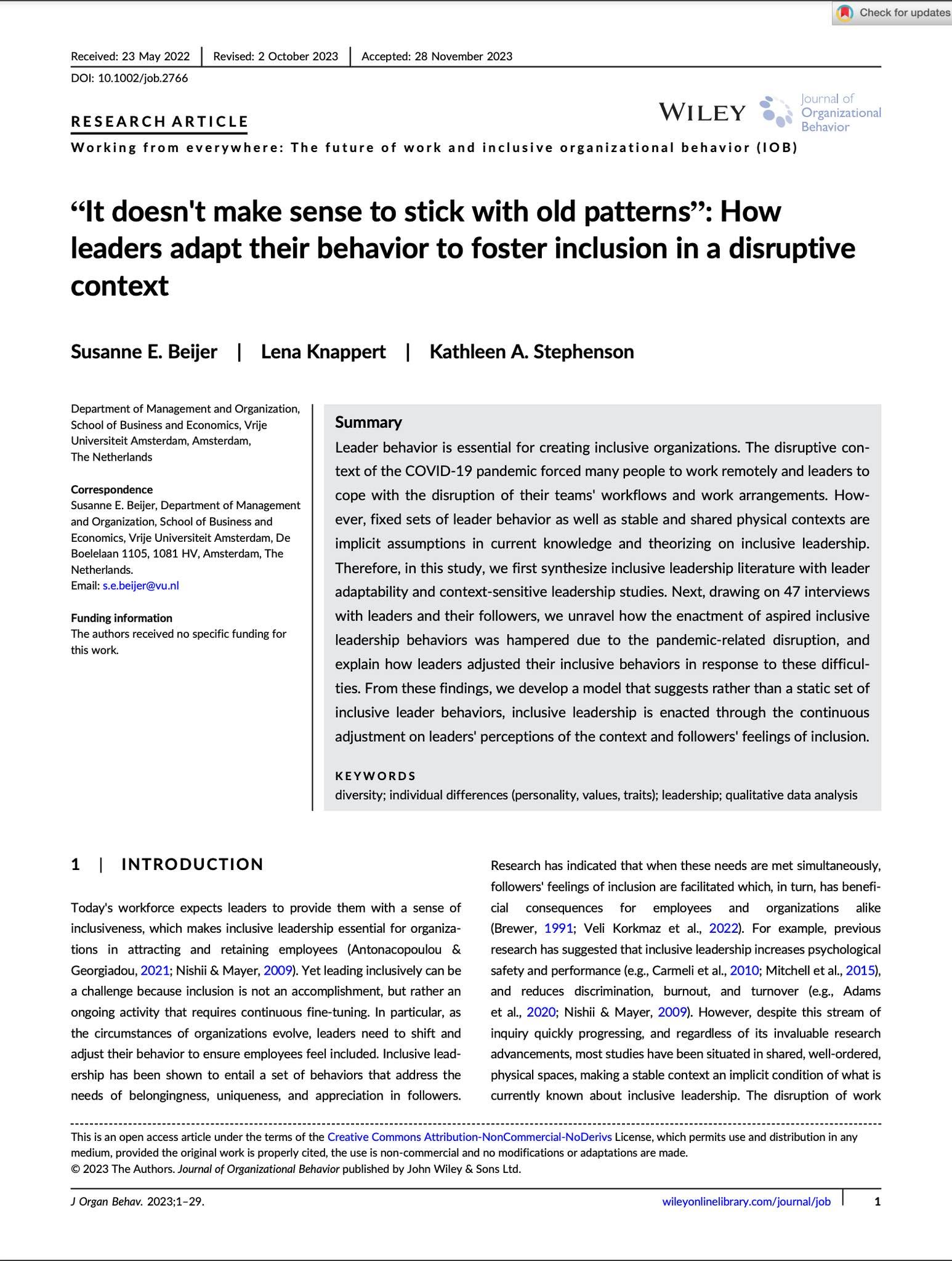
“It doesn't make sense to stick with old patterns”: How leaders adapt their behavior to foster inclusion in a disruptive context
「古いパターンに固執するのは意味がありません」: 破壊的な状況でのインクルーシブを促進するためにリーダーがどのように行動を適応させるか
2024/1/2,Journal of Organizational Behavior
https://onlinelibrary.wiley.com/doi/10.1002/job.2766
インクルーシブ(包括的)な組織を作るためには、リーダーの行動が不可欠である。COVID-19の大流行という破壊的な状況下では、多くの人々がリモートワークを余儀なくされ、リーダーはチームのワークフローや仕事の取り決めの混乱に対処しなければならなかった。しかし、リーダーの行動の固定的なセットや、安定し共有された物理的なコンテクストは、インクルーシブ・リーダーシップに関する現在の知識や理論化の暗黙の前提となっている。
そこで本研究では、まずインクルーシブ・リーダーシップに関する文献を、リーダーの適応性や文脈に敏感なリーダーシップに関する研究と統合する。
次に、リーダーとそのフォロワーとの47件のインタビューをもとに、パンデミックに関連した混乱によって、インクルーシブ・リーダーシップの望ましい行動の実践がどのように妨げられたかを解明し、こうした困難に対応してリーダーがどのようにインクルーシブな行動を調整したかを説明する。
これらの知見から、静的な一連の包括的リーダー行動ではなく、文脈に対するリーダーの認識とフォロワーの包括的感情に関する継続的な調整を通じて、包括的リーダーシップが実現されることを示唆するモデルを構築する。
Received: 23 May 2022 | Revised: 2 October 2023 | Accepted: 28 November 2023 DOI: 10.1002/job.2766 RESEARCH ARTICLE Working from everywhere: The future of work and inclusive organizational behavior (IOB) "It doesn't make sense to stick with old patterns": How leaders adapt their behavior to foster inclusion in a disruptive context Susanne E. Beijer | Lena Knappert | Kathleen A. Stephenson Department of Management and Organization, School of Business and Economics, Vrije Universiteit Amsterdam, Amsterdam, The Netherlands Correspondence Susanne E. Beijer, Department of Management and Organization, School of Business and Economics, Vrije Universiteit Amsterdam, De Boelelaan 1105, 1081 HV, Amsterdam, The Netherlands. Email: s.e.beijer@vu.nl Funding information The authors received no specific funding for this work. Summary Leader behavior is essential for creating inclusive organizations. The disruptive context of the COVID-19 pandemic forced many people to work remotely and leaders to cope with the disruption of their teams' workflows and work arrangements. However, fixed sets of leader behavior as well as stable and shared physical contexts are implicit assumptions in current knowledge and theorizing on inclusive leadership. Therefore, in this study, we first synthesize inclusive leadership literature with leader adaptability and context-sensitive leadership studies. Next, drawing on 47 interviews with leaders and their followers, we uncover how the enactment of aspired inclusive leadership behaviors was hampered due to the pandemic-related disruption, and explain how leaders adjusted their inclusive behaviors in response to these difficulties. From these findings, we develop a model that suggests rather than a static set of inclusive leader behaviors, inclusive leadership is enacted through the continuous adjustment on leaders' perceptions of the context and followers' feelings of inclusion. KEYWORDS diversity; individual differences (personality, values, traits); leadership; qualitative data analysis 1 | INTRODUCTION Today's workforce expects leaders to provide them with a sense of inclusiveness, which makes inclusive leadership essential for organizations in attracting and retaining employees (Nembhard & Georgiou, 2021; Nishi & Mayer, 2009). Yet leading inclusively can be a challenge because inclusion is not an arrangement, but rather an ongoing activity that requires continuous fine-tuning. In particular, as the circumstances of organizations evolve, leaders need to shift and adjust their behavior to ensure employees feel included. Inclusive leadership has been shown to entail a set of behaviors that address the needs of belongingness, uniqueness, and appreciation in followers. Research has indicated that when these needs are met simultaneously, followers' feelings of inclusion are facilitated which, in turn, has positive consequences for employees and organizations alike (Brewer, 1991; Veli Korkamaz et al., 2022). For example, previous researc

※参考
【インクルーシブ・リーダーシップ】リーダーシップ研究からの発展(Hollandar, 2009)
note,インクルーシブ・リーダーシップ駆け出し研究者 佐々木孝仁さん,2023/4/6
https://note.com/takahitosasaki83/n/n95f0c9a84890
>インクルーシブ・リーダーシップはWell-beingや組織の成否によい影響をもたらす。
この方の、note、凄い😍😍
インクルーシブ・リーダーシップってまだ日本語の、これだ!という本がないのですが、論文や洋書を背景に、これ以外にもたくさん投稿頂いています😍
本研究のウェルビーイング小話はこちら😊
はぴテク相談室:リモートワーク時代のインクルーシブなリーダーシップ行動
https://wellbeing-archive.pages.dev/posts/2024-01-21-1705870921/