2024.05.01
仕事と余暇は切り分けるべきだ。ただし、幸せに働いている人は別
Journal of Organizational Behaviorより。
仕事と家庭とか、仕事と余暇は、境界を明確にして、分けた方が幸せ。
という話があります。
最近紹介したのだと、下とか。
ライフとワークの境界マネジメントと幸せ
https://www.facebook.com/groups/wellbeinginfo/permalink/1625643208246371/
でも、ライフとワークが、もう混ざり合っちゃてるけど、幸せな人って結構いるなぁと思っていました。
ーー
で、まさにな研究。
余暇時間に仕事のことを考えちゃうと、幸福度が落ちる。のプロセスを調査。
すると、
確かに余暇中に仕事でのネガティブな側面を感じちゃうと、感情や幸せにマイナス。
(特に神経症傾向の高い人)
でも、
仕事でのポジティブな側面を感じると、余暇には良い影響が出る。
(ただし、論文内ではポジティブな側面を感じる分には、マイナスの影響はない。まで。
一方で、他論文の引用として、↓とのこと。
仕事のポジティブな側面から切り離せないことが、感情状態や幸福感に良い影響を与える可能性を示唆している
(Sonnentag & Niessen, 2020; Wendsche & Lohmann-Haislah, 2017))
ーー
つまり、今めっちゃ幸せに働いている人は、
境界線を設けなくて良くて、休みの時も仕事のポジティブな面に想いをはせるのは、良さそうです😊
ーーー
Not detaching from work during leisure time: A control-theory perspective on job-related cognitions
余暇に仕事を切り離さない: 仕事に関連した認知に関する統制理論の視点
Journal of Organizational Behavior, 2024/4/25
https://onlinelibrary.wiley.com/doi/pdf/10.1002/job.2792
余暇時間中の仕事からの心理的離脱の欠如は、好ましくない感情状態や幸福度の低さと関連しているが、この関係を促進するプロセスについてはほとんど知られていない。
我々は、仕事からの離脱の欠如が、特定の思考プロセスによって翌日のネガティブ感情やポジティブ感情に変換されることを提案する。
反復思考と反芻に対する統制理論的アプローチを基礎として、価値観の視点(否定的な出来事か肯定的な出来事か)と時間方向の視点(後ろ向きか前向きか)を統合した、余暇時間中の仕事に関連した認知の洗練された概念化を紹介する。
243人の従業員から2週間にわたって毎日収集した調査データを用いたマルチレベルパス分析により、
否定的な出来事からの離脱の欠如が、後ろ向き志向の否定的反芻と前向き志向の解決策探索を予測することが明らかになった。
ポジティブな出来事からの離脱の欠如は、後ろ向き志向のポジティブな反芻と前向き志向の目標生成を予測した。
後向き志向の負の反芻のみが、翌日の負の情動を予測した。
神経質性と外向性は、離人症の欠如と職務関連認知との関係を調整し、その結果、神経質性の高い人において、否定的な出来事からの離人症の欠如と翌日の否定的感情との間に特に強い直列間接効果が認められた。
本研究は、余暇における仕事からの心理的離脱の欠如が、なぜ、そして誰にとって特に不利なのかを理解するのに役立つ。
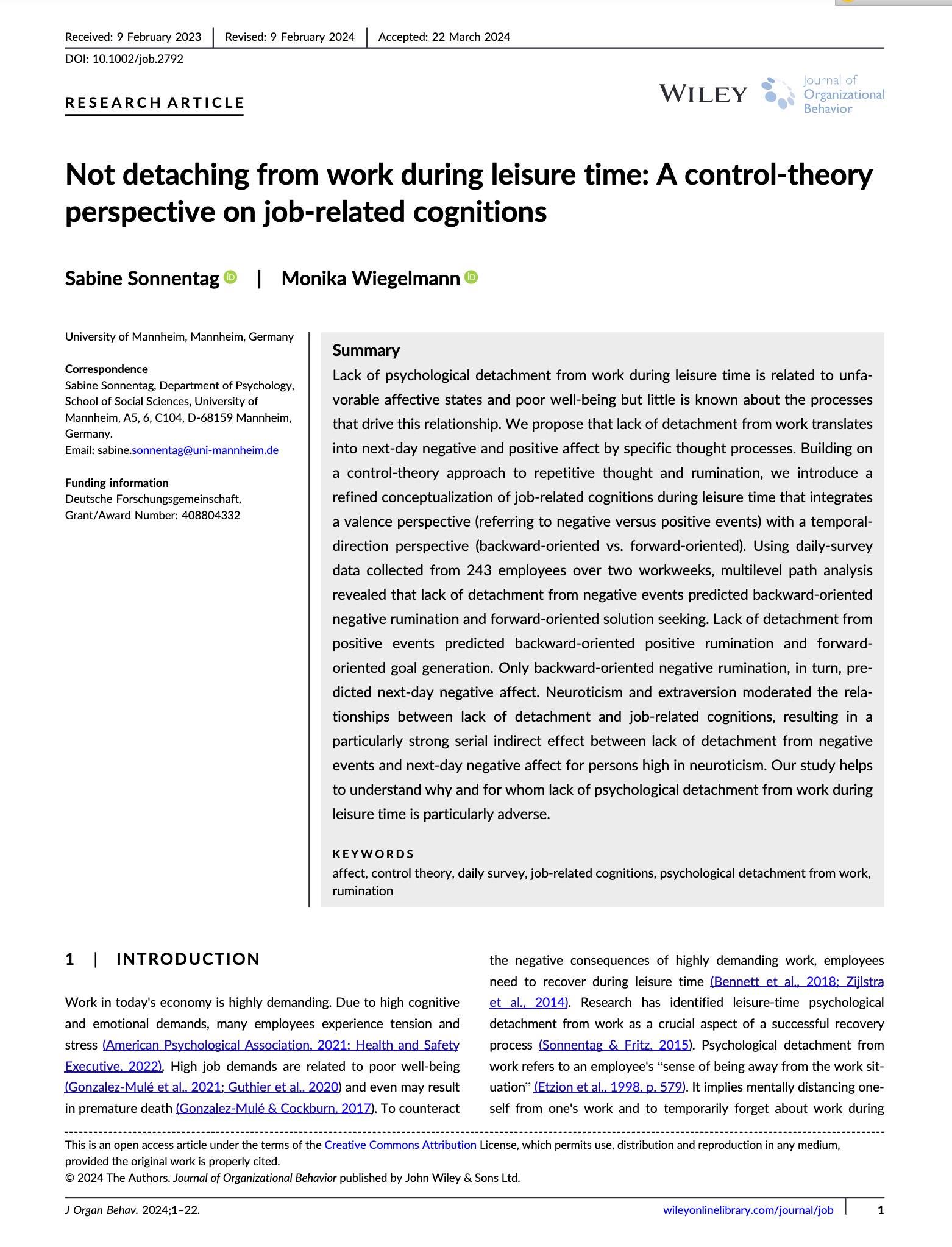
Received: 9 February 2023 | Revised: 9 February 2024 | Accepted: 22 March 2024 DOI: 10.1002/job.2792 RESEARCH ARTICLE Not detaching from work during leisure time: A control-theory perspective on job-related cognitions Sabine Sonnentag | Monika Wiegelmann University of Mannheim, Mannheim, Germany Correspondence Sabine Sonnentag, Department of Psychology, School of Social Sciences, University of Mannheim, A5, 6, C104, D-68159 Mannheim, Germany. Email: sabine.sonnentag@uni-mannheim.de Funding Information Deutsche Forschungsgemeinschaft, Grant/Award Number: 408804332 Summary Lack of psychological detachment from work during leisure time is related to unfavorable affective states and poor well-being, but little is known about the processes that drive this relationship. We propose that lack of detachment from work translates into next-day negative and positive affect by specific thought processes. Building on a control-theory approach to repetitive thought and rumination, we introduce a refined conceptualization of job-related cognitions during leisure time that integrates a valence perspective (referring to negative versus positive events) with a temporal-direction perspective (backward-oriented vs. forward-oriented). Using daily-survey data collected from 243 employees over two weeks, multilevel path analysis revealed that lack of detachment from negative events predicted backward-oriented negative rumination and forward-oriented solution seeking. Lack of detachment from positive events predicted backward-oriented positive rumination and forward-oriented goal planning. Only backward-oriented negative rumination, in turn, predicted next-day negative affect. Neuroticism and extraversion moderated the relationships between lack of detachment and job-related cognitions, resulting in a particularly strong serial indirect effect between lack of detachment from negative events and next-day negative affect for persons high in neuroticism. Our study helps to understand why and for whom lack of psychological detachment from work during leisure time is particularly adverse. KEYWORDS affect, control theory, daily survey, job-related cognitions, psychological detachment from work, rumination INTRODUCTION Work in today's economy is highly demanding. Due to high cognitive and emotional demands, many employees experience tension and stress (American Psychological Association, 2021; Health and Safety Executive, 2022). High job demands are related to poor well-being (Gonzalez-Mulé et al., 2021; Crain et al., 2020) and even a shortened life expectancy in premature death (Gonzalez Mulé & Cockburn, 2017). To counteract the negative consequences of highly demanding work, employees need to recover during leisure time (Bennett et al., 2018; Zijlstra et al., 2014). Research has identified leisure-time psychological detachment from work as a crucial aspect of a successful recovery process (Sonnentag & Fritz, 2015). Psychological detachment from work refers to an employee's "s
本研究のウェルビーイング小話はこちら😊
はぴテク相談室:仕事と余暇は切り分けるべきだ。ただし、幸せに働いている人は別
https://wellbeing-archive.pages.dev/posts/2024-05-01-1714600807/