2024.01.31
気持ちが落ちている人は、あえてネガティブな感情に向かっていく
OECD調査(2021)によれば、日本の17.3%がうつ病・うつ状態と言われていますが、
そんな状態になると、そもそもポジティブ感情を避けて、あえてネガティブに向かっていく。
という話が報告されていました。
(昨年報告されていたんですが、PDFを見つけました😊)
・楽しい話題からネガティブな話題に注意をそらす傾向がある。
・ポジティブな記憶を思い出すことを避ける
・一方で、ネガティブな記憶を反芻(何度も思い出す)しやすい
とのこと。
ーー
これ、企業でのウェルビーイングを拡げていく際にも、大事な点なんですよね。。。
企業でウェルビーイング高めていこうとすると、そこに乗れない人も出てきます。
それはこの論文にある通り、日本人の17%くらいの人は、
そもそもポジティブを避けて、あえてネガティブに向かっていく傾向による部分も大きいかと思います。
ー
なので、
最初は、ポジティブな取り組みは乗り気な人、部署を中心に進めて行くのが大事ですし、
合わせて、
落ち込んでいる人に対しては、
心整える、安心安全、承認といったポジティブよりもベースの部分を担保しつつ、
継続的な働きかけが大事かなと思います。
(西精工の西さんも、わかってくれるまで100回は言う。と決めているそうです。)
ーーー
Choosing to avoid the positive? Emotion regulation strategy choice in depression.
ポジティブなものを避ける選択?うつ病における感情調節戦略の選択。
Journal of Psychopathology and Clinical Science,2023
https://psycnet.apa.org/doiLanding?doi=10.1037%2Fabn0000835
PDF↓
https://psyarxiv.com/eqvpc/
大うつ病性障害(MDD)の患者は、非うつ病の患者よりも、快の感情を減少させ(例えば、肯定的刺激からの注意散漫)、不快の感情を増加させる(例えば、否定的反芻)感情調節方略を用いる傾向が強い。
このような方略が積極的に選択される場合、その選択は、快感情に対する動機づけの弱さ、あるいは不快感情に対する動機づけの強さを部分的に反映している可能性がある。
そこで本研究では、このような方略が選択可能な場合でも、積極的に選択されるかどうかを初めて検証した。
研究1では、行動課題を用いて、MDD参加者(N= 38)は健常対照者(N= 39)よりも、快刺激に対してポジティブな反芻よりも気晴らしを選択する傾向が強く、その結果、快感情が減少した。
しかし、気分がよくなる方略を選ぶように指示された場合、MDD参加者は方略の選択において対照群と差がなかった。
生態学的瞬間評価を用いた研究2では、MDD参加者(N= 58)は対照群(N= 62)よりも、日常生活において快感情から気をそらすこと、および否定的反芻を用いる傾向が強かった。
このような方略の使用パターンは、対照群と比較して、MDD参加者では不快な感情に対する動機づけが強いことから予測された。
また、日常生活における不快感情に対する動機づけの強さは、不快感情の増加と快感情の減少を予測した。
この知見は、非うつ病者と比較して、MDD患者は快感情を減少させる情動調節戦略を選択しやすいことを示唆している。
ーーー
※参考
OECD 図表でみる医療 2023:日本
https://www.oecd.org/health/health-at-a-glance/Health-at-a-Glance-2023-Japan-Launch.pdf
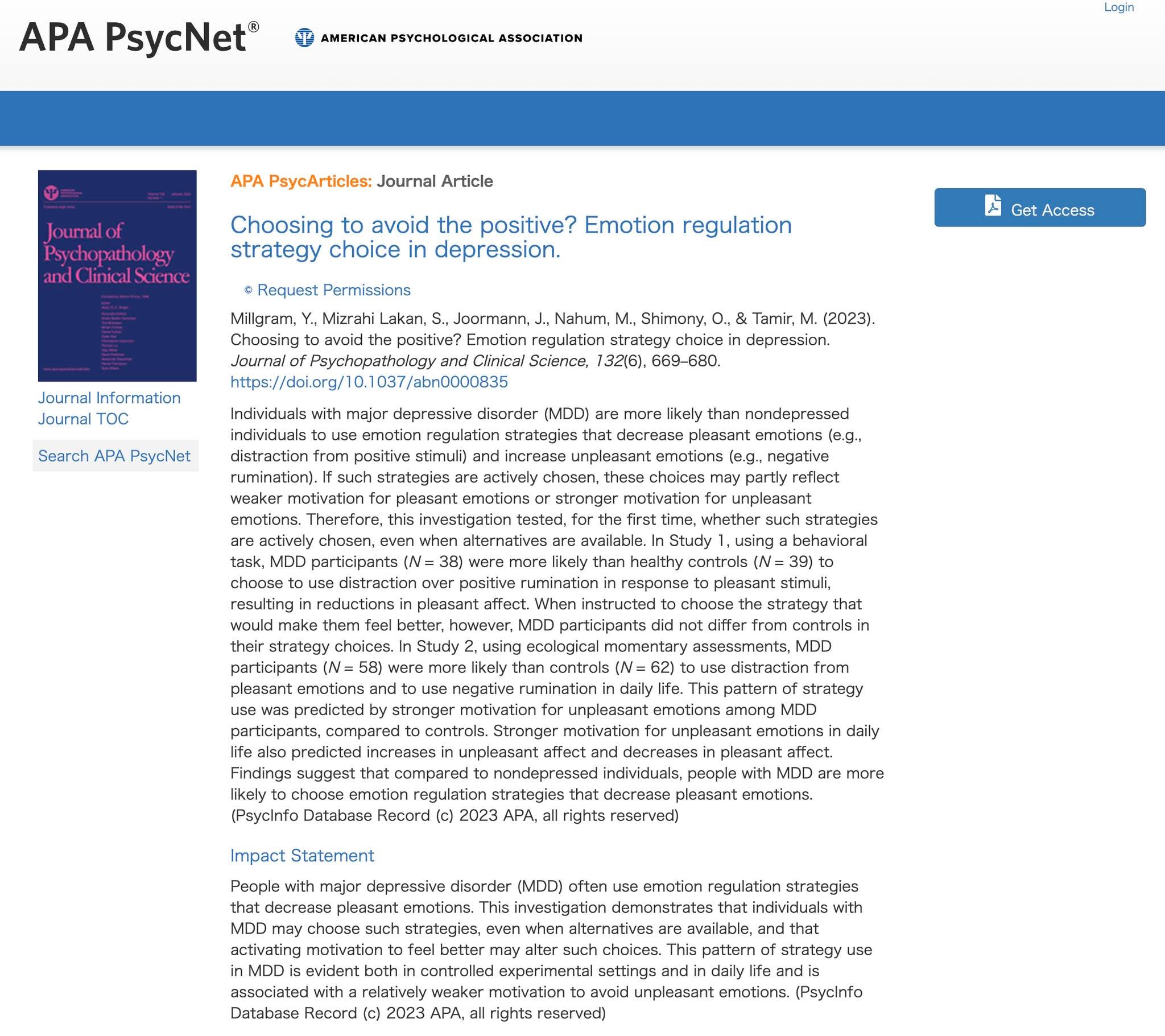
APA PsycNet® AMERICAN PSYCHOLOGICAL ASSOCIATION Login APA PsycArticles: Journal Article Choosing to avoid the positive? Emotion regulation strategy choice in depression. Request Permissions Get Access Journal Information Journal TOC Search APA PsycNet Millgram, Y., Mizrahi Lakan, S., Joormann, J., Nahum, M., Shimony, O., & Tamir, M. (2023). Choosing to avoid the positive? Emotion regulation strategy choice in depression. Journal of Psychopathology and Clinical Science, 132(6), 669-680. https://doi.org/10.1037/abn0000835 Individuals with major depressive disorder (MDD) are more likely than nondepressed individuals to use emotion regulation strategies that decrease pleasant emotions (e.g., distraction from positive stimuli) and increase unpleasant emotions (e.g., negative rumination). If such strategies are actively chosen, these choices may partly reflect weaker motivation for pleasant emotions or stronger motivation for unpleasant emotions. Therefore, this investigation tested, for the first time, whether such strategies are actively chosen, even when alternatives are available. In Study 1, using a behavioral task, MDD participants (N = 38) were more likely than healthy controls (N = 38) to choose to use distraction over positive rumination in response to pleasant stimuli, resulting in reductions in pleasant affect. When instructed to choose the strategy that would make them feel better, however, MDD participants did not differ from controls in their strategy choices. In Study 2, using ecological momentary assessments, MDD participants (N = 58) were more likely than controls (N = 62) to use distraction from pleasant emotions and to use negative rumination in daily life. This pattern of strategy use was predicted by stronger motivation for unpleasant emotions among MDD participants, compared to controls. Stronger motivation for unpleasant emotions in daily life also predicted increases in unpleasant affect and decreases in pleasant affect. Findings suggest that compared to nondepressed individuals, people with MDD are more likely to choose emotion regulation strategies that decrease pleasant emotions. (PsycInfo Database Record (c) 2023 APA, all rights reserved) Impact Statement People with major depressive disorder (MDD) often use emotion regulation strategies that decrease pleasant emotions. This investigation demonstrates that individuals with MDD may choose such strategies, even when alternatives are available, and that activating motivation to feel better may alter such choices. This pattern of strategy use in MDD is evident both in controlled experimental settings and in daily life and is associated with a relatively weaker motivation to avoid unpleasant emotions. (PsycInfo Database Record (c) 2023 APA, all rights reserved)
本研究のウェルビーイング小話はこちら😊
はぴテク相談室:気持ちが落ちている人は、あえてネガティブな感情に向かっていく
https://wellbeing-archive.pages.dev/posts/2024-01-31-1706744020/