2024.01.20
物質主義と幸せ
物質主義とは、消費者が世俗的な所有物を重視することです。
で、その物質主義の人に起きる、負のスパイラルが報告されていました。
物質主義→他人と比較する傾向→ソーシャルメディアで比較が加速(受け身での利用→SNS中毒)→ストレス→幸福度落ちる。
となっていくんだよ。
とのこと。
(矢印一つ一つの研究は多々あれど、一連の流れを検証した論文は新しいよね。とのこと。)
ーーー
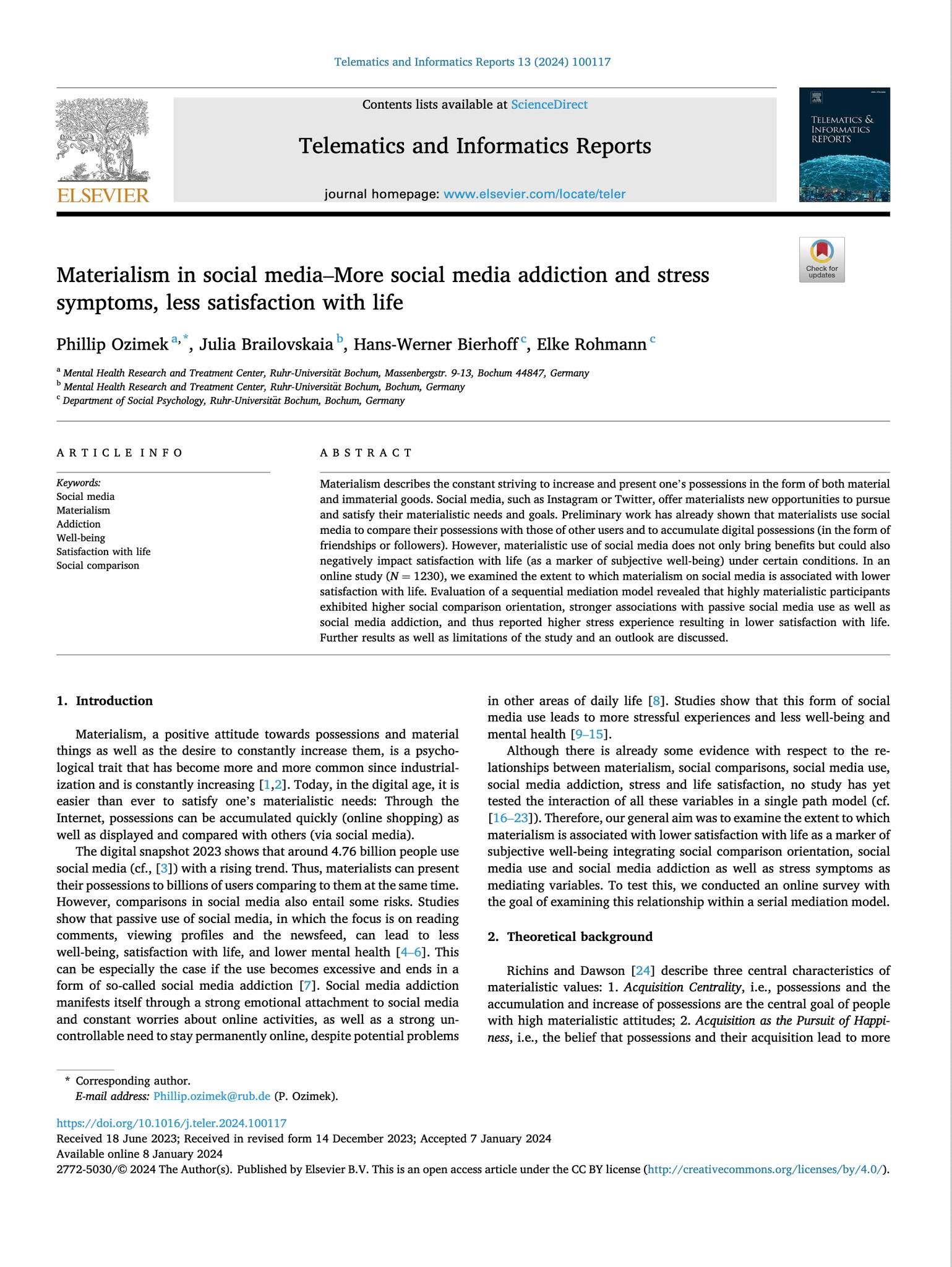
Materialism in social media–More social media addiction and stress symptoms, less satisfaction with life
ソーシャルメディアにおける物質主義-ソーシャルメディア中毒とストレス症状の増加、人生への満足度の低下
Telematics and Informatics Reports,2024/1
https://www.sciencedirect.com/science/article/pii/S2772503024000033?via%3Dihub
ハイライト
・物質主義は、高い社会的比較志向や高いソーシャルメディアの使用と正の関連がある。
・物質主義はソーシャルメディア中毒と正の関係がある。
・物質主義はストレス症状と正の相関がある。
・物質主義は人生への満足度と負の関係がある。
・本研究(N=1230)では、物質主義と生活満足度との間の否定的な関連は、より高い社会的比較志向、より多くのソーシャルメディアの使用、より多くのソーシャルメディア中毒、より多くの知覚されたストレス症状によって順次媒介されることが示された。
ー
要旨
物質主義とは、物質的なものと非物質的なものの両方の形で、自分の所有物を増やし、見せようと絶えず努力することを指す。インスタグラムやツイッターのようなソーシャルメディアは、物質主義者に物質主義的な欲求や目標を追求し、満足させる新たな機会を提供する。予備調査では、物質主義者がソーシャルメディアを利用して、他のユーザーと自分の所有物を比較し、(友人関係やフォロワーという形で)デジタル所有物を蓄積していることがすでに示されている。しかし、物質主義的なソーシャルメディアの利用は利益をもたらすだけでなく、特定の条件下では(主観的幸福の指標としての)生活満足度にマイナスの影響を与える可能性もある。オンライン研究(N = 1230)において、我々は、ソーシャルメディア上の物質主義が生活満足度の低下とどの程度関連しているかを調べた。 逐次的な媒介モデルを評価した結果、物質主義の強い参加者は、より高い社会的比較志向を示し、受動的なソーシャルメディア利用やソーシャルメディア中毒との関連が強く、その結果、より高いストレス体験を報告し、人生に対する満足度が低いことが明らかになった。さらなる結果とともに、研究の限界と展望についても論じている。
Telematics and Informatics Reports 13 (2024) 100117 Contents lists available at ScienceDirect Telematics and Informatics Reports Journal homepage: www.elsevier.com/locate/teler Materialism in social media–More social media addiction and stress symptoms, less satisfaction with life Phillip Ozimek a,*, Julia Brailovskaia a, Hans-Werner Bierhoff a, Elke Rohmann b a Mental Health Research and Treatment Center, Ruhr-Universität Bochum, Massenbergstr. 9-13, Bochum 44467, Germany b Mental Health Research and Treatment Center, Ruhr-Universität Bochum, Bochum, Germany c Department of Social Psychology, Ruhr-Universität Bochum, Bochum, Germany ARTICLE INFO Keywords: Social media Materialism Addiction Well-being Satisfaction-with-life Social comparison ABSTRACT Materialism is a psychological trait that can increase and prevent one's experiences in the form of both material and immaterial goods. Social media, such as Instagram or Twitter, offer materialists new opportunities to pursue and satisfy materialistic needs and wants. Previous work has already shown that materialism is positively related to social media use to compare their possessions with those of other users and to accumulate digital possessions (in the form of friendships or followers). However, materialism use of social media does not only bring benefits but could also negatively impact satisfaction with life (as a marker of subjective well-being) under certain conditions. In an online study (N = 1230), we examined the extent to which materialism on social media is associated with lower satisfaction with life. Evaluation of a sequential mediation model revealed that highly materialistic participants exhibited higher social comparison orientation, stronger associations with passive social media use as well as social media addiction, and thus reported higher stress experience resulting in lower satisfaction with life. Further results as well as limitations of the study and an outlook are discussed. 1. Introduction Materialism, a positive attitude towards possessions and material things as well as the desire to constantly increase them, is a psychological trait that has become more and more common since industrialization and is currently increasing [1-3]. Today, in the digital age, it is easier than ever to satisfy one's materialistic needs: Through the Internet, possessions can be accumulated quickly (online shopping) as well as displayed and compared with others (via social media). The global smartphone 2023 shows that around 4.76 billion people use social media (cf. [3]) with a rising trend. Thus, materialists can present their possessions to billions of users and become known at the same time. However, comparisons on social media also entail serious risks. Studies show that passive use of social media, in which the focus is on reading comments, viewing profiles and the newsfeed, can lead to less well-being, satisfaction with life, and lower mental health [4-5]. This can be especially the case
参考①
Vol.20
「物質主義(マテリアリズム)は幸せか?」 by 前野隆司先生
武蔵野大学
https://www.musashino-u.ac.jp/academics/faculty/well-being/well-being/columns/wb_column_020.html#:~:text=%E5%BF%83%E7%90%86%E5%AD%A6%E3%81%AE%E4%B8%96%E7%95%8C%E3%81%AB,%E3%83%99%E3%83%AB%E3%82%AF%E3%81%AF%E8%BF%B0%E3%81%B9%E3%81%A6%E3%81%84%E3%81%BE%E3%81%99%E3%80%82
参考②
子供にも広がる有害な「物質主義」、対策のカギは感謝の心
FORBES、2018/11/4
https://forbesjapan.com/articles/detail/23725
本研究のウェルビーイング小話はこちら😊
はぴテク相談室:物質主義と幸せ
https://wellbeing-archive.pages.dev/posts/2024-01-20-1705792685/