2024.01.16
幸せと健康の因果関係
感情的な幸福と、主観的な健康。
これは相関していて、幸せだと健康になり、健康だと幸せになる。
と言われていましたが、
これは幸せだから健康になるのか、健康だから幸せになるのか、どっちだろう?
これを1968年から(凄❗)の長期間にわたるデータを元に、調査したフィンランドの研究。
ー
結果としては、
感情的な幸福は、6-11年後までの主観的な健康に影響があり、
その逆もまたしかりだった。
とのこと。
幸せだと健康になるし、健康だと幸せになる😍😍😍しかも、それが6-11年くらい続く❗
どちらも、高めていきましょう😊
ーーー
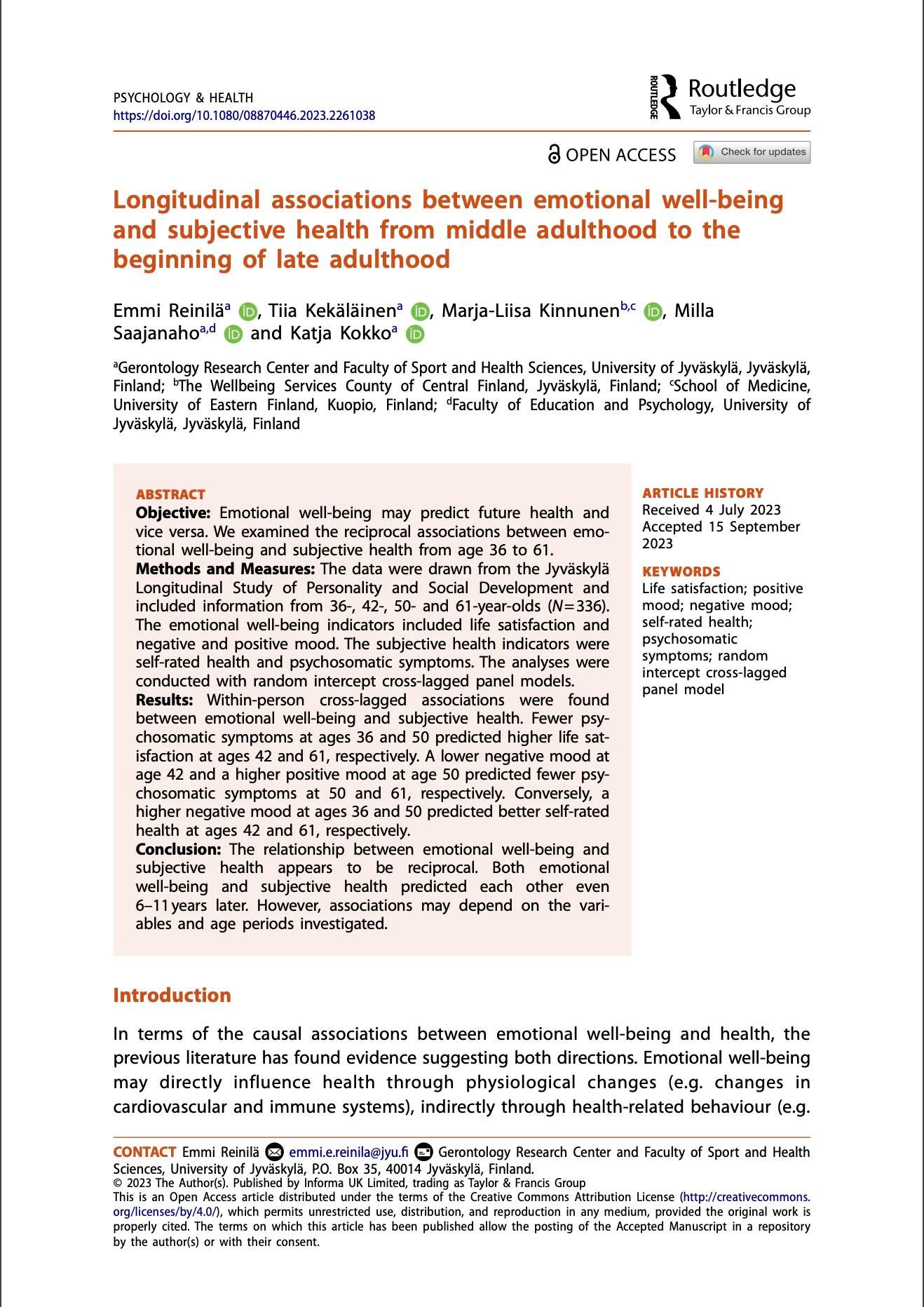
Longitudinal associations between emotional well-being and subjective health from middle adulthood to the beginning of late adulthood
感情的幸福と主観的健康との縦断的関連:成人期中期から成人期後期初頭まで
Psychology & Health ,2023/9/28
https://www.tandfonline.com/doi/full/10.1080/08870446.2023.2261038
目的
感情的幸福は将来の健康を予測し、またその逆もしかりである。我々は、36歳から61歳までの感情的幸福と主観的健康との相互関係を調べた。
方法と対策
データは、ユヴァスキュラの「性格と社会性の発達に関する縦断的研究」から抽出され、36歳、42歳、50歳、61歳(N=336)の情報が含まれている。情緒的幸福の指標には、生活満足度、否定的・肯定的気分などが含まれた。主観的健康指標は、自己評価による健康と心身症状であった。分析は、ランダム切片クロスラグ・パネルモデルを用いて行われた。
結果
感情的幸福と主観的健康との間には、個人内におけるクロスラグの関連が認められた。36歳と50歳における心身症症状の少なさは、42歳と61歳における生活満足度の高さをそれぞれ予測した。42歳時の否定的な気分が低く、50歳時の肯定的な気分が高いほど、50歳と61歳時の心身症が少ないことがそれぞれ予測された。逆に、36歳と50歳の時の否定的な気分が高いほど、42歳と61歳の時の自己評価による健康状態はそれぞれ良好であった。
結論
感情的幸福と主観的健康の関係は相互関係にあるようだ。感情的幸福と主観的健康は、6~11年後でも互いを予測していた。しかし、関連性は調査した変数や年齢期間によって異なるかもしれない。
ーーー
はじめに
感情的幸福と健康との因果関係に関しては、これまでの文献によると、両方向を示唆する証拠が見つかっている。感情的幸福は、生理的変化(心臓血管系や免疫系の変化など)を通じて直接的に、あるいは健康に関連する行動(身体活動や食事など)を通じて間接的に、あるいは困難な状況におけるストレスを緩衝することによって、健康に影響を及ぼす可能性がある(Boehm & Kubzansky,引用2012; DeSteno et al.,引用2013; Pressman & Cohen,引用2005)。とはいえ、健康状態の変化など多様な生活環境は、人々の幸福度や満足度に影響を与える可能性がある(Diener,Citation1984; Diener et al.,Citation1999)。したがって、健康を維持することは、感情的幸福にとって有益であると考えられる。
本研究では、成人期中期(36歳)から成人期後期(61歳)まで追跡調査したフィンランドの成人において、感情的幸福と主観的健康との縦断的な相互関連を調査しようとした。感情的(すなわち快楽的)幸福には、個人の感情的反応と人生に対する満足度の認知的評価が含まれる(Diener et al.)主観的健康は、個人の健康体験を記述するものであり、しばしば単一項目(すなわち自己評価健康)や症状チェックリストで測定される(Cross & Pressman,Citation2017)。本研究では、情緒的幸福の指標には認知的側面(すなわち、仕事や社会関係など生活の複数の領域をカバーする生活満足度)と情緒的側面(すなわち、肯定的気分と否定的気分)の両方が含まれ(Kokkoら、Citation2013、Citation2015)、主観的健康の指標には自己評価による健康と心身症状が含まれた(Kekäläinenら、Citation2020;Kinnunenら、Citation2005)。
結論
結論として、感情的幸福と主観的健康のどちらが両者の関連性の原動力であったかを示唆することはできなかったが、これらの構成要素は縦断的に関連していると結論づけることができる。本研究は、情緒的幸福と主観的健康の両方が6~11年後に互いを予測し、これらの変数が共に変化する可能性を示すことで、情緒的幸福と主観的健康の間の動的で相互的な関係についてのこれまでの知見(Hudsonら、引用2019;Wieseら、引用2019)を支持している。しかし、感情的幸福と主観的健康との関連性の大きさや方向性は、研究対象となる変数や年齢によって異なる可能性があり、感情的幸福と主観的健康との関連性の複雑さをさらに反映している。
PSYCHOLOGY & HEALTH https://doi.org/10.1080/08870446.2023.2261038 OPEN ACCESS Longitudinal associations between emotional well-being and subjective health from middle adulthood to the beginning of late adulthood Emmi Reinilä, Tiia Kekäläinen*, Marja-Liisa Kinnunen*, Milla Saajanaho*,d and Katja Kokko* *Gerontology Research Center and Faculty of Sport and Health Sciences, University of Jyväskylä, Jyväskylä, Finland; †The Wellbeing Services, County of Central Finland, Jyväskylä, Finland; ‡School of Medicine, University of Eastern Finland, Kuopio, Finland; dFaculty of Education and Psychology, University of Jyväskylä, Jyväskylä, Finland ABSTRACT Objective: Emotional well-being may predict future health and vice versa. We examined the reciprocal associations between emotional well-being and subjective health from age 36 to 61. Methods and Measures: The data were drawn from the Jyväskylä Longitudinal Study of Personality and Social Development and included information from 36-, 42-, 50- and 61-year-olds (N = 336). The emotional well-being indicators included life satisfaction and negative and positive mood. The subjective health indicators were self-rated health and psychosomatic symptoms. The analyses were conducted with random intercept cross-lagged panel models. Results: Within-person cross-lagged associations were found between emotional well-being and subjective health. Fewer psychosomatic symptoms at ages 36 and 50 predicted higher life satisfaction at ages 42 and 61, respectively. A lower negative mood at age 42 and a higher positive mood at age 50 predicted fewer psychosomatic symptoms at 50 and 61, respectively. Conversely, a higher negative mood at ages 36 and 50 predicted better self-rated health at ages 42 and 61, respectively. Conclusion: The relationship between emotional well-being and subjective health appears to be reciprocal. Both emotional well-being and subjective health predicted each other even 6–11 years later. However, associations may depend on the variables and age periods investigated. Introduction In terms of the causal associations between emotional well-being and health, the previous literature has found evidence suggesting both directions. Emotional well-being may directly influence health through physiological changes (e.g. changes in cardiovascular and immune systems), indirectly through health-related behaviour (e.g. CONTACT Emmi Reinilä emmi.reinila@jyu.fi Gerontology Research Center and Faculty of Sport and Health Sciences, University of Jyväskylä, P.O. Box 35, 40014 Jyväskylä, Finland. © 2023 The Author(s). Published by Informa UK Limited, trading as Taylor & Francis Group This is an Open Access article distributed under the terms of the Creative Commons Attribution License (http://creativecommons. org/licenses/by/4.0/), which permits unrestricted use, distribution, and reproduction in any medium, provided the original work is properly cited. The terms on which this article has been published allow the posting of t

本研究のウェルビーイング小話はこちら😊
はぴテク相談室:幸せと健康の因果関係
https://wellbeing-archive.pages.dev/posts/2024-01-16-1705446008/