そして、それには、ポジティブ感情が心の中で生じることによって媒介される部分がある。
という研究。が年末に公開されていました。
やっぱり対面での交流は大事だなぁ。だし、受け身でなく、能動的な活動がウェルビーイングを高める。
また、瞬間的なポジティブ感情と、長期的な幸福度はどちらが大切か、という話もありますが、
瞬間的なポジティブ感情が、長期的な幸福度に繋がってくる部分もある。
ですね😄
ーー
①人との交流は幸せ。特に対面だと。
a:対面での交流
b:ITを介した交流
c:一人
だと、a>b>cの順で幸福感を高めるし、それは瞬間的なポジティブ感情の体験によって媒介される。
②能動的な活動は幸せ。
能動的な活動は、ウェルビーイングを高める。それは、瞬間的なポジティブ感情の体験によって媒介される。
ーー
※感情の22種類。これらのどれを強く感じましたか?またそのレベルは?と問うた。
不安、賞賛、怒り、思いやり、感謝、悲しみ、多幸感、娯楽、尊敬、希望、ひらめき、興味、緊張、決意、感動、畏敬、安堵、興奮、肯定的な驚き、優しさ、満足、勝利、誇り、つながり、退屈、平和/落ち着き、感覚的喜び。
※能動的な活動、受動的な活動
能動的な活動とは、
祈ること、食べること、趣味、家事、親密な関係、子どもを見ること、料理、移動中、オンラインコミュニケーション、個人衛生、人との付き合い、運動、ボランティア、仕事・勉強、買い物、ビデオ・電話であった。
受動的とされた活動は、
待つこと、リラックスして何もしないこと、休息すること、テレビを見ることであった。
ーーー
Why Being Social and Active Boosts Psychological Wellbeing: A Mediating Role of Momentary Positive Emotions
社交的で活動的であることが心理的ウェルビーイングを高める理由: 瞬間的なポジティブ感情の媒介的役割
Social Psychological and Personality Science,2023/12/28
https://journals.sagepub.com/doi/full/10.1177/19485506231218362
社会的相互作用と積極的活動は心理的ウェルビーイングの鍵であるが、これらの活動はどのようにしてウェルビーイングを向上させるのだろうか?
ポジティブな感情体験が心理的資源の構築に役立つことを示す研究に基づき、我々は、瞬間的なポジティブな感情体験が社会的相互作用、活動的活動とウェルビーイングの関係を媒介するという予測を検証する。
事前登録された経験サンプリング研究において、106人の参加者が、ウェルビーイング、瞬間的な情動体験、強い情動に結びついた活動を1日5回、15日間(7,110観察)報告した。
参加者は、他者との交流時(特に対面時)、および能動的な活動時により強い肯定的感情を経験したと報告した。
予測されたように、ポジティブな感情体験は、社会的相互作用とウェルビーイングの間、および能動的活動とウェルビーイングの間の正の関係を部分的に媒介した(それぞれ分散の25%および12%を説明する)。
これらの知見は、強烈な情動体験が社会的活動や能動的活動によって引き出されることを示しており、これらの活動が心理的ウェルビーイングをどのように助けるかを説明する一助となる。
はじめに
人々の時間の過ごし方がその人のウェルビーイングを形成することは、多くの研究によって実証されている(例えば、Newman et al.)
家族、友人、知人、見知らぬ人など、他者との社会的交流はウェルビーイングにとって特に重要であり(例えば、Hudson et al.、2020)、
運動やボランティア活動など、積極的な活動に従事する時間も重要である(例えば、Wiese et al.、2018)。
しかし、このような関連性が確立されているにもかかわらず、その根底にあるメカニズムについてはほとんど知られていない。
この疑問を解決することは、ウェルビーイングを改善するための介入策に役立つ。
本研究では、瞬間的なポジティブな感情体験が、社会的・活動的活動とウェルビーイングの関係を説明するのに役立つという仮説を提案し、検証する。
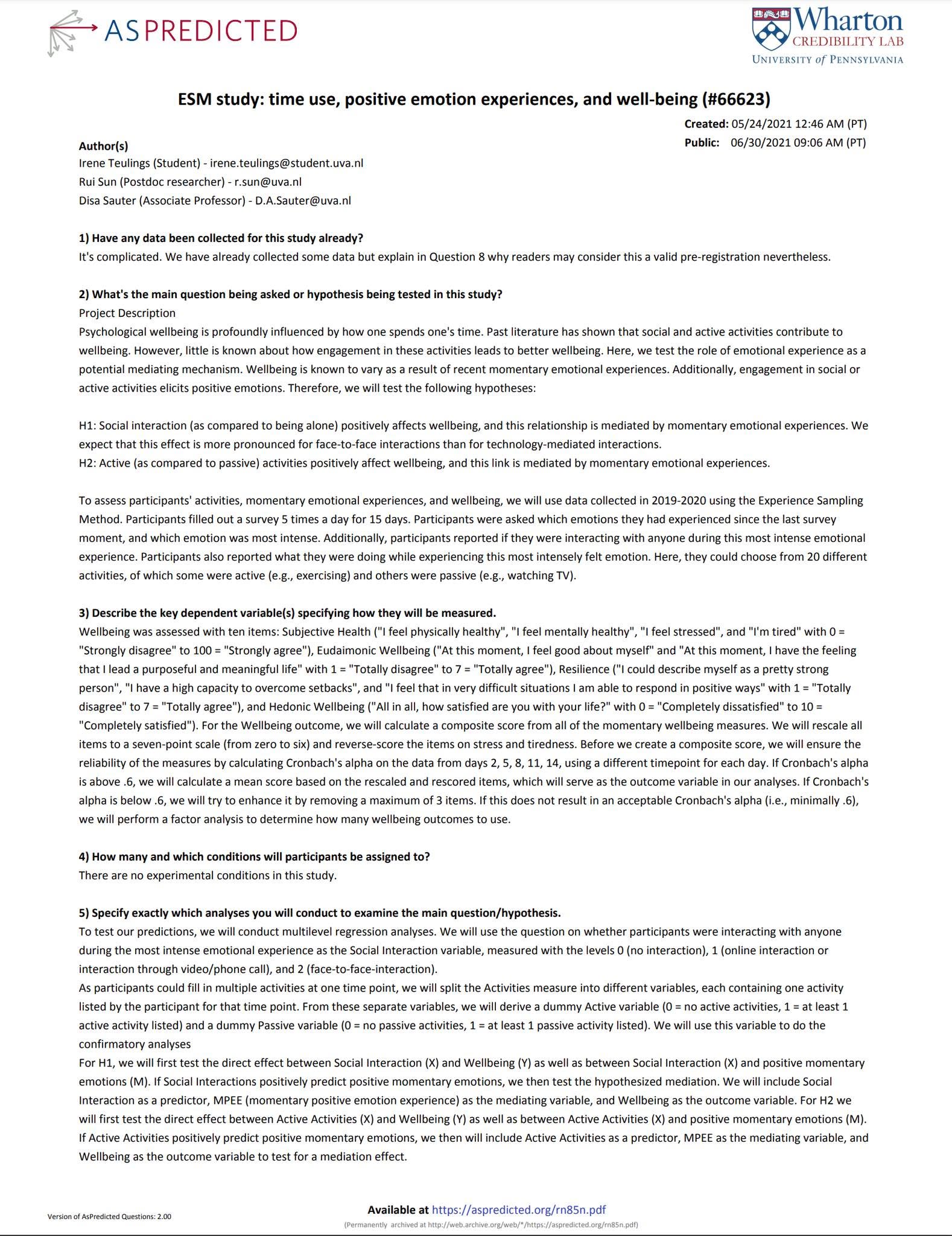
ASPREDICTED Wharton CREDIBILITY LAB University of Pennsylvania ESM study: time use, positive emotion experiences, and well-being (#66623) Created: 05/24/2021 12:46 AM [PT] Public: 06/30/2021 09:06 AM [PT] Author(s) Irene Teulings (Student) - irene.teulings@student.uva.nl Rui Sun (Postdoc researcher) - r.sun@uva.nl Disa Sauter (Associate Professor) - D.A.Sauter@uva.nl 1) Have any data been collected for this study already? It's complicated. We have already collected some data that we will explain in Question 8 why readers may consider this a valid pre-registration nevertheless. 2) What's the main question being asked or hypothesis being tested in this study? Project Description Psychological well-being is profoundly influenced by how one spends one's time. Past literature has shown that social and active activities contribute to wellbeing. However, little is known about how engagement in these activities leads to better wellbeing. Here, we test the role of emotional experience as a potential mediating mechanism. Wellbeing is known to vary as a result of recent momentary emotional experiences. Additionally, engagement in social or active activities elicits positive emotions. Therefore, we will test the following hypothesis: H1: Social interaction (as compared to being alone) positively affects wellbeing, and this relationship is mediated by momentary emotional experiences. We expect that this effect is more pronounced for face-to-face interactions than for technology-mediated interactions. H2: Active (as compared to passive) activities positively affect wellbeing, and this link is mediated by momentary emotional experiences. To assess participants' activities, momentary emotional experiences, and wellbeing, we will use data collected in 2019-2020 using the Experience Sampling Method. Participants filled out a survey 5 times a day for 15 days. Participants were asked which emotions they had experienced since the last survey moment, and which emotion was most intense. Additionally, participants reported if they were interacting with anyone during this most intense emotional experience. Participants also reported what they were doing while experiencing this most intensely felt emotion. Here, they could choose from 20 different activities, of which some were active (e.g., exercising) and others passive (e.g., watching TV). 3) Describe the key dependent variable(s) specifying how they will be measured. Wellbeing was assessed with two items. Subjects rated "I feel physically healthy", "I feel mentally healthy", "I feel stressed", and "I'm tired" with 0 = "Strongly disagree" to 100 = "Strongly agree". Emotional Wellbeing ("At this moment, I feel good about myself" and "At this moment, I have the feeling that I lead a purposeful and meaningful life") with 1 = "Totally disagree" to 7 = "Totally agree"). Resilience ("I could describe myself as pretty strong person", "I have a high capacity to oversetbacks", and "I feel that in my difficult situations I am ab
本研究のウェルビーイング小話はこちら😊
はぴテク相談室:人との交流は幸せ。(特に対面)、能動的な活動は幸せ。
https://wellbeing-archive.pages.dev/posts/2024-01-04-1704409207/