2025.06.08
不安気質な方には、肯定的なフィードバックをマシマシで❗
不安・うつ(疾病までは行かない方)
は、
自信のなさ(自己への過小評価)
につながる。
でも、そのメカニズムはどうなってるの?
というユニバーシティ・カレッジ・ロンドンの研究。
ーー
メカニズムとしては、
実は外部フィードバックへの反応には問題がない。
しかし、
仕事などで一時的に自分なりに良い感じだ!と思っても、
自信を持てない(私って出来るじゃん!とならない。)。
ーー
なので、
ちょっと不安気質な方には、
外部からの肯定的なフィードバックを積極的に、定期的にしていってあげると良いですね😊
もちろん、不安・うつの根本的な対処も大事ですが。
ーーー
※論文
局所的メタ認知からの歪んだ学習は、トランス診断的自信不足を助長する
Distorted learning from local metacognition supports transdiagnostic underconfidence
2025/2/21,nature communications
Sucharit Katyal, Quentin JM Huys, Raymond J. Dolan & Stephen M. Fleming
https://www.nature.com/articles/s41467-025-57040-0
不安やうつ病の症状を経験している人は、持続的な自信不足を示すことが示されています。個人は自分のパフォーマンスを観察することで適切なレベルの自信を学習できるはずであることを考えると、このようなメタ認知バイアスの原因は謎です。2 つの大規模な一般集団サンプル ( N = 230 およびN = 278) で、外部フィードバックを操作しながら、個々のタスクインスタンスに対する「ローカル」自信と長期的な自己パフォーマンス推定値としての「グローバル」自信の両方を測定しました。グローバル自信は、ローカル自信とフィードバック価の両方に敏感です。つまり、肯定的な (否定的な) フィードバックの頻度が高いほど、グローバル自信は増加 (それぞれ減少) し、フィードバックの非対称性も感情的な自己信念の変化につながります。ただし、注目すべきことに、フィードバック価への感受性はそのままであるにもかかわらず、より大きな亜臨床的不安うつ病症状を示す人では、ローカル自信が高いインスタンスに対するグローバル自信の感受性が低下しています。局所的な自信の増加に対する鈍感な感受性という私たちの発見は、パフォーマンスが損なわれていないにもかかわらず、持続的な自信のなさがどのように維持されるのかというメカニズムの基礎を提供します。
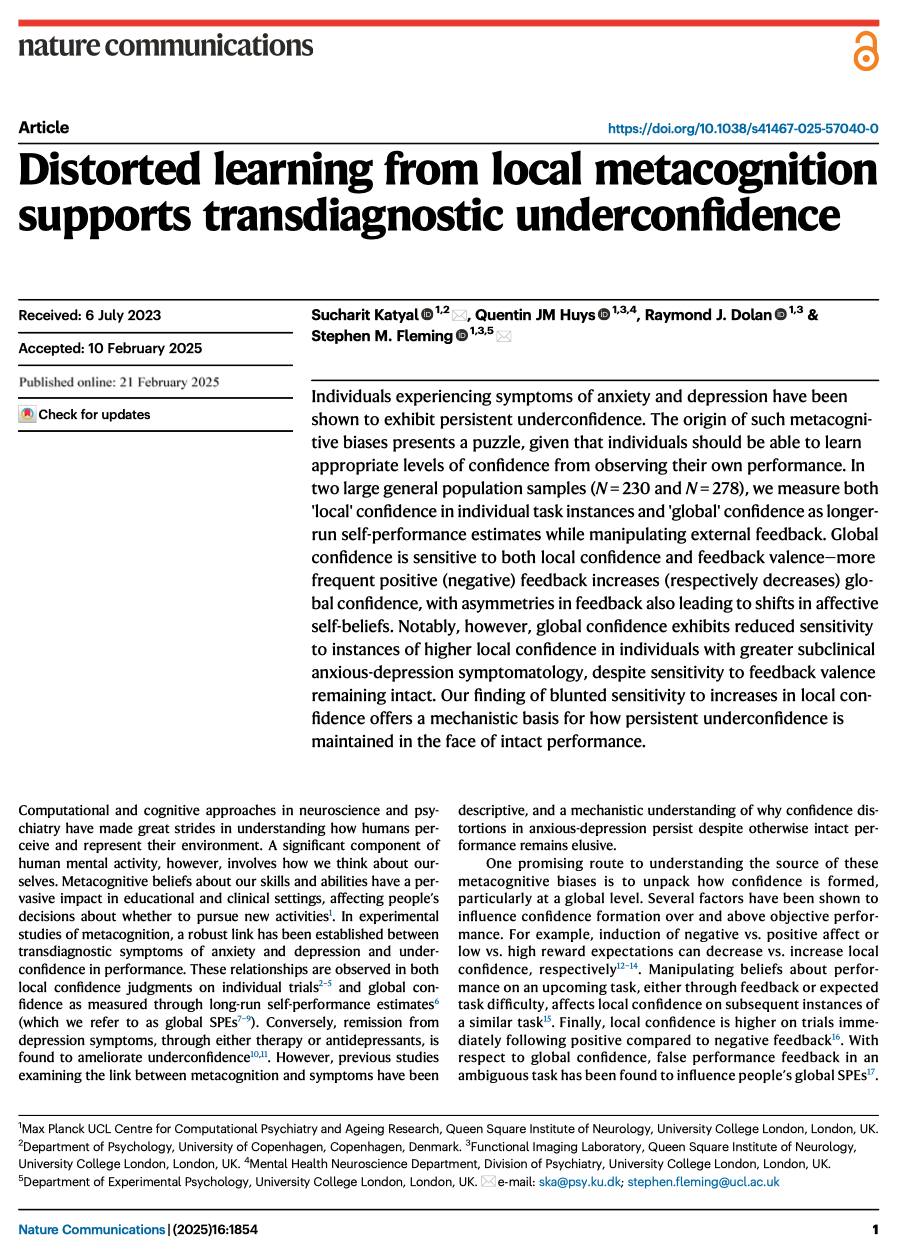
nature communications Article Distorted learning from local metacognition supports transdiagnostic underconfidence Received: 6 July 2023 Accepted: 10 February 2025 Published online: 21 February 2025 Check for updates Sucharit Katyal, Quentin JM Huys, Raymond J. Dolan & Stephen M. Fleming Individuals experiencing symptoms of anxiety and depression have been shown to exhibit persistent underconfidence. The origin of such metacognitive biases presents a puzzle, given that individuals should be able to learn appropriate levels of confidence from observing their own performance. In two large general population samples (N = 230 and N = 278), we measure both 'local' confidence in individual task instances and 'global' confidence as longer-term self-performance estimates while manipulating external feedback. Global confidence is sensitive to both local confidence and feedback valence— more frequent positive (negative) feedback increases (respectively decreases) global confidence, with asymmetries in feedback also leading to shifts in affective self-beliefs. Notably, however, global confidence exhibits reduced sensitivity to instances of higher local confidence in individuals with greater subclinical anxiety/depression symptomatology, despite sensitivity to feedback valence remaining intact. Our finding of blunted sensitivity to increases in local confidence offers a mechanistic basis for how persistent underconfidence is maintained in the face of intact performance. Computational and cognitive approaches in neuroscience and psychiatry have made great strides in understanding how humans perceive and represent their environment. A significant component of human mental activity, however, involves how we think about our selves. Metacognitive beliefs about our skills and abilities have particular and pervasive impact in educational and clinical settings, affecting people's decisions about whether to pursue new activities. In experimental studies of metacognition, a robust link has been established between transdiagnostic symptoms of anxiety and depression and persistent underconfidence as measured through long-run self-performance estimates (which we refer to as 'global' SFEs). Conversely, remission from depression symptoms, through either therapy or antidepressants, is found coupled to amelioration in underconfidence. However, previous studies examining the link between metacognition and symptoms have been descriptive, and a mechanistic understanding of why confidence distortions in anxious-depression persist despite otherwise intact performance remains elusive. One promising route to understanding the source of these persistent underconfidence biases is to unpack how confidence is formed, particularly at a global level. Several factors have been shown to influence confidence formation over and above objective performance. For example, induction of negative vs. positive affect or low vs. high expected outcomes can decrease vs. increase local confidence, resp
この研究の背景となる既存研究を、時系列と論理的な流れで整理してご説明します。
1. メタ認知と精神的健康の関係の発見
🔍 メタ認知とは
「自分の認知について考える認知」=「自分がどれくらいできているかを判断する能力」
初期の重要な発見
Rouault et al. (2018) が画期的な発見をしました:
出典: Rouault, M., Seow, T., Gillan, C. M. & Fleming, S. M. Psychiatric symptom dimensions are associated with dissociable shifts in metacognition but not task performance. Biological Psychiatry 84, 443–451 (2018).
2. 局所的・全体的信頼度の区別
📊 2種類の自信の発見
Seow & Gillan (2020), Seow et al. (2021) らが重要な区別を提唱:
A) 局所的信頼度(Local confidence)
B) 全体的信頼度(Global confidence / Global SPE)
重要な発見
両方とも不安・うつ症状で低下するが、どちらがより重要か、なぜ低下するかは不明だった。
出典:
3. 信頼度形成に影響する要因の発見
🎯 何が自信を左右するかの研究進展
複数の研究グループが、自信に影響する要因を発見:
A) 感情の影響
Allen et al. (2016), Koellinger & Treffers (2015):
B) 報酬期待の影響
Lebreton et al. (2018):
C) フィードバックの影響
Van Marcke et al. (2024), Siedlecka et al. (2022):
出典:
4. 不安・うつと学習バイアスの関係
🧠 ネガティビティバイアスの発見
古典的研究
Beck (1967), Alloy & Ahrens (1987):
現代の学習研究
Korn et al. (2014), Garrett et al. (2014):
Kube et al. (2019):
出典:
本研究のウェルビーイング小話はこちら😊
はぴテク相談室:不安気質な方には、肯定的なフィードバックをマシマシで❗
https://wellbeing-archive.pages.dev/posts/2025-06-08-1749413900/