2024.06.24
合意形成のための会話は神経の調整につながる
先月のnature communicationsに掲載されたダートマス大学の研究。
・会話を通して合意形成をすると、脳活動が同調した。(fMRIでスキャンして調査)
・脳活動が同調すると、お互いの理解が促進されたり、新しい情報の解釈でも同調しやすくなる。
(他にも結束が強まる、ストレスが減る、チームパフォーマンスが高まる、協力が促進される、学習効率が高まる、コミュニケーションの円滑化などにつながる。)
・社会的地位が高い人が、より多く話したり、他者への不信感を示すと、同調が減る。
・他の参加者の発言を促す人がいると、同調が増える。(社会的ネットワークの中心的な人が、そういった行動を取りがち。)
とのこと。
ーーー
面白い😊
やっぱり、職場とかでも会話して合意するのって、大事。
そして誰かが話しすぎず、みんなに話を振る。
さらに、一度同調すると、他の取り組みでも同調しやすくなるので、仕事以外の話での、合意とかも良いんだろうなぁ。
ーーー
合意形成のための会話は神経の調整につながる
Consensus-building conversation leads to neural alignment
nature communications,2024/5/10
https://www.nature.com/articles/s41467-023-43253-8
会話は社会的影響力の主な手段だが、それが脳活動に与える影響は未だ不明である。会話と社会的影響力に関するこれまでの研究では、公の遵守が強調され、私的な信念は主に脇に追いやられてきた。
本研究では、合意形成会話がグループ内の将来の脳活動を整合させ、その整合は参加者が話し合わなかった新しい経験を通して持続することを示す。参加者はfMRIスキャン中に曖昧な映画クリップを視聴し、各クリップの物語について合意に達することを目標にグループで会話した。会話後、参加者の脳は、同じ映画の新しいクリップとともに、再びクリップを視聴しながらスキャンされた。
合意に達したグループは、会話後の脳活動の類似性が高くなった。
社会的地位が高いと認識された参加者が、より多く話し、他者への不信感を示し、そのグループは不平等な順番取と低い神経整合を示した。
対照的に、実世界の社会的ネットワークにおいて中心的な立場にある参加者は、他の参加者の発言を促し、グループの神経的整合をより促進した。
また、社会的に中心的な立場にある参加者は、グループ内の他者と神経的に一致する傾向が強かった。
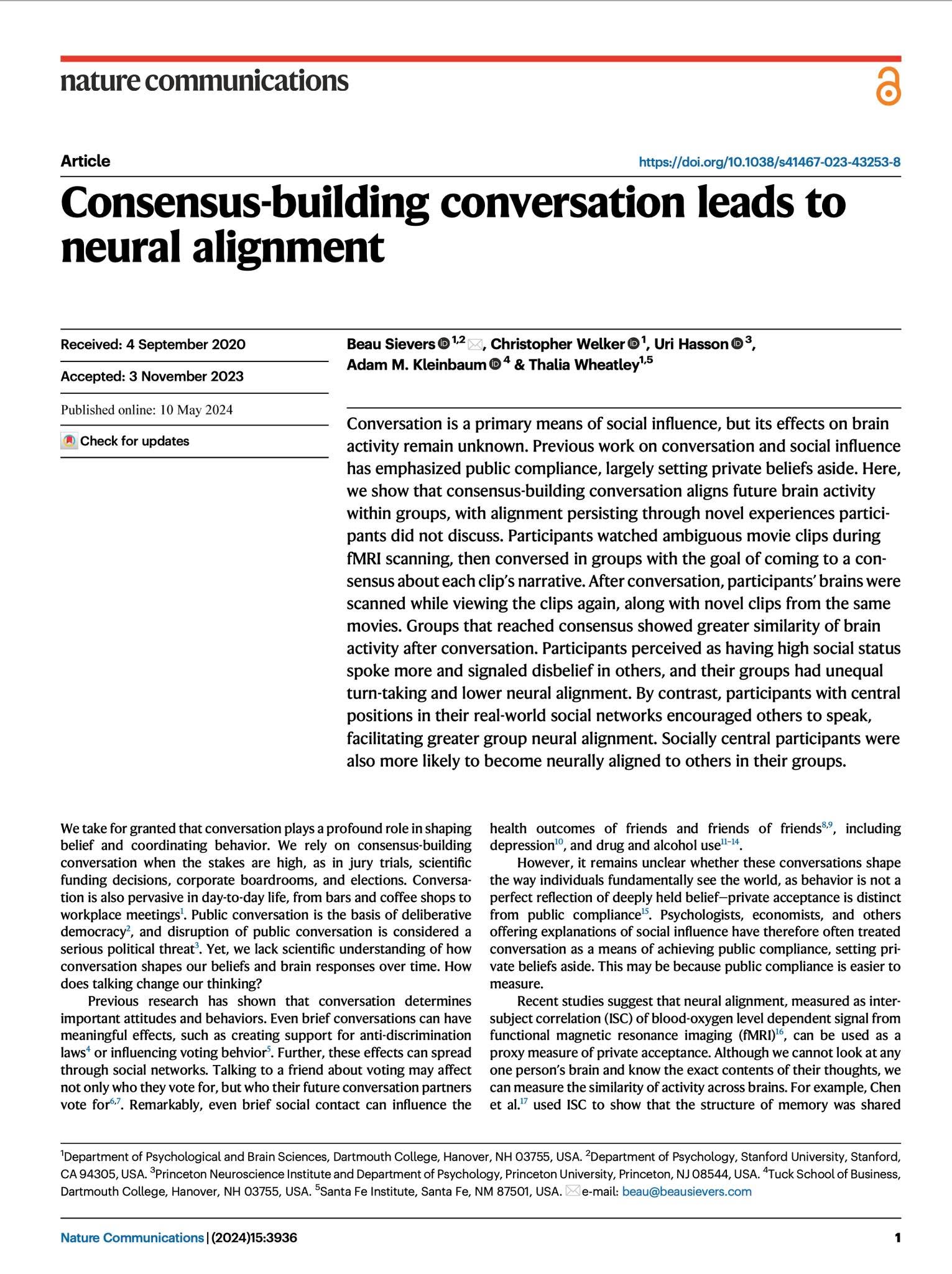
nature communications Article Consensus-building conversation leads to neural alignment Received: 4 September 2020 Accepted: 3 November 2023 Published online: 10 May 2024 https://doi.org/10.1038/s41467-023-43253-8 Beau Sievers 1,2*, Christopher Welker 1, Uri Hasson 3, Adam M. Kleinbaum 4* & Thalia Wheatley 1,5 Conversation is a primary means of social influence, but its effects on brain activity remain unknown. Previous work on conversation and social influence has emphasized public compliance, largely setting private beliefs aside. Here, we show that consensus-building conversation aligns future brain activity within groups, with alignment persisting through novel experiences partici- pants did not discuss. Participants watched ambiguous movie clips during fMRI scanning, then conversed in groups with the goal of coming to a con- sensus about each clip's narrative. After conversation, participants' brains were scanned while viewing the clips again, along with novel clips from the same movies. Groups that reached consensus showed greater similarity of brain activity after conversation. Participants perceived as having high social status spoke more and signaled disbelief in others, and their groups had unequal turn-taking and lower neural alignment. By contrast, participants with central positions in their real-world social networks encouraged others to speak, facilitating greater group neural alignment. Socially central participants were also more likely to become neurally aligned to others in their groups. We take for granted that conversation plays a profound role in shaping belief and coordinating behavior. We rely on consensus-building conversation when the stakes are high, as in jury trials, scientific funding decisions, corporate boardrooms, and elections. Conversa- tion is also pervasive in day-to-day life, from bars and coffee shops to workplace meetings1. Public conversation is the basis of deliberative democracy2, and disruption of public conversation is considered a 'serious political threat'3. Yet, we lack scientific understanding of how conversation shapes our beliefs and brain responses over time. How does talking change our thinking? Previous research has shown that conversation determines important attitudes and behaviors. Even brief conversations can have meaningful effects, such as creating support for antidiscrimination laws4 or influencing voting behavior5. Further, these effects can spread through social networks. Talking to a friend about may alter whom you vote for6,7. Remarkably, even brief social contact can influence the health outcomes of friends and friends of friends8,9, including depression10, and drug and alcohol use11-13. However, it remains unclear whether these conversations shape the way individuals fundamentally see the world, as behavior is not a perfect reflection of deeply held belief—private acceptance is distinct from public compliance14. Psychologists, economists, and others offering explanations of social
本研究のウェルビーイング小話はこちら😊
はぴテク相談室:合意形成のための会話は神経の調整につながる
https://wellbeing-archive.pages.dev/posts/2024-06-24-1719266408/