2024.03.25
階層的なチームでこそ、社会的絆の醸成がめちゃくちゃ大事
階層的なチームでは、社会的絆がどんな影響を与えるのか。
(例えば、趣味趣向の共有やチームTシャツとか、雑談して共通点を見つけるとかで社会的絆を高める。)
なんと、リーダーとメンバーのコミュニケーションと結束が促進。
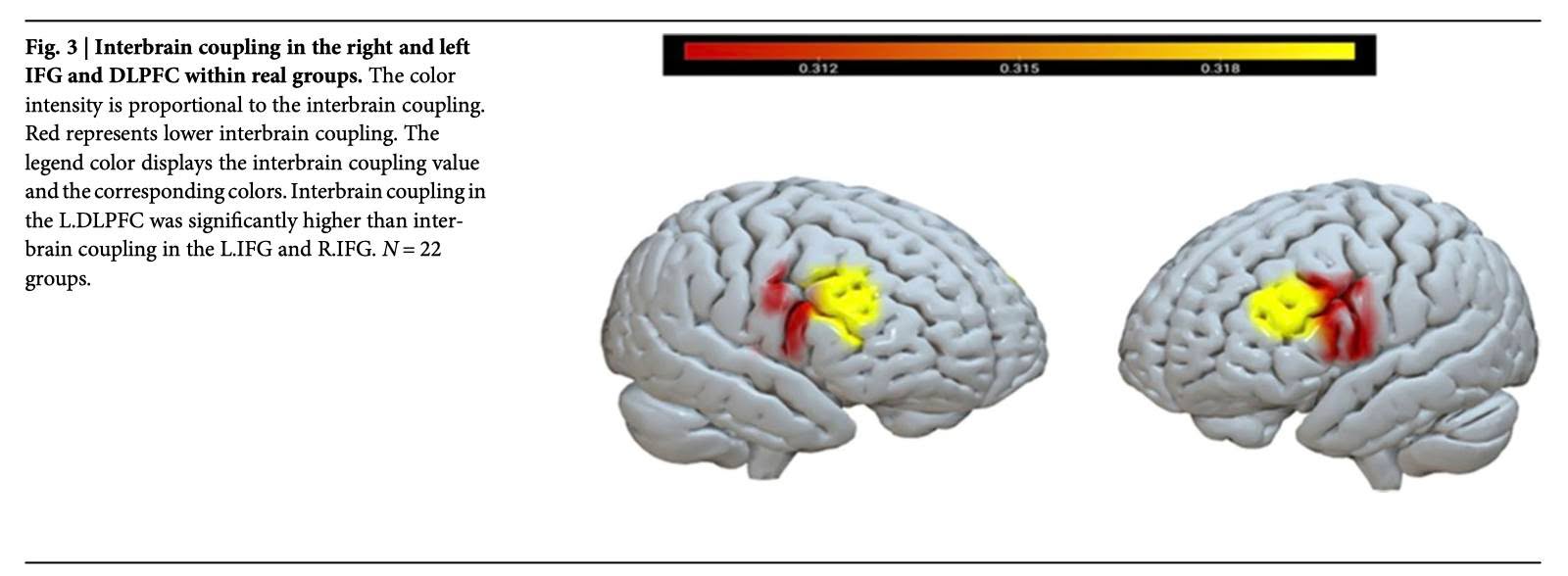
さらにリーダーとメンバーに神経的同期が引き起こった。あうんの呼吸みたいな。
うーん、階層的な会社ほど、社会的絆を育んで行くのが大事そうです😊
ーー
他にも↓とのこと。
①社会的絆は、異なるステータス間(リーダーとフォロワー間)のコミュニケーションと結束を選択的に促進したが、同じステータス間(フォロワー同士)には同様の効果はなかった。
②社会的絆は、リーダーの右前頭前野の活動がフォロワーのそれに1〜6秒先行するような、リーダーからフォロワーへの一方向的な神経同期を引き起こした。
③リーダーの右前頭前野と右側頭頭頂接合部の機能的結合が強いほど、リーダーからフォロワーへの神経同期が強かった。
④異なるステータス間の神経同期は、内集団への好意と外集団への否定的態度の程度と関連していた。
⑤社会的絆は、リーダーの発言と関与を促進し、フォロワーのリーダーに対する反応性と評価を高めた。
ーー
面白かったのは、同じくらいの階層だと、特にコミュニケーションや結束を促進させなかったとのこと。
うーん、階層がないチームでは、絆を深めても、そんなに効果がないのか。。。
まぁ、その場合は、もっと共通目標とか夢の具体化とか、別の方法で対応すれば良いのかな。
ーーー
ヒトの集団における社会的結合は、状態間の情報交換と前頭前野の神経同期を選択的に増加させる
Social bonding in groups of humans selectively increases inter-status information exchange and prefrontal neural synchronization
2024/3/19,PLOS BIOLOGY
https://journals.plos.org/plosbiology/article?id=10.1371/journal.pbio.3002545
様々な社会的種における社会集団は、集団力学と集団内相互作用の性質を形成する階層構造で組織されている。動物の毛づくろい行動や人間社会における集団儀式やチームビルディング活動に代表されるように、集団内の社会的結合は、ヒトとヒト以外の動物の集団において、集団の調和を育み、階層構造を安定化させるための実際的な適応戦略として認識されている。しかし、社会的結合が階層的集団に及ぼす影響の根底にある神経認知メカニズムについては、ほとんど未解明のままである。ここで我々は、社会的結合が階層的相互作用と神経同期にどのような影響を及ぼすかを調べるために、小さな階層的集団(n = 528、176の3人グループに編成)内で集団内コミュニケーションを行っているヒト参加者の同時神経記録を行った。社会的地位の異なる(地位間)個人と同じ(地位内)個人との間の対人相互作用を区別し、地位間相互作用と地位内相互作用に対する社会的結合の異なる効果を観察した。具体的には、社会的結合は、地位間ダイアドでは頻繁で迅速な情報交換と前頭前野の神経同期を選択的に増加させたが、地位内ダイアドでは増加させなかった。さらに、社会的結合はグループリーダーからフォロワーへの一方向的な神経同調を促進し、グループリーダーがフォロワーと自分の前頭前野活動を予測的に同調させることを可能にした。これらの知見は、社会的結合が階層的ダイナミクスと神経同調にどのような影響を与えるかについての洞察を提供すると同時に、ヒト集団における社会的結合経験の強さと性質を形成する上で社会的地位が果たす役割を浮き彫りにした。
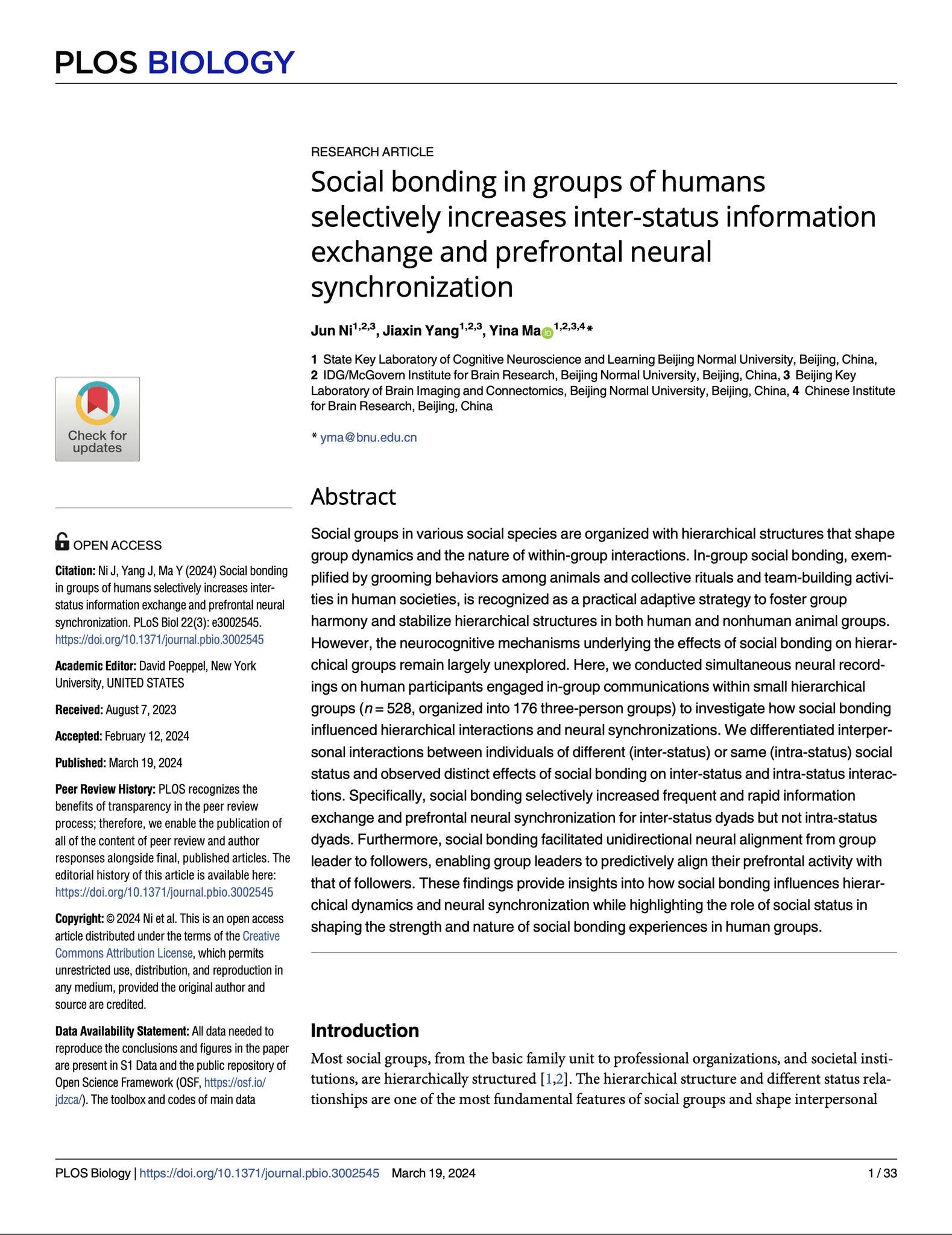
PLOS BIOLOGY RESEARCH ARTICLE Social bonding in groups of humans selectively increases inter-status information exchange and prefrontal neural synchronization Jun Ni1,2,3, Jiaxin Yang1,2,3, Yina Ma1,2,3,4* 1 State Key Laboratory of Cognitive Neuroscience and Learning Beijing Normal University, Beijing, China, 2 IDG/McGovern Institute for Brain Research, Beijing Normal University, Beijing, China, 3 Beijing Key Laboratory of Brain Imaging and Connectomics, Beijing Normal University, Beijing, China, 4 Chinese Institute for Brain Research, Beijing, China * yma@bnu.edu.cn Abstract OPEN ACCESS Citation: Ni J, Yang J, Ma Y (2024) Social bonding in groups of humans selectively increases inter- status information exchange and prefrontal neural synchronization. PLoS Biol 22(3): e3002545. https://doi.org/10.1371/journal.pbio.3002545 Academic Editor: David Poeppel, New York University, UNITED STATES Received: August 7, 2023 Accepted: February 12, 2024 Published: March 19, 2024 Peer Review History: PLOS recognizes the benefits of transparency in the peer review process; therefore, we enable the publication of all research articles alongside final, published articles. The editorial history of this article is available here: https://doi.org/10.1371/journal.pbio.3002545 Copyright: © 2024 Ni et al. This is an open access article distributed under the terms of the Creative Commons Attribution License, which permits unrestricted use, distribution, and reproduction in any medium, provided the original author and source are credited. Data Availability Statement: All data needed to reproduce the conclusions and figures in the paper are present in the text and in the public repository of Open Science Framework (OSF, https://osf.io/ plca/). The toolbox and codes of main data Social groups in various social species are organized with hierarchical structures that shape group dynamics and the nature of within-group interactions. In-group social bonding, exem- plified by grooming behaviors among animals and collective rituals and team-building activi- ties in human societies, is recognized as a practical adaptive strategy to foster group harmony and stabilize hierarchical structures in both human and nonhuman animal groups. However, the neurocognitive mechanisms underlying the effects of social bonding on hierar- chical group interactions remain largely unexplored. Here, we conducted simultaneous neural recordings on human participants engaged in in-group communications within small hierarchical groups (n = 528, organized into 176 three-person groups) to investigate how social bonding influences hierarchical interactions and neural synchronizations. We differentiated inter-personal social interactions between individuals of different (inter-status) or same (intra-status) social status and observed distinct effects of social bonding on inter-status and intra-status interac- tions. Specifically, social bonding selectively increased inter-status information exchange and prefro
本研究のウェルビーイング小話はこちら😊
はぴテク相談室:階層的なチームでこそ、社会的絆の醸成がめちゃくちゃ大事
https://wellbeing-archive.pages.dev/posts/2024-03-25-1711407606/