2024.07.09
カップルの関係満足度は、運命を信じすぎない方が長く続く。
というバーゼル大学の研究。
恋愛関係は運命によって決まる(運命信念)と、恋愛関係は努力で育てられる(成長信念)のカップル904組を調査した所、
・運命信念のカップルは、最初は関係満足度が高いけど、落ちていく。
・成長信念のカップルは、関係満足度が長持ちする。
・一方で、関係満足度が高いカップルは、時間と共に成長信念が高まってくる。
※これらは、パーフォナリティや自尊心などを調整しても、維持された。
ーー
とのことで、
運命を信じるのも良いのですが、一緒に愛を育てていくという考え方が大事ですね😊
(これは恋愛だけに限らず、会社とか友人関係も、育んで行こうという信念が大事なんじゃないかな〜と思います😊)
ーーー
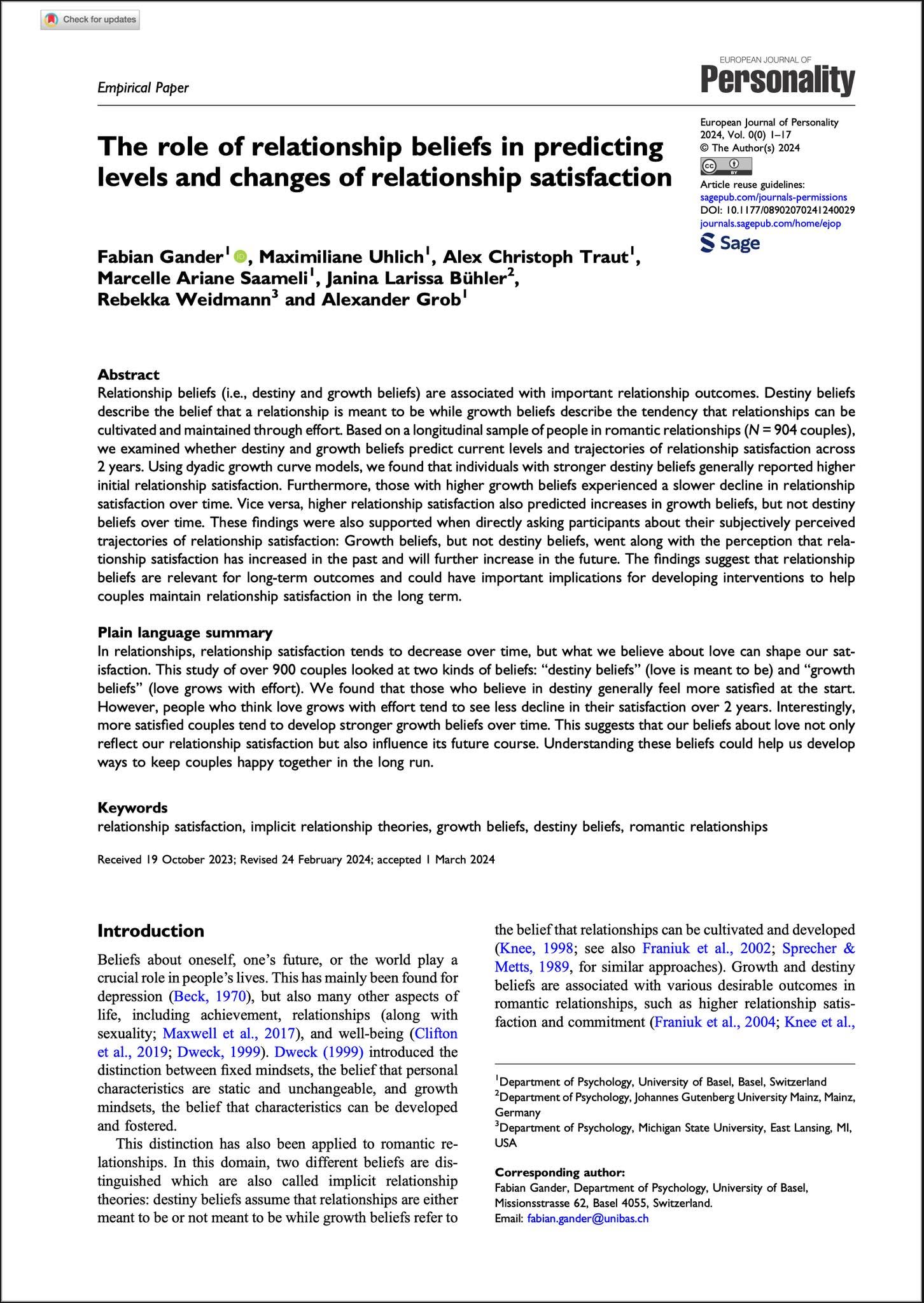
関係満足度の水準と変化を予測する上での関係信念の役割
The role of relationship beliefs in predicting levels and changes of relationship satisfaction
European Journal of Personality,2024/4/9
Fabian Gander et. al.
https://journals.sagepub.com/doi/full/10.1177/08902070241240029
概要
人間関係の信念(すなわち、運命の信念と成長の信念)は、重要な人間関係の結果と関連している。運命信念は、関係がそうなるように運命づけられているという信念を表し、成長信念は、関係は努力によって培われ維持できるという傾向を表す。恋愛関係にある人々の縦断的サンプル(N = 904カップル)に基づいて、運命信念と成長信念が、2年間にわたる関係満足度の現在のレベルと軌道を予測するかどうかを調べた。二者間成長曲線モデルを用いて、より強い運命信念を持つ人は、一般的に初期の関係満足度が高いと報告することがわかった。さらに、成長信念が高い人は、時間の経過とともに関係満足度の低下が緩やかであった。逆に、関係満足度の高さは、成長信念の増加を予測したが、運命信念の増加は予測しなかった。これらの知見は、参加者に主観的に認識された関係満足度の軌跡について直接尋ねた場合にも支持された: 成長信念は、運命信念ではなく、過去に関係満足度が上昇し、将来もさらに上昇するという認識と一致していた。この知見は、関係信念が長期的な結果に関連することを示唆しており、カップルが長期的に関係満足度を維持するための介入策を開発する上で重要な意味を持つ可能性がある。
平易な要約
人間関係において、関係の満足度は時間の経過とともに低下する傾向があるが、愛について何を信じているかによって満足度が形成される可能性がある。900組以上のカップルを対象としたこの研究では、2種類の信念について検討した: 「運命の信念」(愛はなるべくしてなる)と「成長の信念」(愛は努力によって成長する)である。その結果、運命を信じる人は一般的に、最初から満足感を感じていることがわかった。しかし、愛は努力によって成長すると考える人は、2年間の満足度の低下が少ない傾向がある。興味深いことに、より満足度の高いカップルは、時間の経過とともにより強い成長信念を持つようになる傾向がある。このことは、私たちの愛に関する信念が、私たちの関係の満足度を反映するだけでなく、その将来の経過にも影響を与えることを示唆している。このような信念を理解することは、長期的にカップルを幸せに保つ方法を開発するのに役立つだろう。
Empirical Paper The role of relationship beliefs in predicting levels and changes of relationship satisfaction Fabian Gander¹ , Maximiliane Uhlich¹, Alex Christoph Traut¹, Marcelle Ariane Saameli¹, Janina Larissa Bühler², Rebekka Weidmann³ and Alexander Grob¹ Abstract Relationship beliefs (i.e., destiny and growth beliefs) are associated with important relationship outcomes. Destiny beliefs describe the belief that a relationship is meant to be while growth beliefs describe the tendency that relationships can be cultivated and maintained through effort. Based on a longitudinal sample of people in romantic relationships (N = 904 couples), we examined whether destiny and growth beliefs predict current levels and trajectories of relationship satisfaction across 2 years. Using dyadic growth curve models, we found that individuals with stronger destiny beliefs generally reported higher initial relationship satisfaction. Furthermore, those with higher destiny beliefs experienced a slower decline in relationship satisfaction over time. Vice versa, higher relationship satisfaction also predicted increases in growth beliefs, but not destiny beliefs over time. These findings were also supported when directly asking participants about their subjectively perceived trajectories of relationship satisfaction. Growth beliefs, but not destiny beliefs, were along with the perception that relationships can be improved in past and future increase in the past, all of which further increase in the future. The findings suggest that relationship beliefs are relevant for long-term outcomes and could have important implications for developing interventions to help couples maintain relationship satisfaction in the long term. Plain language summary In relationships, relationship satisfaction tends to decrease over time, but what we believe about love can shape our satisfaction. This study of over 900 couples looked at two kinds of beliefs: "destiny beliefs" (love is meant to be) and "growth beliefs" (love grows with effort). We found that those who believe in a destiny generally feel more satisfied at the start. However, people who think love grows with effort show less decline in their satisfaction over 2 years. Interestingly, more satisfied couples tend to develop stronger growth beliefs over time. This suggests that our beliefs about love not only reflect our relationship satisfaction but also influence its future course. Understanding these beliefs could help us develop ways to keep couples happy together in the long run. Keywords relationship satisfaction, implicit relationship theories, growth beliefs, destiny beliefs, romantic relationships Received 19 October 2023; Revised 24 February 2024; accepted 1 March 2024 Introduction Beliefs about oneself, one's future, or the world play a crucial role in people's lives. This mainly been found for depression (Beck, 1970), but also many other aspects of life, including achievement, relationships (along with sexuality, Maxwell

本研究のウェルビーイング小話はこちら😊
はぴテク相談室:カップルの関係満足度は、運命を信じすぎない方が長く続く。
https://wellbeing-archive.pages.dev/posts/2024-07-09-1720562410/