2024.04.14
一人当たりGDPと主観的幸福度
中国31省の11年間の研究。
(といっても、11年研究した訳ではなく、11年分のSNSデータから主観的幸福度を推定)
一人当たりGDPが増えると、幸福度は高まるのか?
ーー
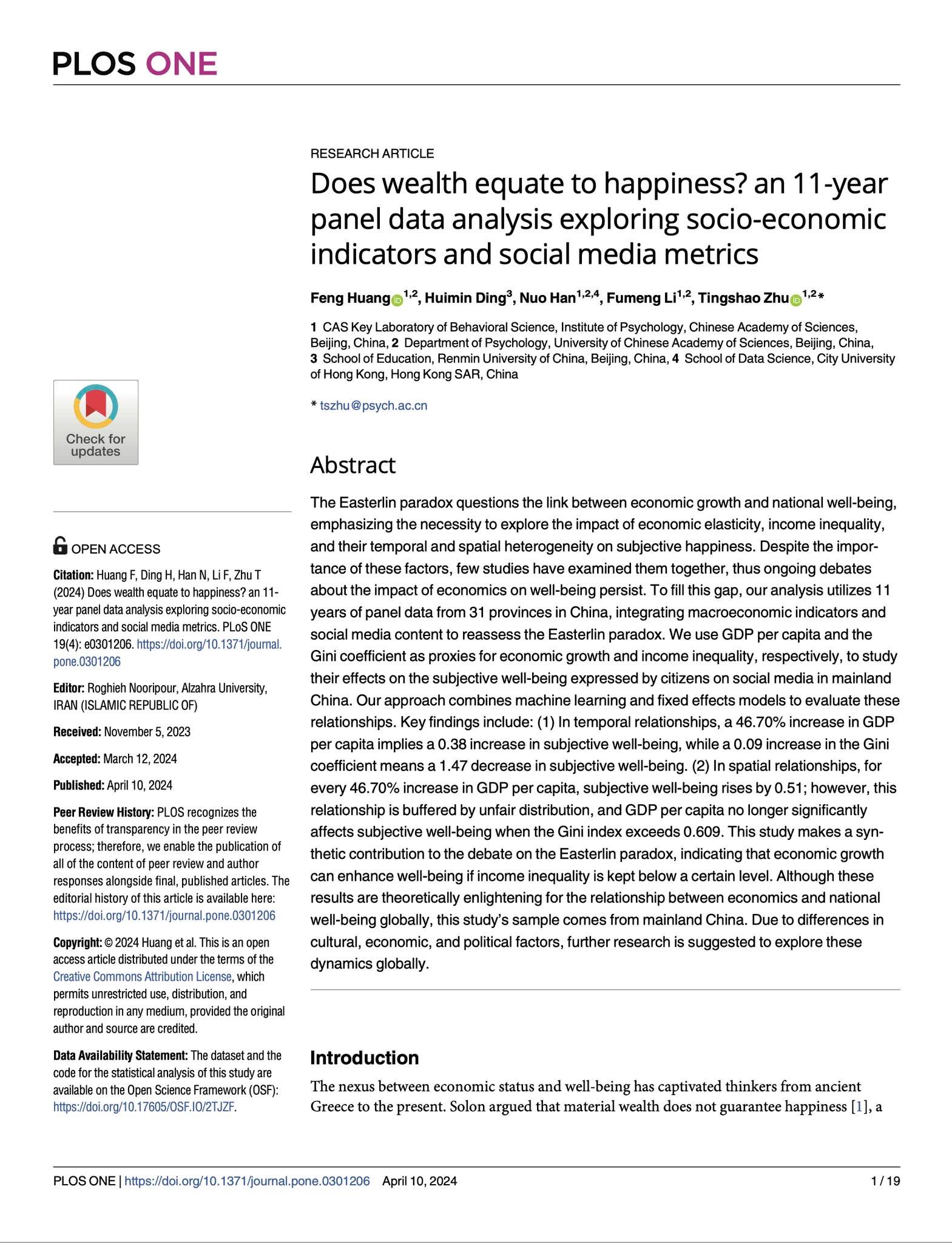
>(1)時間的関係では、一人当たりGDPが46.70%増加すると主観的幸福度が0.38増加し、ジニ係数が0.09増加すると主観的幸福度が1.47減少する。
>(2)空間的関係では、1人当たりGDPが46.70%増加するごとに主観的幸福度は0.51上昇するが、この関係は不公平な分配によって緩衝され、ジニ係数が0.609を超えると1人当たりGDPは主観的幸福度に有意な影響を与えなくなる。
※主観的幸福度は1〜7の7段階で調査。
ーー
とのことで、
一人当たりGDPが約50%上がると、主観的幸福度が5%弱上がる。
うーん、相当上がっても、幸福度にはそんなに影響がなさそうな・・・
一方で、
ジニ係数(格差)が0.09増加すると、主観的幸福度が20%くらい落ちる。
というので、めっちゃ効いてきますね。。。
日本は2021年にジニ係数が0.381。0.4を超えると要注意らしいです。
※ちなみに、どちらも線形ではないので、かけ算にはなりません。
ーー
まぁ中国での研究なので、日本では違う傾向も出るかもですが。
ただ、一人当たりGDPって、幸福度に効かなければ、何に効くのでしょうか・・・
ーーー
社会経済指標とソーシャルメディア指標を探る11年間のパネルデータ分析
PLOS ONE,2024/4/10
https://journals.plos.org/plosone/article?id=10.1371/journal.pone.0301206
要旨
イースタリン・パラドックスは、経済成長と国民の幸福の関連性に疑問を投げかけ、主観的幸福に対する経済弾力性、所得不平等、それらの時間的・空間的不均質性の影響を探る必要性を強調している。これらの要因の重要性にもかかわらず、これらを一緒に検討した研究はほとんどないため、経済学が幸福に与える影響について継続的な議論が続いている。このギャップを埋めるために、我々の分析では、中国の31省から11年間のパネルデータを利用し、マクロ経済指標とソーシャルメディアコンテンツを統合して、イースタリンのパラドックスを再評価する。一人当たりGDPとジニ係数をそれぞれ経済成長と所得不平等の代理指標として使用し、中国本土のソーシャルメディア上で市民が表明する主観的幸福への影響を研究する。我々のアプローチは、機械学習と固定効果モデルを組み合わせてこれらの関係を評価するものである。主な結果は以下の通りである:(1)時間的関係では、一人当たりGDPが46.70%増加すると主観的幸福度が0.38増加し、ジニ係数が0.09増加すると主観的幸福度が1.47減少する。(2) 空間的関係では、1人当たりGDPが46.70%増加するごとに主観的幸福度は0.51上昇するが、この関係は不公平な分配によって緩衝され、ジニ係数が0.609を超えると1人当たりGDPは主観的幸福度に有意な影響を与えなくなる。本研究は、イースタリンのパラドックスに関する議論に総合的な貢献を行い、所得不平等が一定水準以下に保たれれば、経済成長は幸福度を高めることができることを示している。これらの結果は、世界的な経済と国民の幸福の関係を理論的に啓発するものであるが、本研究のサンプルは中国本土のものである。文化的、経済的、政治的要因には違いがあるため、これらのダイナミクスをグローバルに探求するためのさらなる研究が示唆される。
PLOS ONE RESEARCH ARTICLE Does wealth equate to happiness? an 11-year panel data analysis exploring socio-economic indicators and social media metrics Feng Huang 1,2, Huimin Ding 2, Nuo Han 1,2,4, Fumeng Li 1,3, Tingshao Zhu 1,2* 1 CAS Key Laboratory of Behavioral Science, Institute of Psychology, Chinese Academy of Sciences, Beijing, China, 2 Department of Psychology, University of Chinese Academy of Sciences, Beijing, China, 3 School of Education, Renmin University of China, Beijing, China, 4 School of Data Science, City University of Hong Kong, Hong Kong SAR, China * tszhu@psych.ac.cn Abstract The Easterlin paradox questions the link between economic growth and national well-being, emphasizing the necessity to explore the impact of economic elasticity, income inequality, and their temporal and spatial heterogeneity on subjective happiness. Despite the importance of these factors, few studies have examined them together, thus ongoing debates about the impact of economics on well-being persist. To fill this gap, our analysis utilizes 11 years of panel data from 31 provinces in China, integrating macroeconomic indicators and social media content to assess the Easterlin paradox. We use GDP per capita and the Gini coefficient as proxies for economic growth and income inequality, respectively, to study their effects on the subjective well-being expressed by citizens on social media in mainland China. Our approach combines machine learning and fixed effects models to evaluate these relationships. Key findings include: (1) In temporal relationships, a 46.70% increase in GDP per capita implies a 0.38 increase in subjective well-being, while a 0.09 increase in the Gini coefficient means a 1.47 decrease in subjective well-being; (2) In spatial relationships, for every 46.70% increase in GDP per capita, subjective well-being rises by 0.51; however, this relationship is buffered by unfair distribution, and GDP per capita no longer significantly affects subjective well-being when the Gini index exceeds 0.09. This study makes a synthetic contribution to the debate on the Easterlin paradox, indicating that economic growth can enhance well-being if income inequality is kept below a certain level. Although these results are theoretically enlightening for the relationship between economics and national well-being globally, this study's sample comes from mainland China. Due to differences in cultural, economic, and political factors, further research is suggested to explore these dynamics globally. Introduction The nexus between economic status and well-being has captivated thinkers from ancient Greece to the present. Solon argued that material wealth does not guarantee happiness [1], a OPEN ACCESS Citation: Huang F, Ding H, Han N, Li F, Zhu T (2024) Does wealth equate to happiness? an 11-year panel data analysis on socio-economic indicators and social media metrics. PLoS ONE 19(4): e0301206. https://doi.org/10.1371/journal.pone.0301206 Editor: Roghieh Nourjou, A
本研究のウェルビーイング小話はこちら😊
はぴテク相談室:一人当たりGDPと主観的幸福度
https://wellbeing-archive.pages.dev/posts/2024-04-14-1713132010/